
The Archive
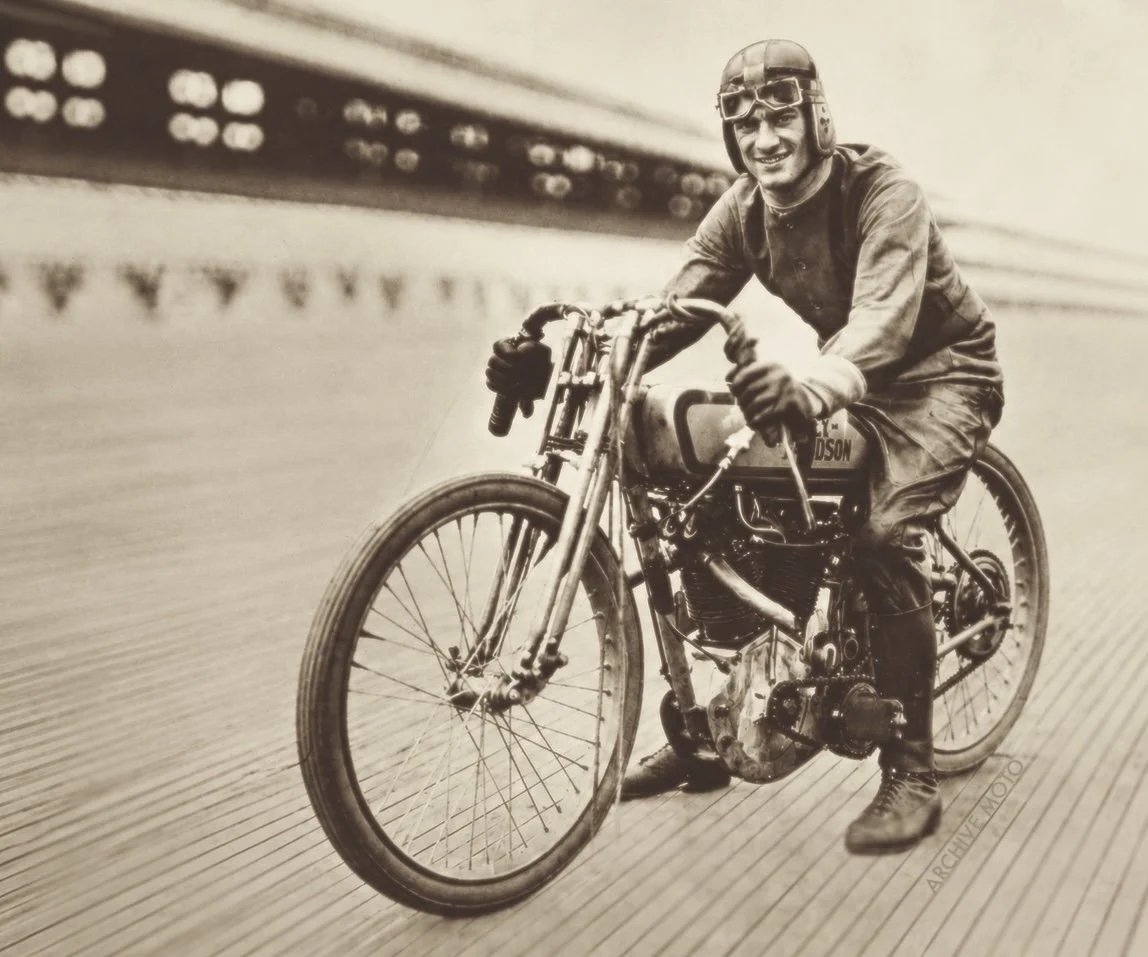
One hundred and ten years ago, in 1916, as America celebrated its 140th Anniversary, Harley-Davidson was busy building momentum as one of the world’s best motorcycle brands. Leading the charge was the Bar and Shield’s first racing star, Leslie “Red” Parkhurst, who spent the day sending shivers through the grandstands in Brooklyn, New York, with his blistering speed. Running one of Harley-Davidson’s first overhead-valve factory racing machines, Parkhurst thrilled the crowd of 18,000 at speeds well in excess of 90 mph at the massive 2-mile-long board track super speedway at Sheepshead Bay. His efforts earned him both the 2-mile FAM National Championship and the title in the 100-mile race and set a new 50-mile record.
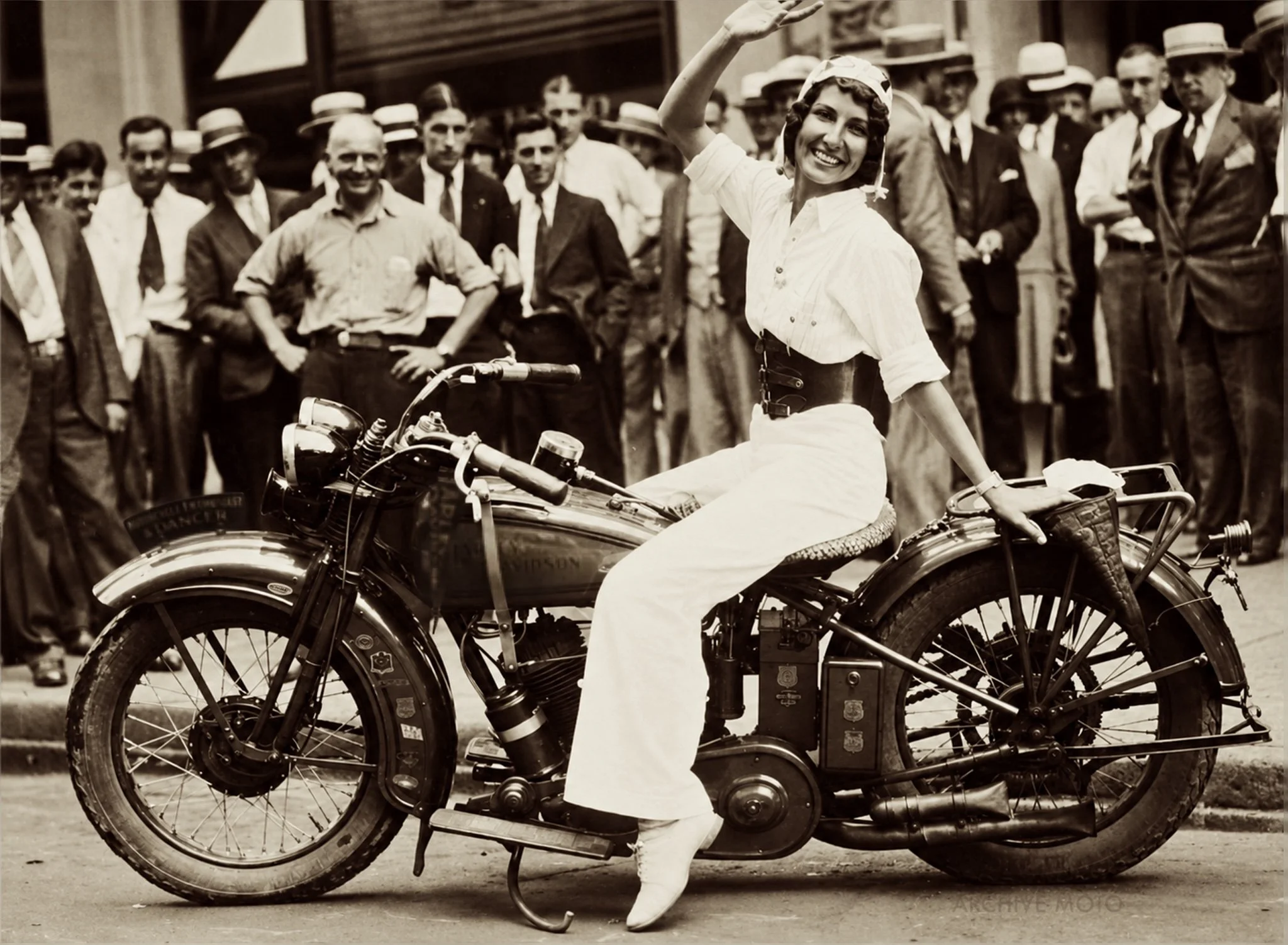
The Enthusiast Girl, Miss Vivian Bales, Harley-Davidson’s eternally lovely, fearless, and unwavering first lady was a pioneer American adventurer who defied the conventions of the Roaring Twenties and defined for herself and a century of riders since what it meant to be a woman and motorcyclist. In the Summer of 1929, Bales clocked over 5,000 miles alone on a Harley-Davidson Model D, the first in Milwaukee’s famed “45” lineage. Without as much as a single flat tire, Bales and her trusty Model D triumphed, both over the miles that lay behind her as well as the conventions that girls simply shouldn’t ride motorcycles. Throughout her 78-day, 5,000+ mile adventure covering 14 states, the White House in Washington D.C., and a bit Canada, Bales blazed a trail for all future female motorcyclists to become a good will ambassador for enthusiasts everywhere. She had shaken the hands of more mayors than she could count, met the President of the United States, the founders of the company she had chased her dream onboard, and charmed the hearts of thousands along the way.
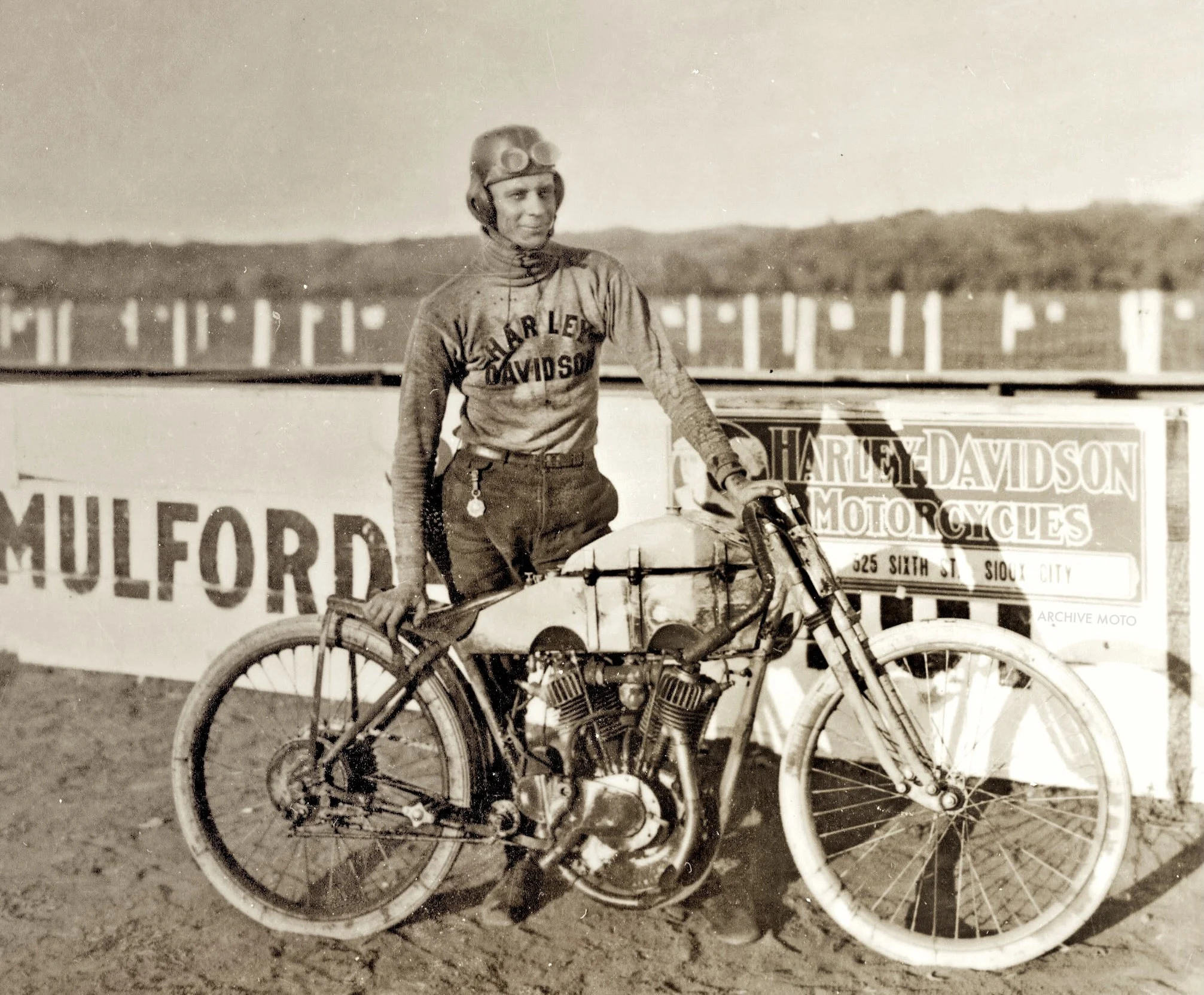
An all-too-often forgotten founder of the Harley-Davidson racing dynasty, William Fred Brier, poses with his early 10K factory racer in Sioux City, Iowa, September 2, 1914. This remarkable image offers an early glimpse into the formative moments of the Harley-Davidson factory racing program as it took its first steps into the sport of professional racing in late 1914.
An Illinois native, Bill Brier worked as a mechanical engineer at the Aurora Automatic Machine and Tool Company, builders of Thor motorcycles, alongside the company’s chief designer and head of its racing department, William Ottaway. Once released from their production contract with Indian in 1907, Ottaway began working on new engine and motorcycle designs, leveraging the emerging sport of racing to test out his machines. With riders like Shorty Matthews, Paul Derkum, and Bill Brier, Thor began building a reputation in the sport and a growing presence in the industry. Thor, along with Indian, Merkel, and Excelsior, were the brands that established the sport of motorcycle racing in America and created a thriving industry by the early teens.
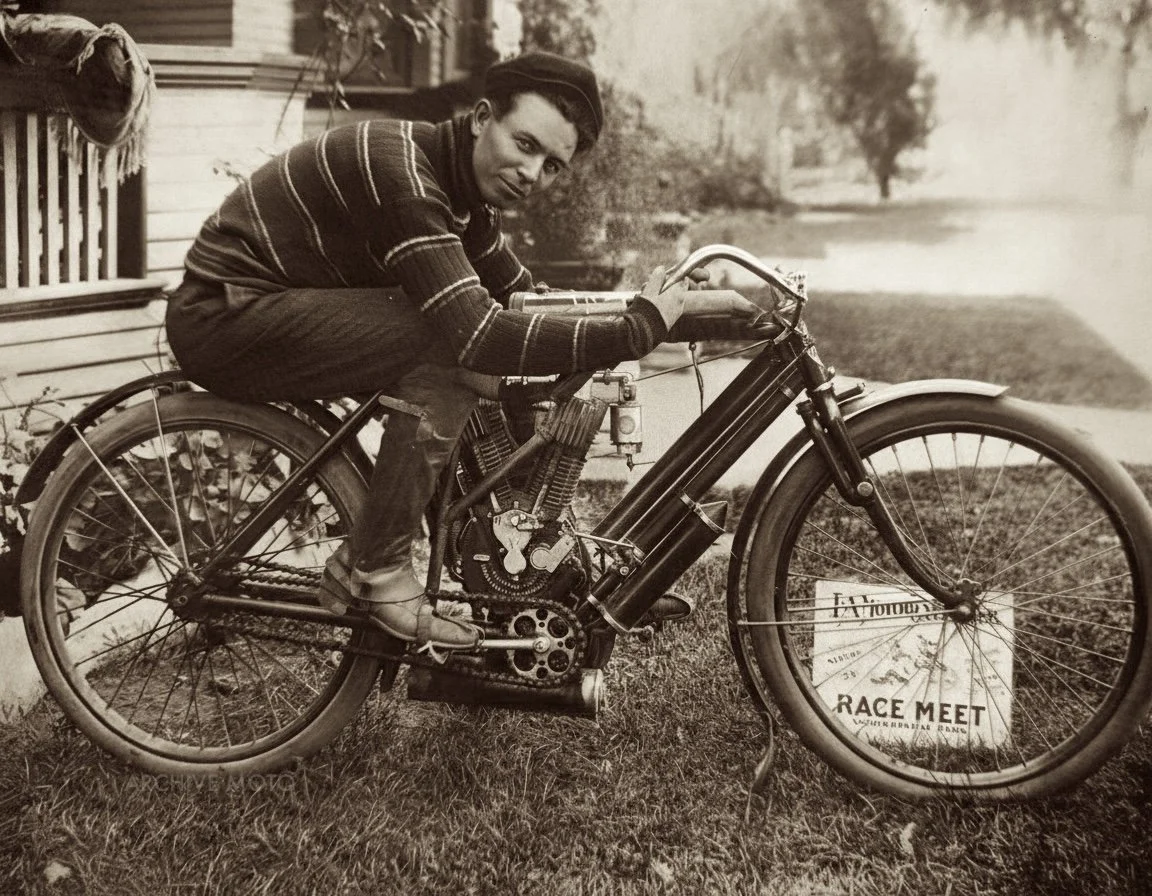
Pictured here, 26-year-old Paul “Daredevil” Derkum poses on board a slightly modified, first-year production Indian twin to promote the races at Agriculture Park on September 9th, 1907. Already a recognized figure among the earliest class of American motorcycle racers, Derkum stood at the forefront of a sport still defining itself as one of its first true celebrities. Born in Hamilton, Ohio, Derkum arrived in Los Angeles with his family in 1890 and quickly took to bicycle racing, a culture then sweeping the nation. He became a fixture in the city’s growing cycling scene, working alongside his brother in a bicycle shop and spending long hours at the dusty oval of Agricultural Park. There, amid the gamblers and sporting men who crowded the grounds, he likely crossed paths with Will Risden, another young bicycle dealer and racer whose influence, together with Derkum, would shape the course of motorcycling on the West Coast.
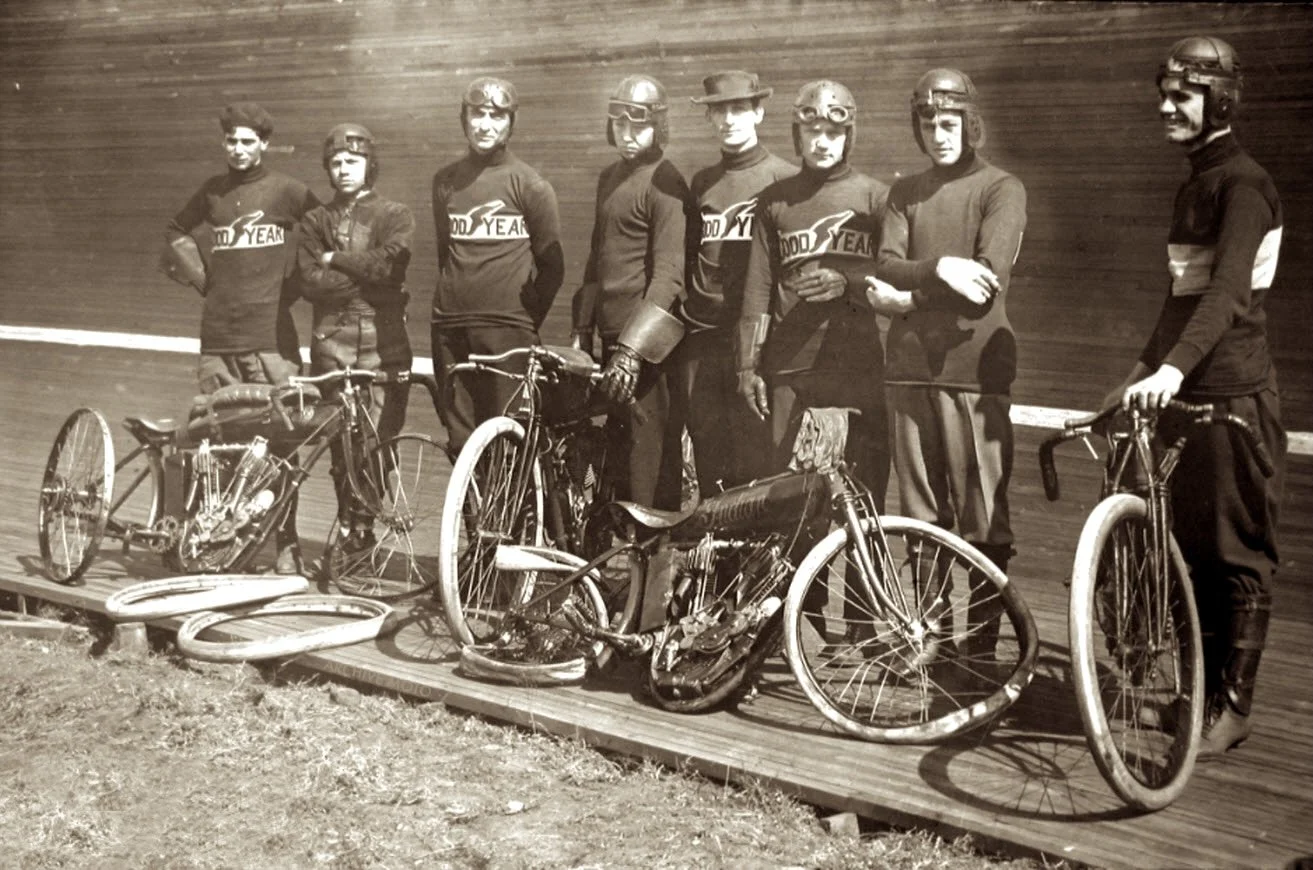
On the warm autumn evening of October 21, 1912, beneath the arc lights of the Lake Cliff Motordrome in Dallas, Texas, a stadium full of racing enthusiasts witnessed a miracle on the boards. The country was still in shock as the tragedy at the Valisburg Motordrome occurred only weeks before, on September 8. The horrific and now infamous crash, the precursor of the “murderdrome” moniker, claimed the lives of Indian racing stars Johnny Albright and local Texan hero Eddie Hasha, along with 6 spectators, 5 of whom were teenage boys. In the weeks that followed the Valisburg track shutdown, papers nationwide ran stories about the carnage, and an outcry for improved safety standards prompted organizers and promoters to implement new rules and infrastructure. For the riders, however, racing was their livelihood, and though their friends had just perished, death was just another aspect of their daily lives and most were eager to get back onto the boards.
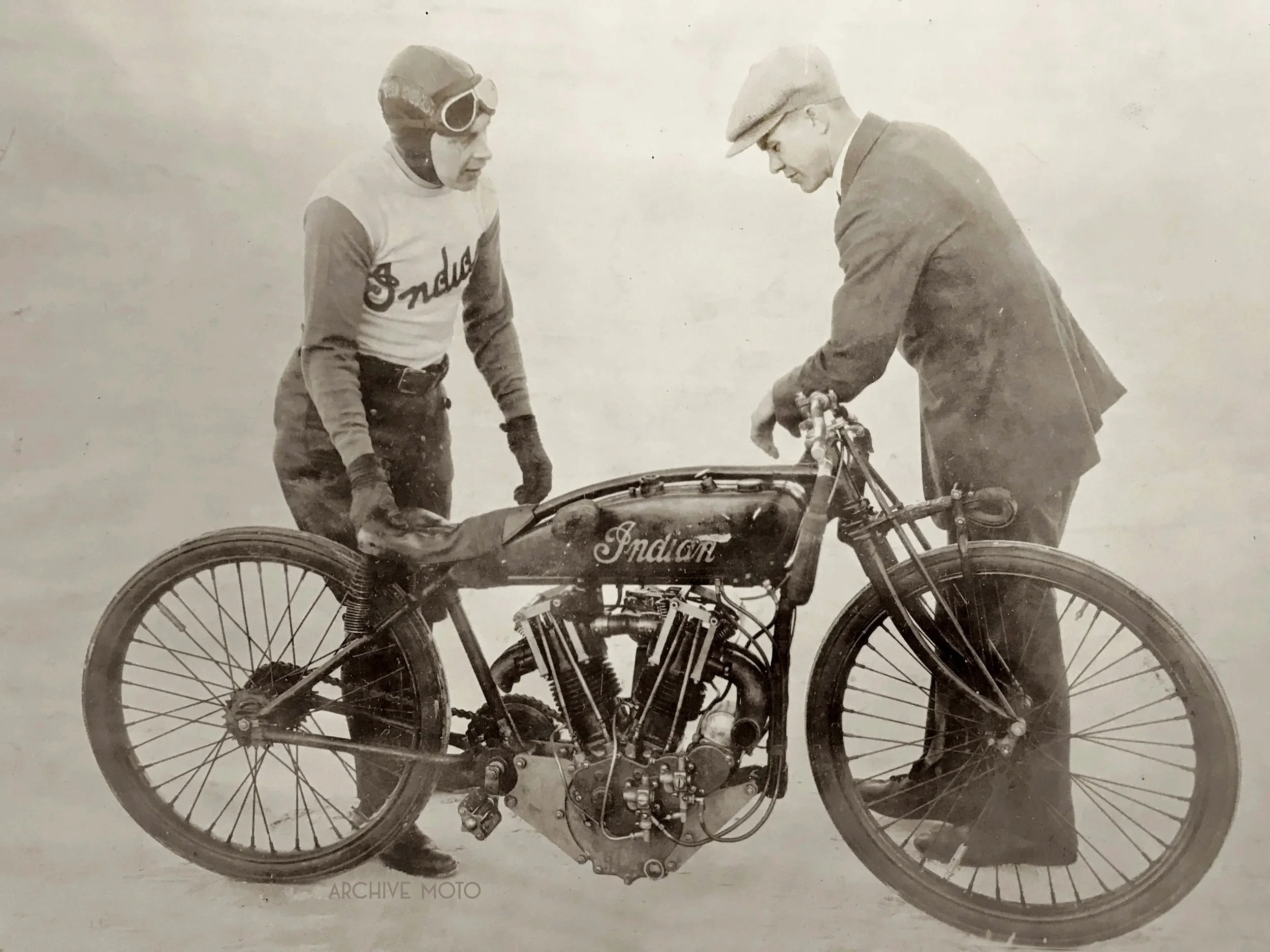
American racing icon John Charles Seymour was the fearless champion, a young talent recruited onto Indian’s factory program alongside fellow legends like Gene Walker, Hammond Springs, Maldwyn Jones, and Eddie Brinck during the sport’s spectacular revival following WWI. During one of the most dynamic and exciting eras of the sport, Seymour acted as an anchor for the storied Springfield brand and remained one of the few men left at the top of the professional racing game by the late 1920s. Born in Schaffer, just outside Escanaba, in the Upper Peninsula of Michigan, on October 8, 1898, to Canadian immigrants, Seymour tragically lost his mother and older brother in the summer of 1908 at only 10 years old. Unlike many at the time, he was able to maintain his schooling and took a job working on motorcycles at a local shop as a teenager. By the time of his graduation, Seymour had saved up enough to purchase his own Indian, a brand he would stick with for the next decade.

There are names spoken in reverence whenever early American motorcycling legends are recalled; Hedstrom, DeRosier, Ottaway, but etched just as indelibly into the books of our two-wheeled past is that of, Charles Bayly Franklin, the soft-spoken Irishman who defined what a motorcycle was to be for a new modern era and cast the mold for its future.
A Dubliner, innovator, racer, and genuine pioneering motorcycle icon, Franklin remains among the most significant contributors to motorcycling culture to have ever jockeyed a throttle. Long before he reshaped the fortunes of the Indian Motorcycle Company, Franklin was a rising star in Ireland’s young yet burgeoning motorcycling scene.
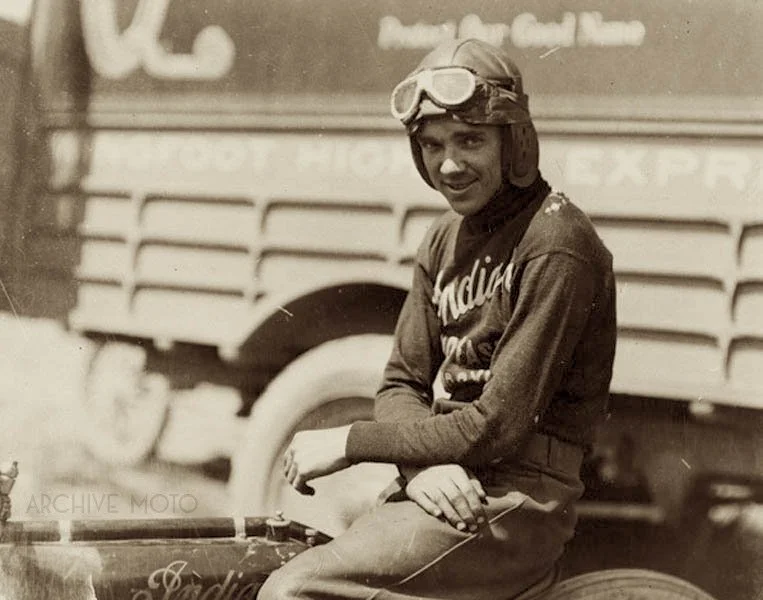
Albert "Shrimp" Burns, the young California crack that once pestered the country’s best riders, is perhaps one of America's most recognizable and widely loved stars from the early days of motorcycle racing. Growing up just around the corner from the local Pope dealer in Oakland, Burns was the scamp perpetually having to be shooed away from the motorcycles parked out front by management. It is said that his first ride was actually the result of the manager's absence, a brief window in which the boy fired up one of the machines and took off around the block. Coming of age in the sensational motordrome era, Shrimp soon developed an interest in the flourishing sport of racing. Still, unlike many of his schoolyard buddies, Shrimp wasn't content to simply sit and watch. So, at the age of 14, he rebuilt an Indian twin and began competing in dirt-track races, bound for his destiny as one of the greatest motorcycle racers in history.

It is strange to think that Harley-Davidson, the now global giant in the world of motorcycling, began its story without fanfare or celebration, a single flake amid the blizzard of motorcycle brands blanketing the country at the turn of the century. A genuine personification of the American dream, what would eventually become The Harley-Davidson Motor Company famously began in the imagination of two boyhood friends, neighbors Arthur Davidson and William S. Harley, who became enthralled with creating their own motorized cycle as soon as the technology arrived in the US. Undoubtedly inspired by machines from America’s earliest motorcycle builders like E. R. Thomas, as well as local upstarts like Mitchell and Merkel humming and popping on the streets of Milwaukee by 1901, the first evidence of the teenaged duo’s exploration dates to a schematic sketch William Harley made of a small engine in July 1901. Still, it wasn’t until the practical machining skills of Arthur’s experienced older brother, Walter, who returned to Milwaukee from his railroad job in Kansas for the eldest Davidson brother, William’s wedding in 1903, that the first complete and functional Harley-Davidson came together in a real way. Together, the trio spent the winter of 1903/1904 working out the kinks and gremlins discovered in that prototype in the Davidson family home’s back yard shed on shed to produce a more robust, production-ready motorcycle by the spring of 1904, with three more built by the end of the year.

Though not as recognizable as many of his iconic peers, Robert Thomas Stubbs, better known as Bob, was a champion pioneer in the earliest days of motorcycle sport at the turn of the century. Hailing from Birmingham, Alabama, Stubbs was the eldest of ten children of Lizzie Gilbert and Thomas Jefferson Stubbs, a Confederate soldier who fought in the battles of Tuscaloosa and Chickamauga. Like many of America's first motorcycle racers, Stubbs was active in the cycling world of the late 1800s, competing in regional events throughout the southeast. His passion for two-wheeled racing soon turned to the exciting new motorized machines as they first appeared in the South. As Indian was among the first manufacturers to establish a firm grip on production and distribution at scale, Stubbs' name became among the first in the American South, just as his counterpart in Georgia, Harry Glenn, to appear beside mentions of the Springfield marque in the earliest local competitions. By 1907, Stubbs had been elected President of the newly formed Birmingham Motorcycle Club, where he organized some of the first track competitions in the region at the nearby dirt track at the Alabama State Fairgrounds, arranging the first ever meet there on July 4, 1907, and sweeping every event.

The tail end of 1914 stirred talk throughout the motorcycling world of a new contender in the racing game, and with Harley-Davidson’s victories in Venice, Oklahoma City, and La Grande as the 1915 season began, the rumblings had been proven true. Still, it was at the 2nd annual Dodge City 300, the Coyote Classic held July 3rd, 1915, that the Motor Company staked its claim as the American motorcycle manufacturer to beat. All of the momentum built by the company over the previous decade and the effort put in by Bill Ottaway to create a world-class racing team the year before came to a crest in a small town in the heart of America as the eyes of the motoring world turned towards Kansas.

Seen here is the Harley-Davidson Motor Company in 1906, featuring founders, staff, and customers alongside a handful of its earliest machines. The photo is listed as 1906; however, it may actually be 1907, as it was taken in front of the Chestnut Street factory, the first expansion beyond the Davidson family's shed. This is because Chestnut St. wasn't complete until December 1906, so if this was taken then it looks unseasonably balmy.

Former bicycle racer and American motorcycle pioneer Walter G. Collins onboard his 1908 Indian twin in San Francisco, July 12, 1908. “Mile A Minute” Collins, as he became known after being the first to top the 60 MPH mark at LA's Agriculture Park track onboard a cumbersome French Peugeot twin, was one of the founding fathers of American motorcycle racing. Hailing from LA, Collins had been among the best bicycle racers on the West Coast during the sport’s heyday before quickly transitioning to motorcycles once they first arrived.
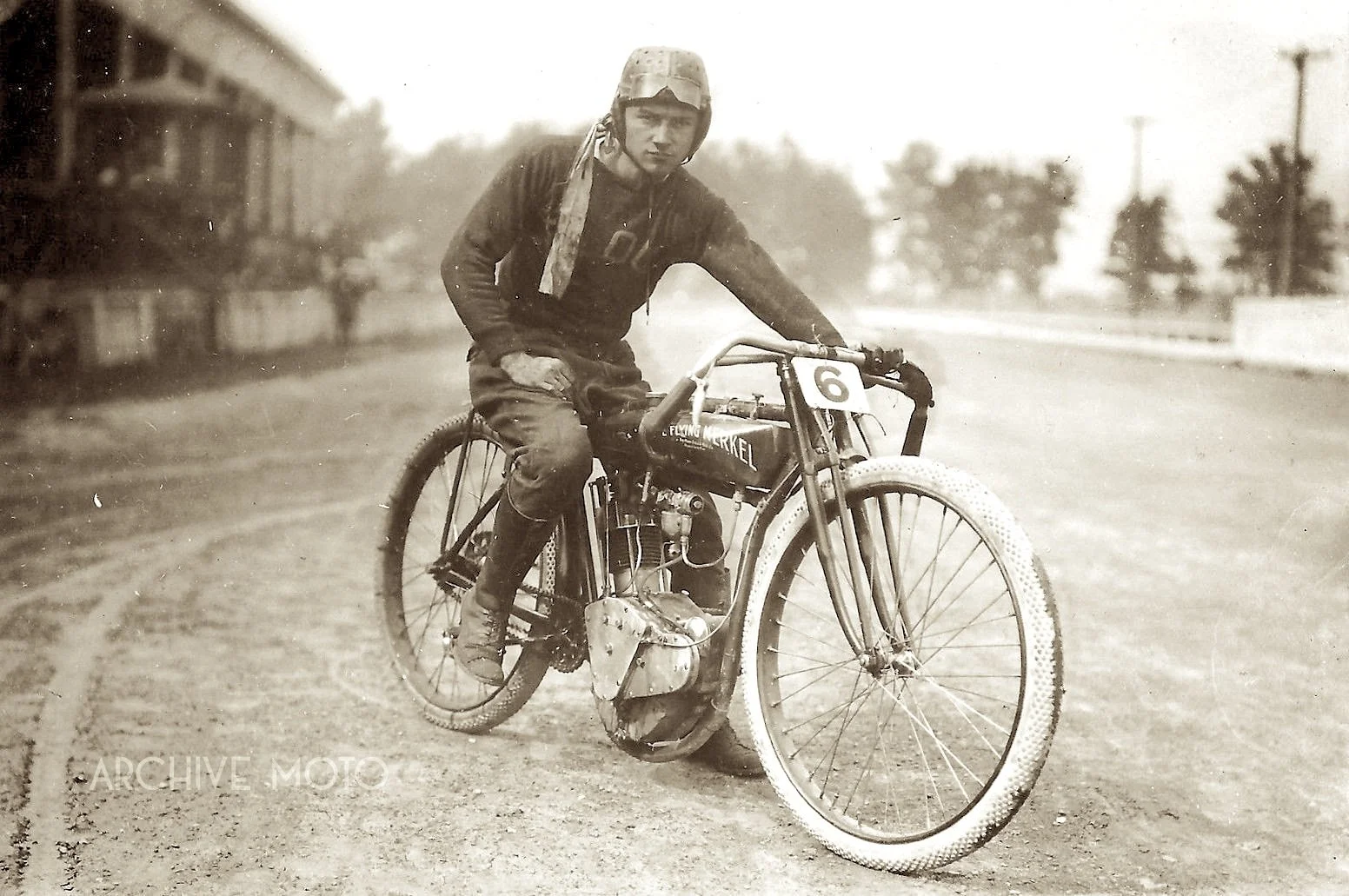
Among my favorite pioneer motorcycle racers and images, Cleo Francis Pineau embodied all that made that first generation of racers a class of their own. Here he is photographed sitting astride his single-cylinder Flying Merkel racer during the June 1914 races in Toledo, Ohio. Like so many of America's early professional motorcycle racers, Cleo Francis Pineau was carved from the rugged wood of the frontier—equal parts grit, speed, and insatiable wanderlust. Born in Albuquerque, New Mexico, during the waning years of the 19th century, Pineau was slight in both stature and temperament, coming of age at a time when machines were beginning to reshape the modern world. He never took kindly to being boxed in by schoolhouse walls. Legend has it he left formal education behind in the sixth grade—drawn not by books but by speed, fuel, and the open road.

Otto Walker and Leslie Parkhurst, two of history’s most accomplished pioneer motorcycle racers and pillars of Harley-Davidson legendary factory team, the Wrecking Crew, bombing the slant at New York’s Sheepshead Bay Speedway in July, 1917. The two men were on the hunt for speed records, specifically the 500-mile, 1,000-mile, and 24-hour records for solo riders and sidecars as organized by George Wood, the Motor Co.’s distributor in the state. Otto Walker was on hand as he had been working as a foeman in Harley’s Manhattan branch following the leg injury that took him out of the game in 1916. Eager to get back in the saddle but still nursing his injury, Walker signed up to run the sidecar for the 24-hour record attempt, with Carl Lutgens acting as copilot in the hack.

In the pantheon of American motorcycles, few names command the reverence of the Henderson brand. From its earliest rumblings in Detroit in 1912 to its final breath in 1931, Henderson was more than just a motorcycle—it was a refined symbol of engineering ambition and pre-Depression optimism. The company's signature inline four-cylinder engine didn't just set records; it emblemized the highest reaches of motorcycling life and defined one of its richest eras.
Beginning with brothers William and Tom Henderson, who, steeped in a legacy of mechanical innovation, set out at the turn of the 20th century to build the finest motorcycle in America. While Tom was the more business-oriented of the two and set out to handle the administrative aspects of their venture, the younger William was the creative force.

Herschel Chamberlain, a local amateur motorcycle racer from Detroit, Michigan, is but one of the countless hundreds of America’s daring, early enthusiasts to have found the thrill of speed on two wheels and took to the track to test their mettle. Proudly straddling his winning mount, Chamberlain rode this spartan and unruly 1911 Indian twin to victory in the 3-mile novice competition at the Detroit Motorcycle Club’s Labor Day weekend races that same year. The young speedster rolled to the line alongside some of the finest riders in the country, men like Frank Hart, Johnny Constant, Don Klark, Charles Gustafson, and William Teubner.

Los Angeles' own J. Howard Shafer, one among the few pioneers of motorcycle racing in America with his Thor twin in 1908. Shafer was a part of the first class of enthusiasts in the Los Angeles area at the turn of the 20th century and one of the first motorcyclists in the country to venture into competition. As a founding member of the Los Angeles Motorcycle Club, Shafer acted as the club's secretary and was highly active within an elite group, including racing icons like Paul Derkum, Charlie Balke, Ray Seymour, Will Risden, and Morty Graves, many of which represented the first motorcycle dealerships in California. Before long, the club began sponsoring and promoting races at the nearby 1-mile-long horse track at Agriculture Park.

I have had the distinct pleasure of being asked to give a guest lecture at the Glenn H. Curtiss Museum this Thursday, February 27 at 7 pm EST, available for anyone to attend for free via Zoom.
Curtiss was one among America’s first class of motorcycle pioneers, equal parts engineer, entrepreneur, and fearless sportsman that helped give birth to the machines themselves. Often overlooked given his diverse mechanical interests and successes in the earliest days of aviation, Curtiss stood alongside men like Charles Metz, Oscar Hedstrom, and Joseph Merkel as the founding fathers of both the American motorcycle and the sport of motorcycle racing. Join in tomorrow, February 27 at 7 pm EST for a look back to the beginning of motorcycle racing and the invaluable contributions made to the culture by Hammondsport’s own Glenn Curtiss.
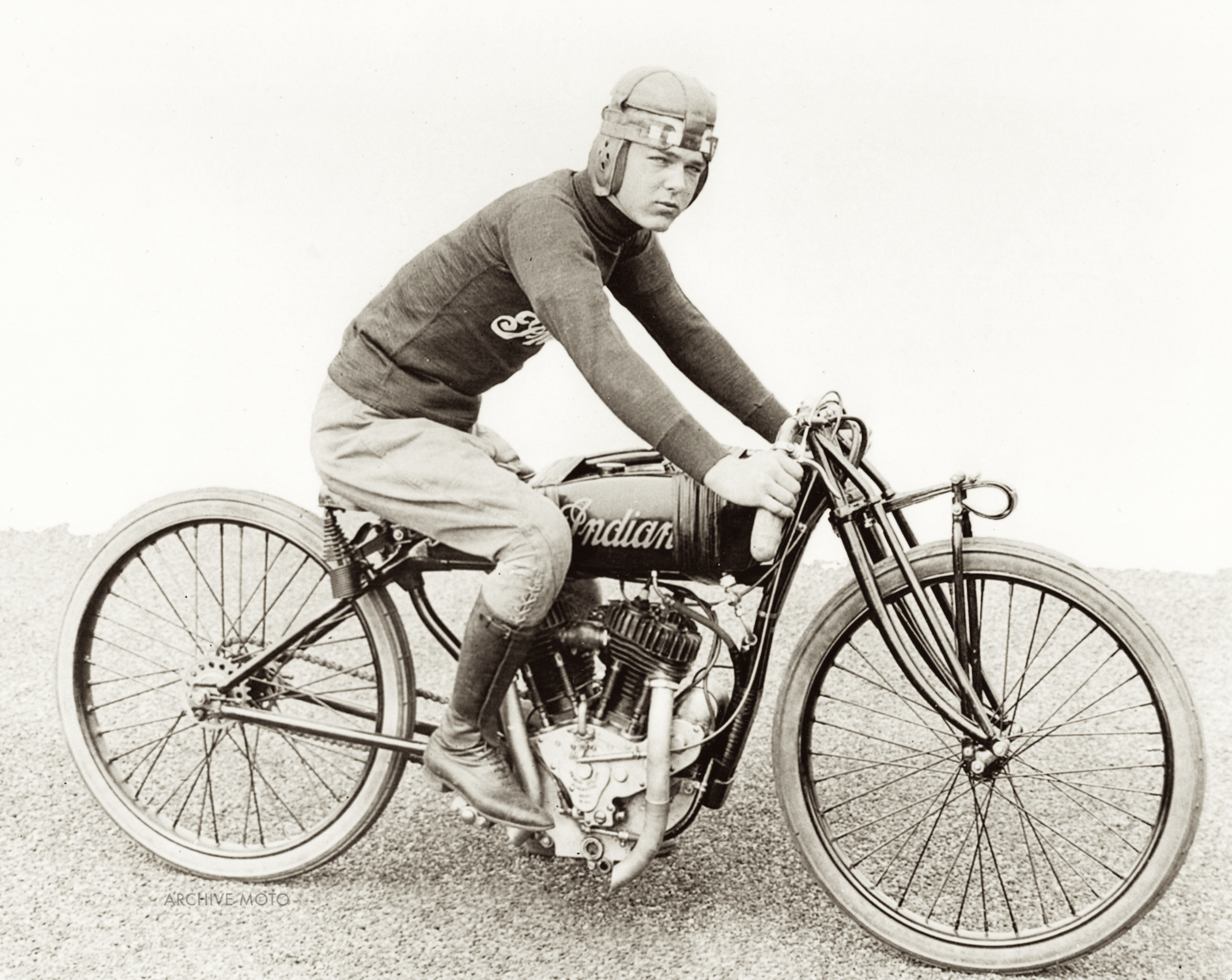
I’m looking into re-releasing my first book, Georgia Motorcycle History soon. It was a project which marked the beginning of my interest in writing about this unique history back in 2013 which was funded with the support of the community. Though it was a narrow niche the response was inspiring, and after 3 pressings sold to enthusiasts in over 20 countries I fell in love with researching motorcycle history and decied I wanted to do what I could to help preserve stories from the early days of this rich culture of ours. The project quickly evolved into Archive Moto, and I have thuroughly enjoyed the ooportunity to dig deeper into my passion, connect and collaborate with so many like-minded folks, and share in this collective interest. GMH has been sold out for the better part of 5 years now, and though the printing house in Georgia I used to produce it is no longer available, I have been exploring ways to have another pressing.

Indian’s Big Base 8-valve was the very concept of speed, raw and uncompromising, distilled by one of the most talented engineering pioneers specifically for the task at being unbeatable yet refined in its simplicity as only Oscar Hedstrom could accomplish. And for that, the Big Base remains a legendary machine, equal parts brutality and elegance, the embodiment of the thrilling age of the board track motordrome, … and in a word, a purebred.

In early September 1910, Ray Seymour returned home to California as one of the world's top motorcycle racers. He was the newest recruit on Indian's dominant factory team as an understudy of the undisputed greatest motorcycle racer in the world, Jacob DeRosier. Only four years prior, Seymour had thrown his leg over a motorcycle for a race at LA's Agriculture Park for the first time, but in 1910, he returned with the crown of National Amateur Champion resting on top of his dusty blonde hair. He reacquainted himself with California's warm winter climate with a few dirt track races in San Jose before returning to Los Angeles. Once home in LA in late September, Seymour and his Indian cohorts soon gathered to assault the records at the large 1-mile wooden circle at Playa Del Rey.

GRIT - A History of Board Track Racing
A three-part documentary examining the history of the American Motordrome.
Often conflated with carnival thrill shows and the massive wooden speedways of the 1920s, America's original timber race tracks, called motordromes, were dangerous and exhilarating saucers where the toughest of the tough went elbow to elbow for a taste of the glory and the gold. For just 5 short years between 1909 and 1914, only 26 of these perilous stadiums were ever built, many having only hosted motorcycle races for a season or two. Still, inside their steeply banked walls, the heroes of a thrilling and often deadly sport captivated the country, cementing a legacy and mythology which continues to sends chills through those that learn about it.
Head to the Archive Moto Youtube Channel to watch the trailer for GRIT, a three part documentary series looking at the history board track racing, one of America’s most infamous and sensational sports.

On 328 acres of farmland just north of Indianapolis and at the cost of an estimated $350,000, America gained its first closed circuit raceway, the 2.5-mile-long Indianapolis Motor Speedway, in the late summer of 1909. Rushed to completion for the Federation of American Motorcyclist's National Meet that August, the imposing speedway was like nothing seen before, with massive grandstands capable of seating 10,000, bleacher seating at the turns to accommodate even more spectators, concessions buildings, a state-of-the-art garage paddock, and medical facilities. The pace required to complete such a compound proved to be a bit too hasty, and reports from its first observers likened it to a dirt road sprinkled with a loose layer of crushed stone. Today, the IMS holds a reputation as one of the preeminent auto racing tracks in the world, but upon its unveiling, the first competition to take place at Indianapolis was a motorcycle race, and 18-year-old Ray Seymour, the California Wonder arrived to unleash his Reading-Standard racing special.

For too long, the life and accomplishments of Ray Seymour, one of America’s most successful pioneer motorcycle racers, have gone unacknowledged. Like so much of the remarkable history of American motorcycle racing, Seymour’s story has largely been lost over time. Perhaps it is because of his steady and reserved personality compared to his more bombastic and temperamental contemporaries like Jacob DeRosier or Charlie Balke. Maybe his avoidance of tragedies like those that cut short the lives of countless young racers, like his close friend and teammate Eddie Hasha, shielded him from a similar infamy. Unlike later generations of professional racers like Jim Davis and Joe Petrali, Seymour was among the first class of motorcycle racers, long since out of the game by the time the sport reached its height. Still, he was in his prime at the height of the infamous age of board track motordromes and excelled because of his skill, athleticism, and temperament, outliving many of his pioneering friends and conquering nearly every podium and record of his time.

Archive Moto, the little research project that began with Georgia Motorcycle History has grown yet again! I am excited to now be producing videos in a continued effort to preserve and share the remarkable history of American motorcycle culture. It is a new chapter for the project, supported by enthusiasts who have become members of the Archive Moto Patreon. Both the Patreon community and the Youtube channel are young but growing, and if you enjoy the articles, videos, and books, consider helping support the project by Subscribing to the channel, liking videos, and sharing them. If you would like to support this research and help keep quality content rolling out, considering joining the Archive Moto Patreon community for as little as $5.
Beyond that, the mission is to preserve and share this history, so the best thing you can do to help is simply enjoy reading and watching, and share what you like with the folks who’d like it too.

As it did around the globe, the Great Depression served as a grand a catalyst within American motorcycle culture. Both the sport and the industry were forced to adapt to the economic decline in and the changes spawned an entirely new culture. Indian and Harley further refined their smaller 45 cubic inch models, packing them with value, and leaning into a focus on design to weather the storm. With the addition of the American motorcycle Associations professional 45 class, both companies newest machines became American favorites. Still, the financial crisis marked the end of the road for Excelsior Motorcycles, one of America’s Big Three manufacturers who had been in business since 1908. Despite having found success on both the road and the track, including being one of Indian’s fiercest competitors in the golden age of the motordrome, Excelsior shuttered its doors in 1931, leaving Springfield and Milwaukee to duke it out for supremacy.

The early years of the roaring twenties represent the first high water mark in professional motorcycle racing. It was a period when sophisticated machines were let loose by men of true and unrelenting grit. In the previous decade, motorcycle racing had bloomed into several forums, and the spectacle enthralled the country. By the early 1920s, racers had kicked-up tails of dirt and dust on flat tracks, kept the enthusiasts breathless on the edge of the motordrome bleacher, and stretched the capabilities of iron and rubber on the colossal board track speedways to their limits. Still, by the latter half of the decade, the sport, as well as the industry, was in significant decline, and the high waters of the golden age of motorcycle racing began receding.

In the years preceding WWI, motorcycle racing in the United States had grown from low-speed grudge matches on local horse tracks to unrestrained, factory-supported speed blitzes on motordromes, flat tracks, and superspeedways. With Harley-Davidson entering the sport in 1914, the two central competing brands, Indian and Excelsior, found themselves in a three-way battle against a well-funded and laser-focused adversary. Local dirt flat tracks continued to rise in popularity, and the Dodge City 300 became the sport's premier race. Still, as the gates of America's infamous board track saucers, the fabled motordromes closed, a new breed of track soon emerged.
When this brief autobiography of Joe Wolters appeared in the spring of 1920, the racing season had already begun under tragic circumstances for Wolters and the Excelsior factory team. On January 2, teammate Bob Perry was killed while running at full clip during qualifying at Los Angeles’ Ascot Park for the upcoming 100-Mile National, crashing aboard the formidable overhead-cam Excelsior he had helped develop.
For Wolters, Perry’s accident came late in a career that had already spanned nearly the entire history of American motorcycle racing, Wolters himself having survived multiple crashes that could have easily ended the same as Perry’s, and though he was back in the saddle one week later, retirement was drawing closer to focus. “Farmer Joe,” as he was known, was one of the sport’s founding fathers; prolific, decorated and profoundly influential during an era when motorcycle competition evolved from improvised local contests to the sensational board track motordromes, massive wooden speedways and increasingly sophisticated factory racing programs.