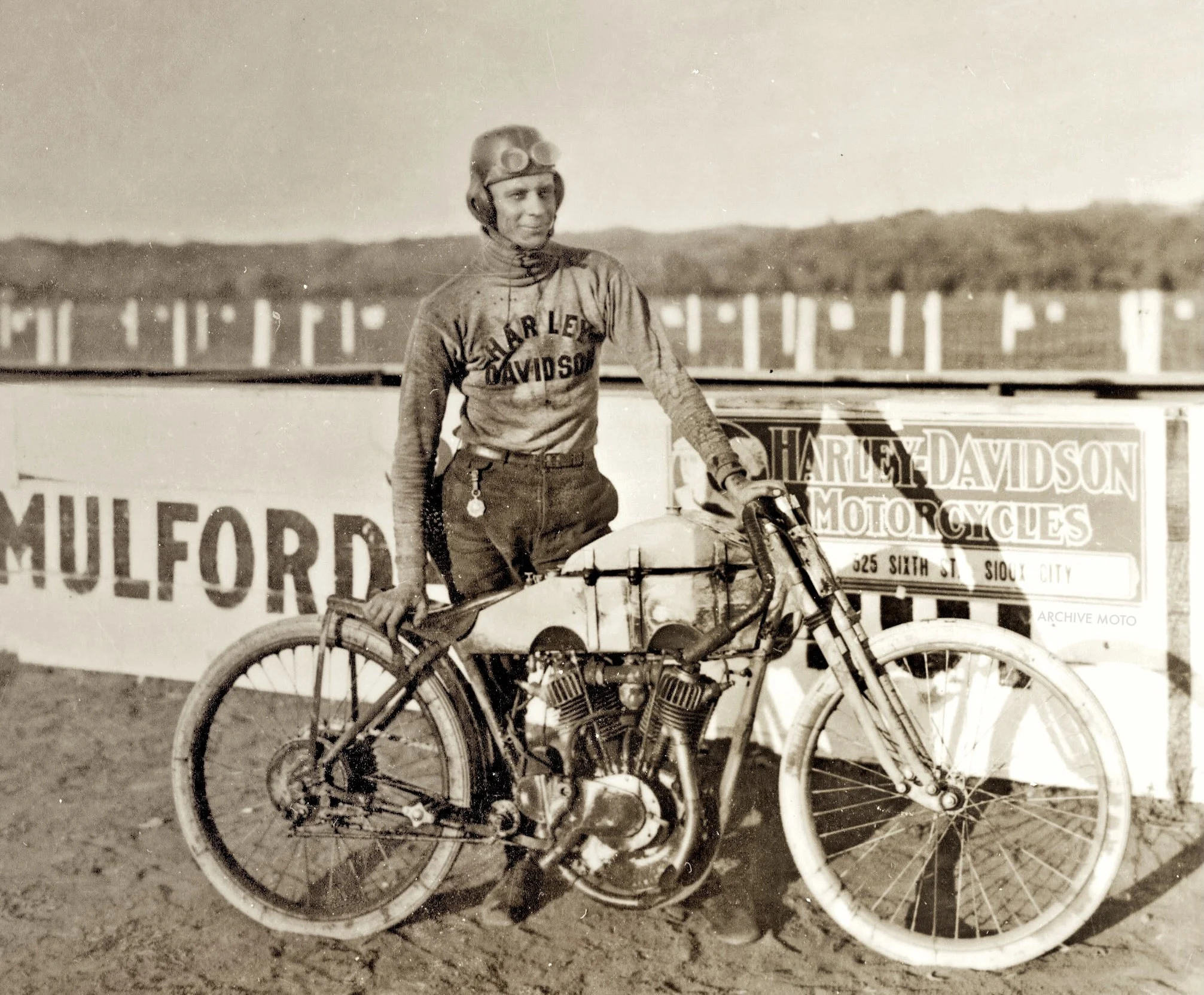
Bill Brier with his early 1914 Harley-Davidson 10k racer, specially equipped with an auxiliary fuel tank for the 250-mile race in Sioux City, iowa, September 2, 1914.
An all-too-often forgotten founder of the Harley-Davidson racing dynasty, William Fred Brier, poses with his early 10K factory racer in Sioux City, Iowa, September 2, 1914. This remarkable image offers an early glimpse into the formative moments of the Harley-Davidson factory racing program as it took its first steps into the sport of professional racing in late 1914.
An Illinois native, Bill Brier worked as a mechanical engineer at the Aurora Automatic Machine and Tool Company, builders of Thor motorcycles, alongside the company’s chief designer and head of its racing department, William Ottaway. Once released from their production contract with Indian in 1907, Ottaway began working on new engine and motorcycle designs, leveraging the emerging sport of racing to test out his machines. With riders like Shorty Matthews, Paul Derkum, and Bill Brier, Thor began building a reputation in the sport and a growing presence in the industry. Thor, along with Indian, Merkel, and Excelsior, were the brands that established the sport of motorcycle racing in America and created a thriving industry by the early teens.
Though they had remained surprisingly absent at the tracks during the rise of the sport, including at the height of the infamous board track motordrome days, Harley-Davidson’s interest in the racing game shifted as the races became larger, more controlled, and more lucrative in the early teens. With Thor’s evident success, the Motor Co. recruited Ottaway to come to Milwaukee, develop a new racing machine at Harley, and build a world-class factory racing program beginning in December, 1913. Using the 1914 Model 10 as a baseline, Ottaway got to work in early 1914 on the new machine, tapping a lanky young motordrome rider from Denver, Leslie Parkhurst, who was in town to run at the Milwaukee Motordrome that April, to test-ride tuned prototype engines.
The Motor Company’s unofficial debut came in July 1914, at the inaugural 300-mile Dodge City championship race with a test run of the new 10K racing machines. However, the extreme heat, the novelty of the 10K design, and the grueling nature of the long-distance road race made for a dismal soft launch, as none of the five Harley entries finished. As usual in those days, Indian reigned supreme with Glenn “Slivers” Boyd taking first place, but Ottaway’s old number two, Bill Brier, managed to score a second-place finish for Thor riding one of Ottaway’s former factory machines. Ottaway returned to Milwaukee hat in hand to refine his 10K platform and recruit potential factory riders.
The next appearance of the 10K came in Little Falls, New York, on July 29th, when Herman Lewis clocked 74.69 MPH to win a time trial. The following week, on August 3rd and 6th, Parkhurst unveiled a new 10K sporting a low-and-lean, short-coupled frame at the Milwaukee State Fairground track. There, Parkhurst split the honors with Indian’s Ray Creviston, winning three of the 6 events on what was being called a “stripped stock” machine. On the 9th, Alva Stratton, the second to have joined Parkhurst in the Harley-Davidson testing program, arrived in Rockford, Illinois, for a 100-mile road race. This was the second big race to have the Milwaukee crew in contention, with Stratton being joined by Dodge City teammates Leslie Parkhurst and Paul Gott, a local Harley dealer/racer. During a big dust-up on lap 65, both Gott and Parkhurst crashed out, but Stratton continued to fight out one of the closest battles for first at the front of the pack against Excelsior’s Carl Goudy and Thor’s Bill Brier.
Ultimately, Stratton edged past Brier for second place, but it was Goudy who won the day. Ottaway’s 10K was proving itself a top contender, so much so that protests were filed against it at the Rockford race, claiming its frame and oiling system were not found on stock machines, leading to some of the first “stripped stock” model advertisements to satisfy primitive homologation suspicions. It was also at Rockford that Ottaway must have convinced Bill Brier to leave Aurora behind for Milwaukee, as the next race on the calendar would feature Brier and a new variation of the 10K. That race was a 250-mile championship in Sioux City, Iowa, on September 2nd, 1914, where this photograph was taken.
For his debut with the Bar and Shield, Brier was equipped with this specially configured 10K. Along with its 61 CI pocket-valve, Ottoway-tuned M serial narrow-case “fast motor,” it featured the short-coupled frame with a clipped rear fender, dropped bars, and a sprung fork for long-distance events, similar to the earliest Dodge City machines. Mounted atop the narrowed, scalloped racing tanks was an auxiliary fuel tank, the first appearance of the assembly. The Sioux City race was a flurry of near misses and close shaves, with Flying-Merkel’s Cleo Pineau taking a spill so violent it broke his engine from its frame, and Indian’s Glenn Boyd locking bars with teammate Edwin Dehnert, sending both men to the hospital.
As he had for Thor, Brier held a strong position at the top of the field, going elbow to elbow with Excelsior’s Joe Wolters for nearly 4 hours straight. In the end, Wolters and his beefy Excelsior 7 bested Brier on the new Harley 10K, who finished second in front of Indian’s Ray Creviston in third. The newest recruit to a budding program, Brier quickly joined Parkhurst and Stratton in winners' circles around the country, laying the foundations for Harley-Davidson’s racing legacy. In October, Ottaway leveraged the lessons learned with the 10K development into a new generation of factory racing machines, the 11K, which would set a new standard both for Harley-Davidson and the sport moving forward.
With the new 11k, Parkhurst, Stratton, and Brier continued to mark up wins and podium finishes for the remaining events in 1914. From Philadelphia to Phoenix, Cleveland to Birmingham, Ottaway’s stable of machines and riders continued to build momentum. Then, on Thanksgiving Day, Harley-Davidson officially organized, supported, and publicized a factory racing team for the first time at the 300-Mile Grand Prize race in Savannah, Georgia. With Parkhurst still in the southwest, Bill Brier was selected to captain Harley’s first official team at the Savannah race, though a tremendous crash during practice would put Brier in the hospital for the historic event.
Still, from a dusty oval in Sioux City to the national stage in Savannah, Brier’s steady hand and Ottaway’s restless engineering planted a flag in the culture for Harley-Davidson. Starting in 1915, The Motor Company mounted a charge in the sport that wouldn’t slow until the 1920s, and though Bill Brier’s career would be rife with injury and ultimately end in tragically in 1916, the foundation he helped lay onboard his 10K more than justify his place among the legends of the sport.