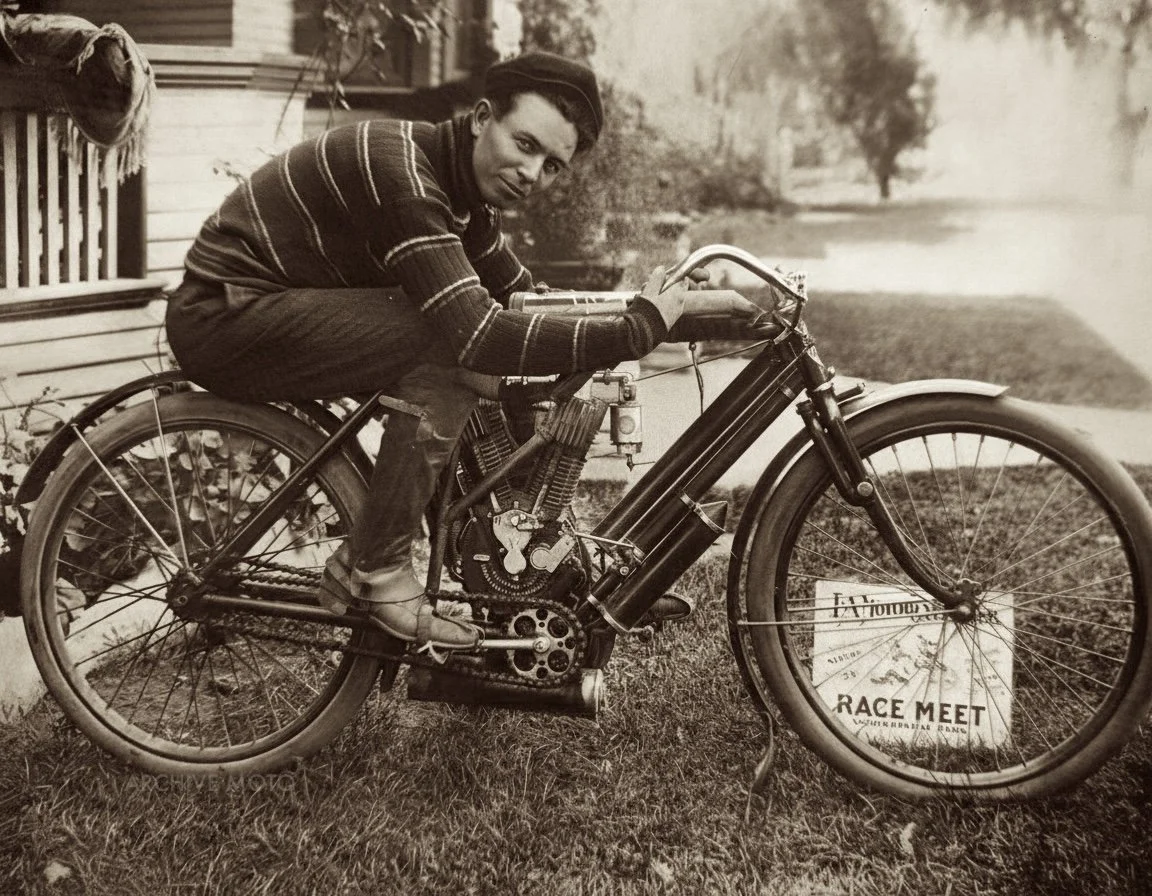
Paul Daredevil Derkum on board a 1907 Indian V-twin, modified for the big races at LA’s Agriculture Park by his friend C. Will Risden.
Pictured here, 26-year-old Paul “Daredevil” Derkum poses on board a slightly modified, first-year production Indian twin to promote the races at Agriculture Park on September 9th, 1907. Already a recognized figure among the earliest class of American motorcycle racers, Derkum stood at the forefront of a sport still defining itself as one of its first true celebrities. Born in Hamilton, Ohio, Derkum arrived in Los Angeles with his family in 1890 and quickly took to bicycle racing, a culture then sweeping the nation. He became a fixture in the city’s growing cycling scene, working alongside his brother in a bicycle shop and spending long hours at the dusty oval of Agricultural Park. There, amid the gamblers and sporting men who crowded the grounds, he likely crossed paths with Will Risden, another young bicycle dealer and racer whose influence, together with Derkum, would shape the course of motorcycling on the West Coast.
In December 1899, Derkum, Risden, and the other usual suspects among LA’s cycle-crazed bore witness to the birth of a new age. At the 10th Avenue Velodrome, Atlanta cycling champion John Chandler piloted an Orient tandem pacer, one of the first gasoline-powered machines to appear before an American crowd. The machine was a marvel, filling the venue with sounds and smells scarcely encountered before, and moving the most intrepid in the crowd towards a budding new industry. Another local bicycle dealer and avid racer, Ralph Hamlin, was the first to acquire his own motorized cycle from the same Orient company in Waltham, Massachusetts. Hamlin’s Orient would be the first motorcycle west of the Rocky Mountains. Hamlin became an agent for Orient machines, followed shortly by Will Risden, who dealt Holley machines, an early brand from Pennsylvania, from his cycling shop.
Keen on drumming up sales of his novel machines, Hamlin arranged to race against the few local motorcycles that existed at Agriculture Park on May 7, 1901, an event that would be recorded as the first motorcycle race in the United States. Hamlin and his stout 2 1/4 HP Orient handily bested Will Risden, Archie Hoxie, and John Burgess, covering 10 miles in a shade over 18 minutes with an average speed of 32.2 mph. The machines were crude and unreliable, but undeniably exciting to all who witnessed their novel speed. Following the race, Hamlin began focusing on automobiles, specifically the Franklin marque, and Risden immediately began looking for a more capable brand of motorcycle. Risden landed on an upstart manufacturer from Springfield, Massachusetts, named Indian, acquiring two of the first off the line and organizing his dealership to be a key distributor on the West Coast. For men like Derkum, the appeal of the motorcycle was undeniable. Still, the industry was too new and lacked the viability to serve as a reliable means of earning a living.
Instead, Paul Derkum took up work as a fireman on the Southern Pacific’s Owl Train, heading to Risden’s shop in 1903, to purchase a single-cylinder Holley for his commute. He rode it daily, spending his nights managing the Owl’s fires between Los Angeles and San Francisco, a grueling schedule that left little time for competition but kept him closely tied to machinery. Motorcycle racing, at that stage, remained little more than a curiosity, with occasional grudge matches and hill-climb exhibitions drawing modest crowds, often with Risden and his cohorts at the newly formed Los Angeles Motorcycle Club responsible for organizing the events. Still, by 1907, the seeds of motorcycle racing planted in Southern California by Risden and Hamlin had begun to bloom. Over the years, racing had steadily grown to dozens of races each year, with new venues, long-distance events, and the organization of the LAMC. Motorcycle competition was proving not only popular but profitable. That same year, Derkum traded his Holley single for a new Indian from Risden’s shop, joined the ranks of the LAMC, and returned to his old stomping grounds at Agricultural Park to once again have a go at victory. Paul Derkum quickly established himself among the region’s best riders by the end of the 1907 season, competing aboard machines supplied and often modified by Risden, now the largest Indian distributor on the West Coast.
For the September races, Risden secured one of Oscar Hedstrom’s newly introduced production V-twin Indian’s for Derkum to ride. The machine, a 5-horsepower, 38.61 CI V-twin roadster, was then modified for competition. Its distinctive “camelback” fuel tank was replaced with a torpedo-style racing tank available on Hedstrom’s exclusive factory racers. The handlebars were dropped, and though not visible in photographs, it is likely the machine was fitted with one of Hedstrom’s “monkey on a stick” racing saddle assemblies, placing the rider much lower and farther back in the frame for control and speed. Still, it is possible that the saddle assembly was simply removed for the photo, Derkum having to precariously perch himself on the rear fender for a more speedy aesthetic. Though he had yet to earn his nickname of the “Daredevil,” Derkum was billed as one of the main attractions, set to face Los Angeles rival Walter G. Collins, the president of the LAMC. Collins, another of the early cycling racers in LA, would ride a belt-driven Peugeot twin from France, equally powerful but larger and arguably less refined.
On September 9th, 1907, a crowd of 5,000 spectators gathered at Agricultural Park for what was the largest motorcycle race in the region’s history. They paid 25 cents for admission and filled the stands as a band played popular tunes and early automobiles honked along in uneven chorus. Twelve events were scheduled with entrants mounting machines from Indian, Curtiss, Reading-Standard, Torpedo, and even a locally built Holmes & Hoag. Along with Derkum, Collins, and Risden, rising talents lined up for the race, including 16-year-old Charlie Balke, who would later become one of the sport’s most recognizable champions. The early races established the tone. Balke captured the 3-mile event. Risden himself proved formidable, winning the 5-mile Charles Fuller Gates Cup, the 4-mile relay, and placing second in the day’s free-for-all. In the LAMC Club Challenge Cup, Jim Mazzii rode a powerful Curtiss twin to an upset victory over both Collins and Derkum.
Derkum rode aggressively, exploiting the relative balance and reliability of the Indian twin compared to the other twins at the event. In the Australian pursuit race, he pushed the machine wide open through the corners, something few riders dared attempt on the heavier Curtiss or less stable Peugeot. The result was not only a win, but a reputation for his fearless nature and reckless determination in the saddle. The culmination of that autumn day at Agriculture Park came in the final events, the 5-mile Risden Cup Challenge, where Derkum and Collins faced off directly. Though well-matched in both horsepower and grit, Collins surged ahead in the closing laps, driving his Peugeot to a record-breaking pace. On the final lap, he circled the mile-long track in one minute flat, 60 miles per hour, earning the nickname “Mile-A-Minute” Collins and his place in the history books as the first man to accomplish the feat on a motorcycle. Ultimately, Derkum was bested across the line, but the acclaim he received from a portion of the crowd and later, the press set the hook. For the 1908 season, Will Risden convinced Oscar Hedstrom to send one of his personal factory racing twins to Los Angeles for Derkum to ride. Nicknamed “Old Liz,” Derkum rode the 5 HP Indian twin in February to new records in every distance from 1 to 10 miles, beating “Mile-A-Minute” Collins’ existing times, and acquiring his own nickname of the “Daredevil.”
As 1908 progressed, Derkum mounted a campaign of victories across Southern California, beginning with the Altadena hill climb. Daredevil Derkum bested all entrants, cars and motorcycles alike, with an average speed of 63 mph. He then broke Jacob DeRosier’s standing records in April, followed by testing runs at the Seal Garden’s Velodrome, a slightly larger wooden velodrome that, along with the Clifton Velodrome in New Jersey, cast the mold for the infamous board track motordromes to come. By July 1908, Paul Derkum joined a very small group of motorcycle racers to be classified as professionals, the first of their kind in America, as the sport began to explode. Paul Derkum would remain a central influence in the culture of motorcycle racing for years to come, his ascent tracing the arc of the motorcycle itself from curiosity to lifestyle, from spectacle to profession. Paul Derkum was known long before the legends of the great board tracks of the teens were written, having already defined what it meant to be a motorcycle racer.