At only 17 years old, Ray Seymour, the “California Wonder” had already established himself as one of the top competitors in the sport of American motorcycle racing by 1909. The freckle-faced youngster had only begun racing around the dirt tracks of Southern California the year before, and became a staple crack at LA’s Agriculture Park, one of the first hubs of the sport. His ability to hold his own at such a young age against the country’s first generation of racers, experienced and hardened carry-overs from the glory days of bicycle competition put him at the top of the class of America’s second wave of pioneer racers, and helped earn him a factory sponsorship with Reading Standard.
“Farmer” Joe Wolters debuting the powerful new Excelsior “7” on the boards of Chicago’s Riverview Motordrome in early August, 1911. Wolters had just arrived in the Windy City from racing at the two board track motordromes in Denver, Tuileries and Lakeside that June. Joe had first acquired an Excelsior mount the season prior from the local Denver dealer, and when he discovered that the belt on his ported Excelsior single would slip once it became oily he set about converting it to a chain drive, as such introducing the first chain-driven Excelsior, squeezing 10 mph more out of the machine.
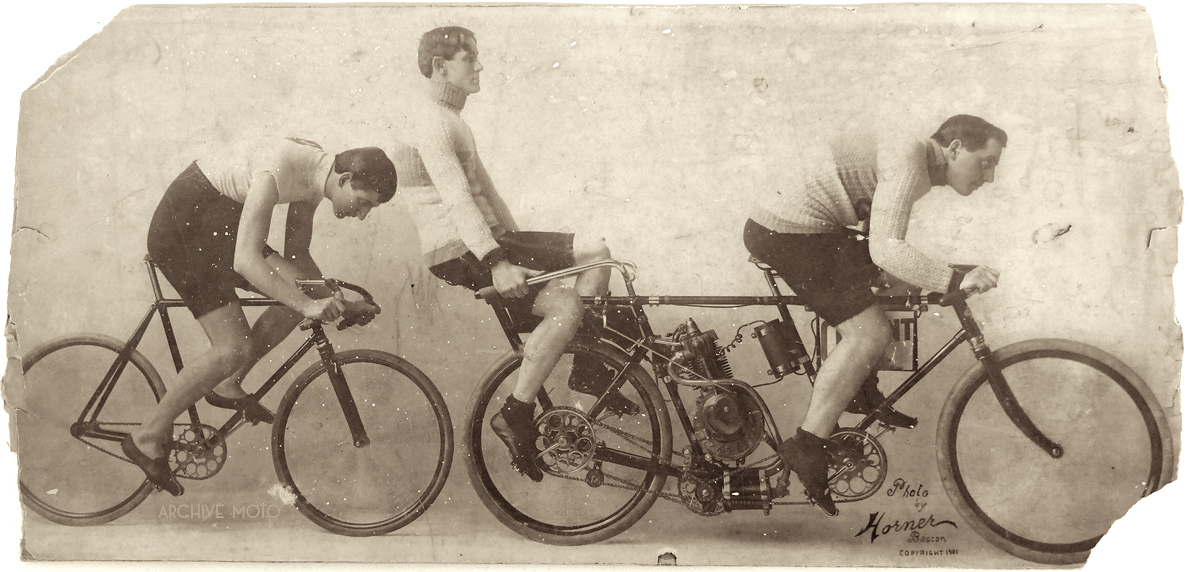
Inspired by French cycling star Henri Fournier’s motorized pacing machine which he brought to the United States in 1897, companies like the Waltham Manufacturing Company, makers of the popular Orient line of bicycles and tandem pacers began acquiring French made DeDion button engines to experiment with their own motor-pacer designs. Paced bicycle races had grown in popularity leading up to 1900, and with the introduction and application of new gasoline powered combustion engines the pacing machines had quickly become a sensation at the track.
The eternally lovely, fearless, and unwavering Miss Vivian Bales onboard her beloved 1929 Harley-Davidson Model D, on which she traversed thousands of miles throughout North America at the end of the Prohibition Era. A seamstress and dancing instructor from Albany, Ga., Vivian grew restless in her small south-Georgia town so she picked up her first Harley-Davidson in 1926 and set out seeking adventure. As she grew more confident and resilient her journey’s grew longer, and the petite Miss Bales eventually caught the eye of Harley-Davidson’s co-founder, then acting President Arthur Davidson.