You may have seen this iconic image of two men going head to head on a motordrome's steep angled boards. A few may even point out that it was taken at the Springfield Stadium Motordrome, but unfortunately it has been captioned incorrectly. It is in-fact a moment captured on the high-banked turns of the oval shaped Los Angeles Coliseum, America's first motordrome built by Jack Prince just prior to the construction of the Stadium track at Springfield in 1909. A result of an honest misidentification by the original source, the vast photo collection of Mr. A.F. Van Order. The error has been published countless times, myself included, with the wrong information, but hopefully my upcoming trip to Springfield will produce an equally triumphant photo of a hero or two blasting around the Springfield drome.
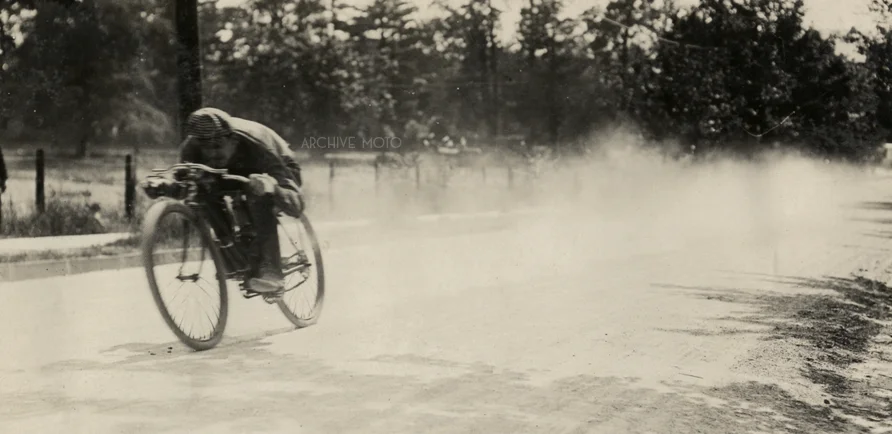
GET AT IT! American motorcycle racing pioneer Arthur G. Chapplle blasting down the road course during the New York Motorcycle Club's annual Spring Run held on Sunday May 9, 1909. Chapplle was arguably Indian's second in command behind Jake DeRosier when it came to working magic on the track and he held a lengthy tenure with the Springfield company. Chapplle also served as the Captain of the NYMC and can be seen here with a rooster tail of dust flying off of his factory "torpedo tank" Indian twin.
The pace of technological advancement in the modern era is one of the most remarkable aspects of the human experience. Think back just ten years ago and how different your day to day life was, how limited the info stream was, and how little we shared outside of our circle of friends. The all powerful Facebook was just a year old, the iPhone wouldn’t be around for another two years, the Star Wars everyone was freaking out about was Revenge of the Sith, and an upstart video site named Youtube was first introduced. Looking back gives us perspective on just how far we’ve come in such a short span, but if we go back to the beginning of the industrial age we find that folks did the very same thing and looked back on just how far they had come.
This photo comes from a 1911 issue of Bicycling World and Motorcycle Review. It offers a contrast on just how far two-wheeled locomotion had come in the 40 years that occurred between the two photos. The comparison starts with a privileged gent from Cleveland, Ohio atop his “bone shaker,” one of the earliest and often credited as the first successful bicycle designs, comingout of France in the mid-1860’s. Speed as we know it developed quickly once the motorcycle was introduced at the turn of the century, but only after several incarnations and experiments with bicycle design. On the right we see the tuck, the ideal position that every kid with a bicycle knows that he needs when speed is the goal, and a stance that originated in the first days of motorcycle racing. The rider is a Maryland racer named “Chic” Thomas, and his mount is a top of the line 7HP Indian from 1911, dressed and ready for the track.
You may even wish to take it a step farther, imagine the machines that were available 40 years after that. You find the hulking, beastly road machines of the 1950’s and the nimble, no-nonsense powerhouse flat trackers. Pull forward again and in just a few jumps, roughly a single century in the whole of human existence and you enter the modern age of super bike speed and the super computer, truly a remarkable progression.
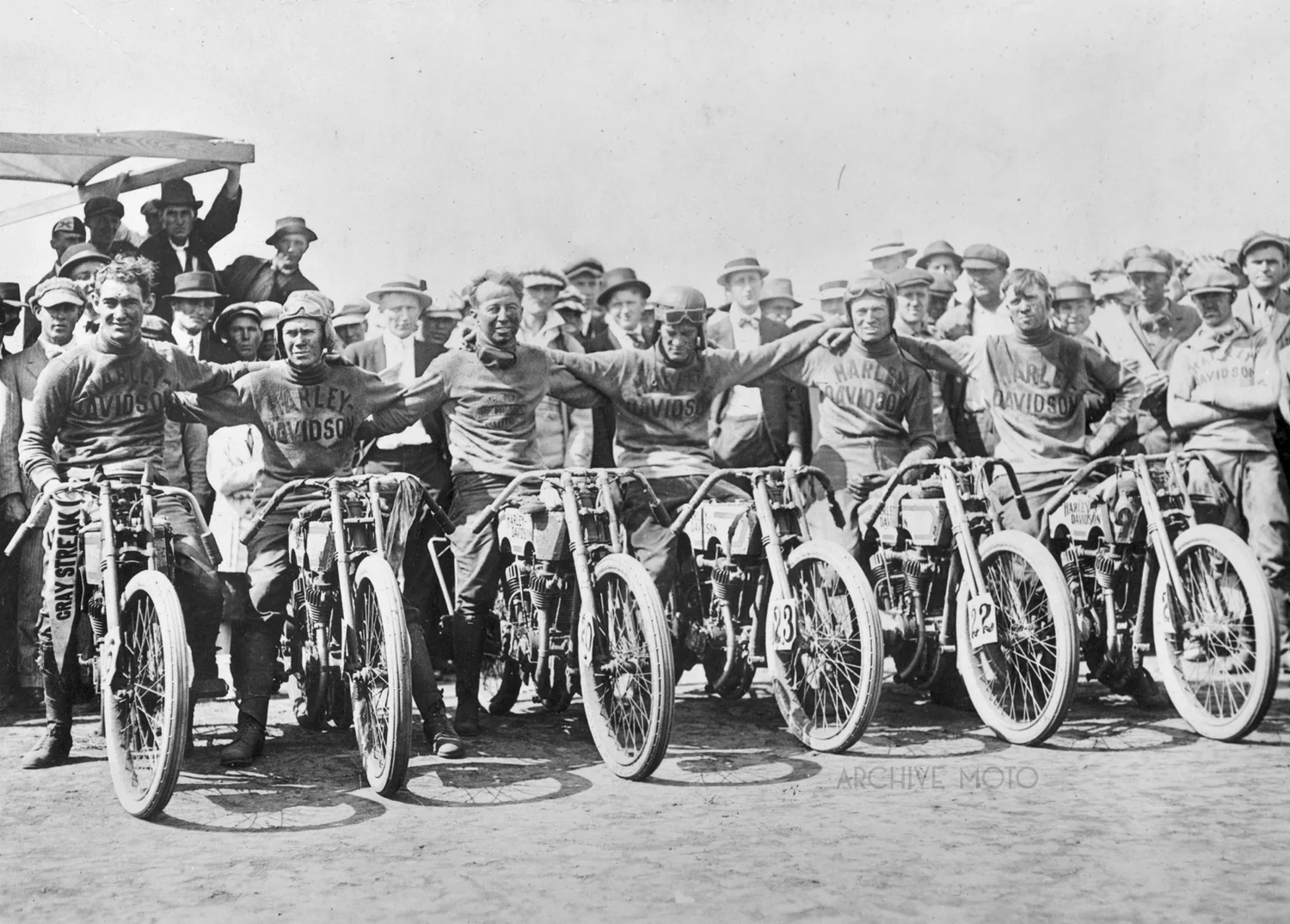
Harley was a bit of a late comer to the racing game, but with the introduction of its 11k racing model in 1915, the brand and its legendary stable of team riders (later known as the Wrecking Crew) became an unstoppable force in the sport. Actually the 11k model made its underwhelming debut at the 1914 Dodge City 300, after a bit of tweaking HD hired racer Red Parkhurst who piloted the new machine to victory in Birmingham a few months later, though there was still no officially sponsored program. Harley's first official race and podium took place in November of 1914 when Irving Janke blasted an 11k to 3rd place at the Savannah 300. 1915 marked the first official racing season and the first official championship victory for Harley-Davidson, and intrepid riders like Red Parkhurst and Joe Wolters (pictured on their 1915 11-KT and 11-KR racers) helped to make the brand an American Icon.