The motorcycle was well into its second decade of existence, having created a rich and diverse culture firmly planted in the contemporary American experience. Motorcycle racing was never before as popular as it was in the mid-teens, and on the dirt tracks and spectacular wooden saucers peppered throughout the United States men with heroic levels of character hurled themselves headlong into the wind with a violent grace.
There was no denying that at the time the boys at Indian had stacked the deck, with their overhead-valve thoroughbreds and stable full of talented riders the Springfield crew was the always team to beat. Flying-Merkel and Excelsior presented the toughest opposition when it came to running in the dirt, Excelsior being one of the few manufacturers that fielded teams against Indian on the country’s sensational wooden motordromes, and smaller companies like Thor and Reading-Standard rounded out most other rosters. By 1913, the mighty Harley-Davidson Motor Company had yet to develop its own racing program, though the machines were a familiar sight in competition being entered for years by privateers and local distributors. That all changed 101 years ago today in Savannah, Georgia, 1914.
The event was the second annual American Classic Championship, a 300 mile road race held on the former Grand Prize circuit in Savannah. For the race, Harley sent an train car full of experimental new motorcycles being developed by Bill Ottoway, machines that would proudly announce the arrival of Harley-Davidson onto the scene and forever change the landscape of American motorcycle culture. These developing and experimental "stripped stock" machines were known as the 11k racers, having been tested only a handful of times leading up to the Thanksgiving Day event. The milestone machine featured a shortened frame, mechanical intake with tank cutaways, primitive yet revolutionary oiling system, dropped bars, bobbed fender, and was configured for the 300 with an auxiliary fuel tank... a true racer.
The team assembled was a mix of Veterans, rising national stars, local heroes, privateers, and dealers. A far cry from the dominant assembly of icons Harley created after WWI that became known as the Wrecking Crew, but none the less the 1914 crew were a talented group of 8. Veteran racer Bill Brier was selected to lead the team as captain, but a spill during practice left him walking with a cane and in no shape to run. Another team member, R.B. “Mud” Gardner also went down on the sandy roads of Georgia’s oldest city, leaving the Harley-Davidson team down two entrants the day before the race.
Alva Stratton took over Brier’s responsibility as team captain, he placed 7th over all but it was shattering of the course record on his final lap that earned him the most notoriety. He blasted around the course with an average speed of just over 72 mph, hitting close to 90 mph on the straights on his final lap, after already running his machine for nearly 300 miles.
As for Brier’s machine, after strong petitioning from the community a young local talent was selected to take his place. Zeddie Kelly, a member of the Savannah Motorcycle Club was rumored to be the fastest in the region, and after consistently besting the masterful Joe Wolters and leading the race the majority of laps he made, Kelly confirmed his reputation. Tragically, on his 19th lap on a technical turn known as the Sand Fly Zeddie lost control at full clip, running off the track and into a tree, Kelly was dead within hours.
The death of Zeddie Kelly was heart breaking enough on its own, but sadly it was preceded by another incident which resulted in a fatality, and again the loss would come from the Harley team. An experienced racer and Harley dealer from Mooresville, NC, Gray Sloop had just won the 50 mile national at the Isle of Palms in September on a prototype 11k and was a shoe-in for a spot on the team. After completing a blistering 2 laps Gray lost control of his machine, laying it down near Norwood Ave. The initial fall was not enough to injure Gray too badly, but it did severely crack the right side of his handlebar. Determined, Gray pushed on until the handlebar finally gave way at speed when approaching a hard turn at Waters Rd. and Estill Ave. The impact of his second spill was much more violent, veering off the course headlong into a guide wire that was securing a tree, he was dead before reaching the hospital.
Aside from the tragic loss of Kelly and Sloop the team performed well and Harley's 11k racers performed better than expected. One of only two entrants that did not finish, Edwin French took over the machine that “Mud” Gardner was supposed to run, but dropped out with mechanical issues before finishing 10 laps. Future Wrecking Crew legend Ray Weishaar was the other to drop out, making it to lap 24 and claiming the second fastest lap of the race.
The honors of the fastest man out of the gate was yet another HD team, Savannah local Martin Schroeder. Schroeder, who served as the treasurer for the Savannah Motorcycle Club blasted off the line and set the fastest initial lap leading the race, however he could not maintain the pace and finished in 8th place. Of the 8 members of the Harley-Davidson team, 7 broke the lap record and 4 finished in the top 8.
Jacksonville’s Jonathan Yerkes also finished in the top ten, placing 6th, but it was the young Irving Janke who took top honors of the day. Janke blasted through the pack, starting in 20th position he finished in 3rd place, the first podium in Harley’s history. Janke had just begun his racing career in 1914, and at 19 years old he was the youngest entrant at the Savannah 300.
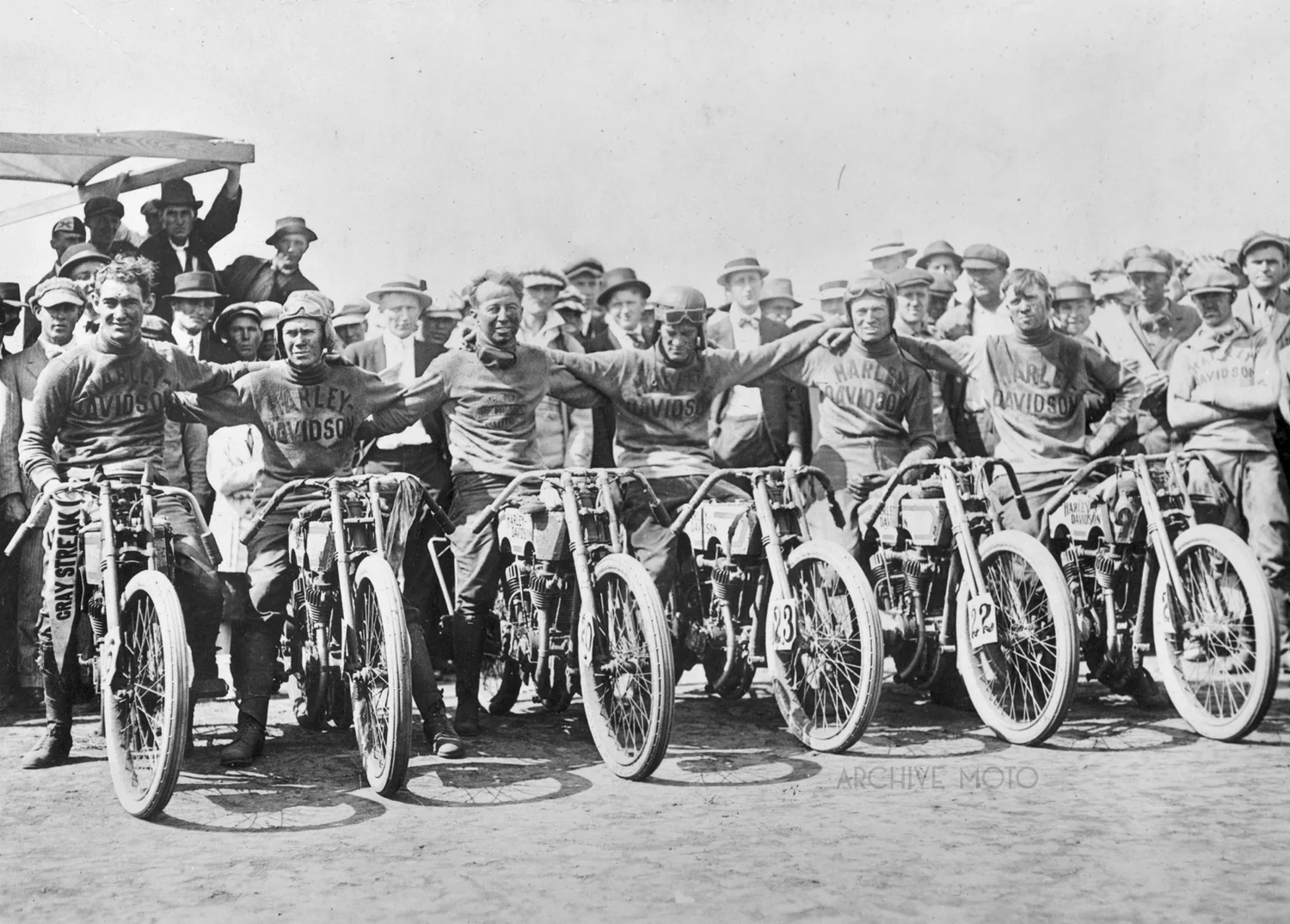
Though the day was marred with tragedy the team made a momentous showing at the 1914 Savannah 300. Harley-Davidson, with the 11k racers established themselves as a new force in professional motorcycle racing and would go on to foster one of the most storied legacies in history. Pictured here, the first ever factory supported Harley-Davidson team 101 years ago, on Thanksgiving Day, 1914. Pictured left to right, Captain Alva Stratton, Jonathan Yerkes, Zeddie Kelly, Irving Janke, Martin Schroeder, Gray Sloop, Edwin French, and Ray Weishaar.