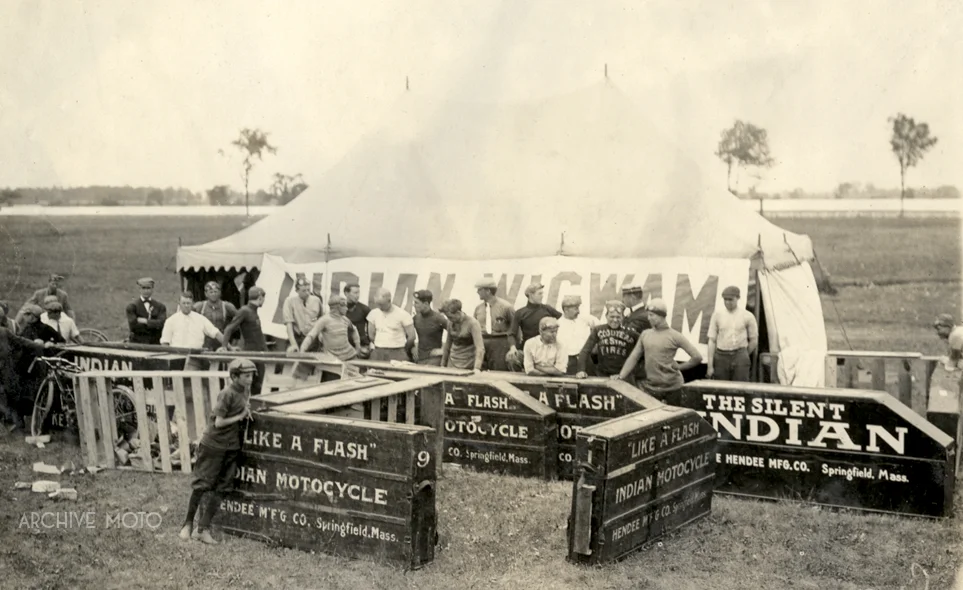
Indian's "WigWam" Basecamp, Ft. Erie 1911

Comment

Indian's "WigWam" Basecamp, Ft. Erie 1911

A remarkable scene captured overlooking the Indian camp, known as the Wigwam during the FAM National Championship in July of 1911. The races were held at the track in Fort Erie, Ontario, just across the river from Buffalo, NY near Niagra Falls. By this time Indian, the manufacturer from Springfield, MA was the team to beat, having been one of the first American companies to support a racing program and engineer machines specifically for racing. Many of America's first racing stars were a part of this legendary team, many of whom can been seen in this photograph. A handful of the 14 riders fielded by Indian are gathered at the team tent with a handful of their hastily unpacked motorcycle crates littering the camp. Those with a keen eye can pick out (from left to right) team members Don Klark, Dan Willis, Eddie Hasha, EG "Cannonball" Baker, John U Constant, Ed Stauder, Charlie Balke, and Frank Hart. Oddly, some riders typically associated with Indian like AG Chapple and Morty Graves joined forces with WJ Teubner and Arthur Mitchell on the Merkel team for the event. Another man known to race for Indian, Lee S. Taylor donned the Emblem jersey, and among the other notable entrants was L. Steinhauser on a rare Bradley. In predictable fashion Indian took the most podium spots that weekend, with Anderson, Hasha, Constant, and Hart each taking the top spots. After the points were tallied it was Indian's Frank Hart (seen standing in beanie and goggles 2nd from the right next to Charlie Balke who is wearing a Goodyear jersey) who took home the Bosch Trophy that weekend.
Comment

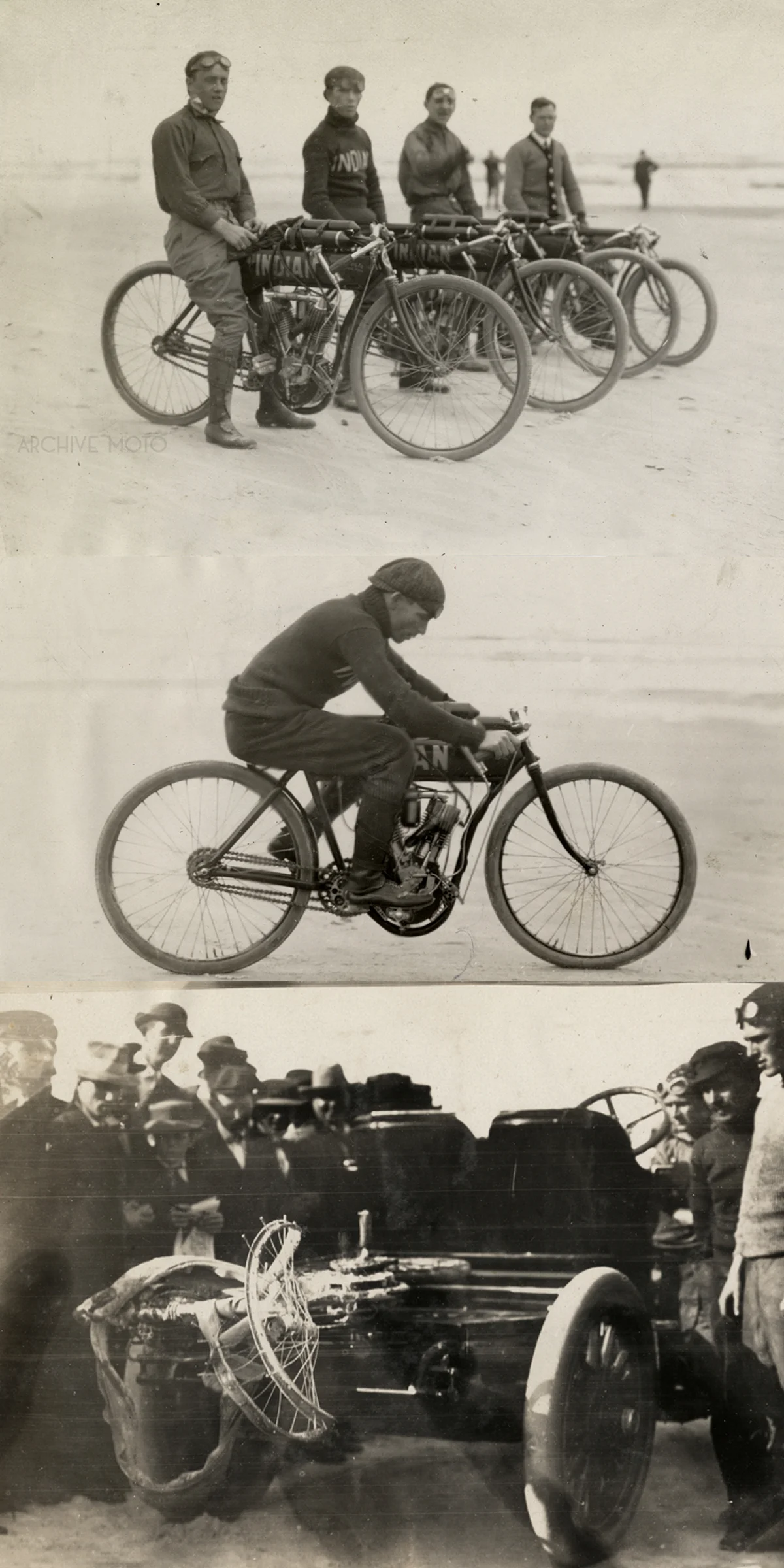
Robert Stubbs, Tumbleweed, Ormond Beach 1909

Comment

Robert Stubbs, Tumbleweed, Ormond Beach 1909

Many of you have seen this emblematic photograph of four men posing proudly atop their Indian motorcycles on the sands of Ormond Beach, "The Birthplace of Speed" near Daytona in 1909. I am sure far fewer of you have caught a glimpse of this shot however, of one of the machine's after going down on that gritty surface at top speed. The bike belonged to one of the four Indian riders, Birmingham, Alabama's Robert Stubbs, dealer and one of Indian's earliest racing stars. He was asked to accompany Indian's chief engineer Carl Oscar Hedstrom along with teammates Walter Goerke and AG Chapple to Ormond Beach in order to stretch out the new lot of Indian racing machine's to their limits. Each man from the "tribe" reached and broke new records at the 1909 Carnival of Speed with the exception of Hedstrom, who was reported as being too busy tinkering with his Simplex powered Hot Shot, which had too large a displacement to qualify for any FAM record runs. During a run on Wednesday afternoon Stubbs met and exceeded the limit of his powerful Indian twin racer, and at over 80 mph, undoubtedly the fastest creature on the planet earth at that moment he went over the bars. Stubbs not only came out of the incident unscathed but smiling, an unusual emotional break for a typically stoic man according to all photographic accounts... his machine however was done for the day.

Comment

1908 NYC to Chicago FAM Road Run

3 Comments

1908 NYC to Chicago FAM Road Run

The most important aspect of any culture is the coming together of like minded people to share in the experience of their enthusiasm. At the beginning of the 20th century, in the first days of a burgeoning new motorcycle industry the earliest fanatics began to band together, forming America's first motorcycle clubs. These first clubs began organizing events around their beloved machines, often times consisting of long-distance tours of their area. Naturally those first country tours grew into friendly competitions, and grew still into sanctioned endurance runs. At this time the growing pangs of the industry were centered around efficient engineering, top speed had not yet become top priority and manufacturers were still focused on improving and advertising their machine's reliability and hardiness. As such many of America's first motorcycle races were points-based, long-distance reliability runs where riders would spend days in the saddle and were responsible for any and all necessary repairs to their machines.

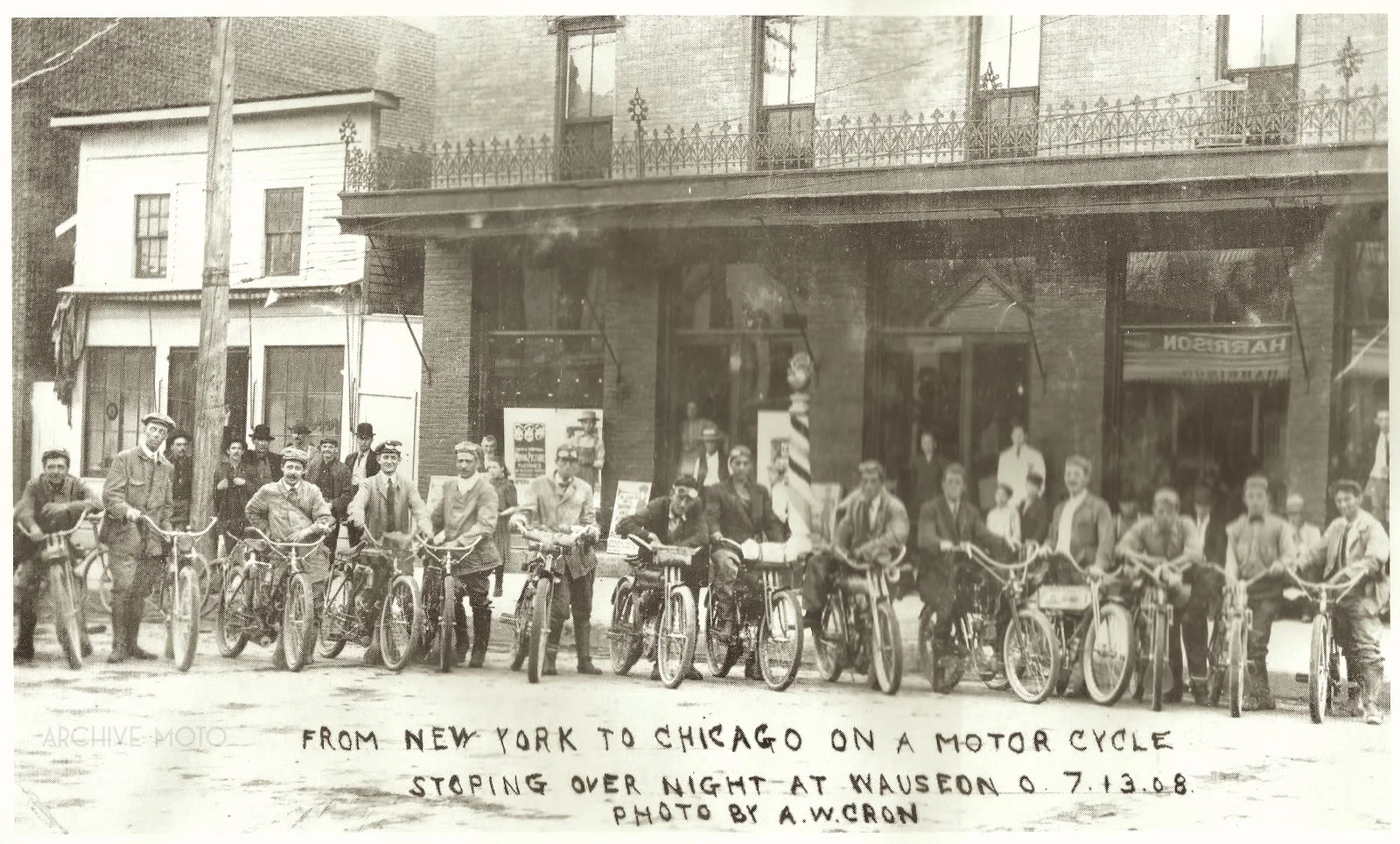
On July 6th, 1908 under the auspices of the western district of the FAM twenty men mounted their motorcycles for a 1,200 mile reliability run from New York to Chicago. Over 9 days the men piloted their machines over a multitude of crude American road surfaces, including sand, gravel, gouged mud, and sticky clay. Manufacturers keen on converting success in such endeavors into sales figures entered teams to compete for points. Indian, Merkel, Thor, Reading Standard, and Excelsior all fielded teams, and in typical fashion for the time period it was Indian who came out the victor. The only team to post perfect scores, the Indian boys George Holden, Bert Barrows, and Stanley Kellogg (who was the only rider entered on a twin cylinder machine) happily took the Examiner Cup back to Springfield. Worn down, beaten, and battered the men were greeted by throngs of cheering people lining the streets as they rolled into Chicago on July 15th. Of the 20 entrants 17 completed the journey with points, only the 3 member Light team failed to finish due to significant mechanical failures. It is said that the toughest 166 miles of the entire route, the leg between Cleveland and Wauseon proved to be the gauntlet where many teams lost their perfect scores. This photo, taken in Wauseon after that challenging leg captures a handful of the exhausted yet enthusiastic competitors near the end of their journey.

3 Comments

Archive Icon: Henry Hammond Springs

Comment

Archive Icon: Henry Hammond Springs

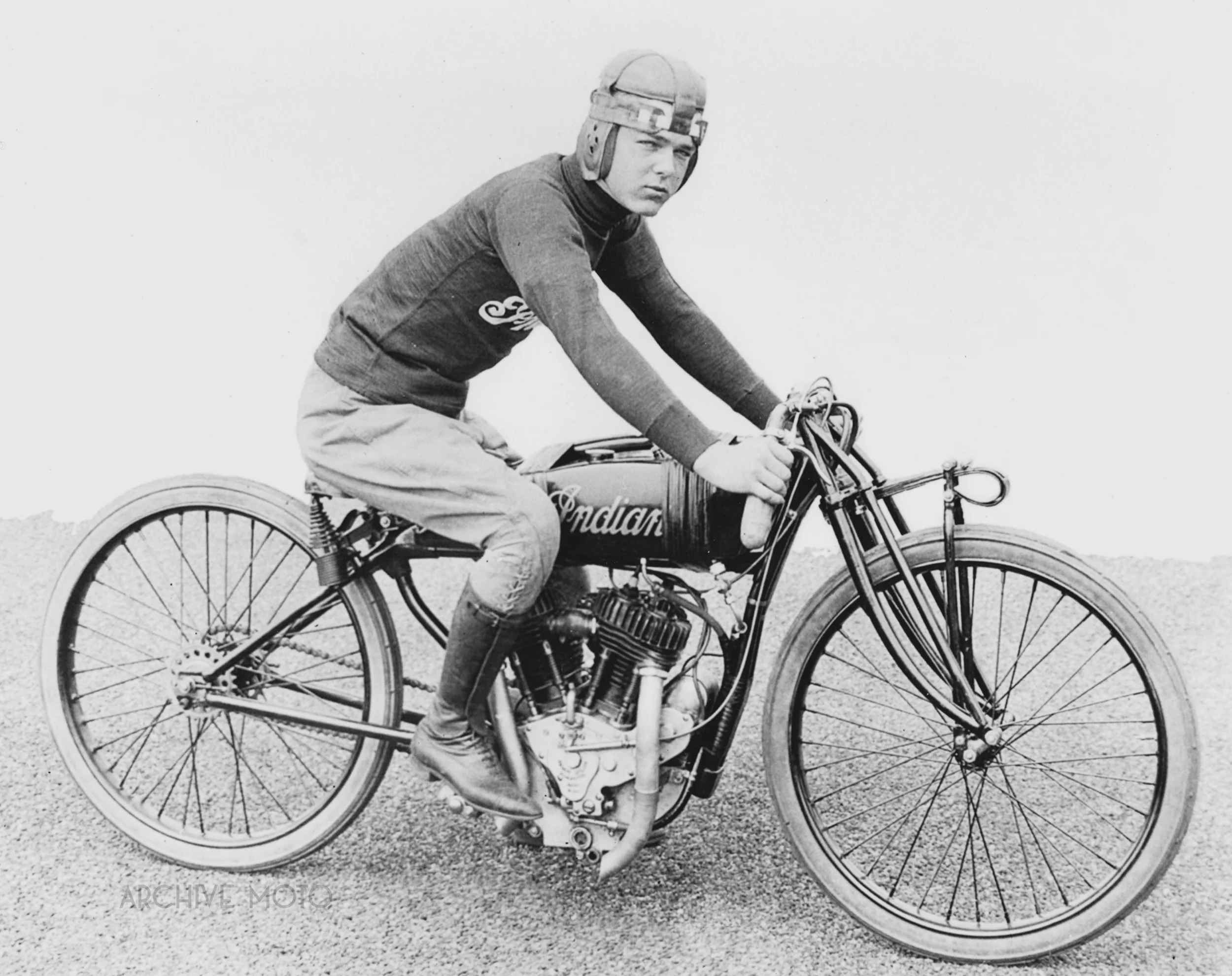
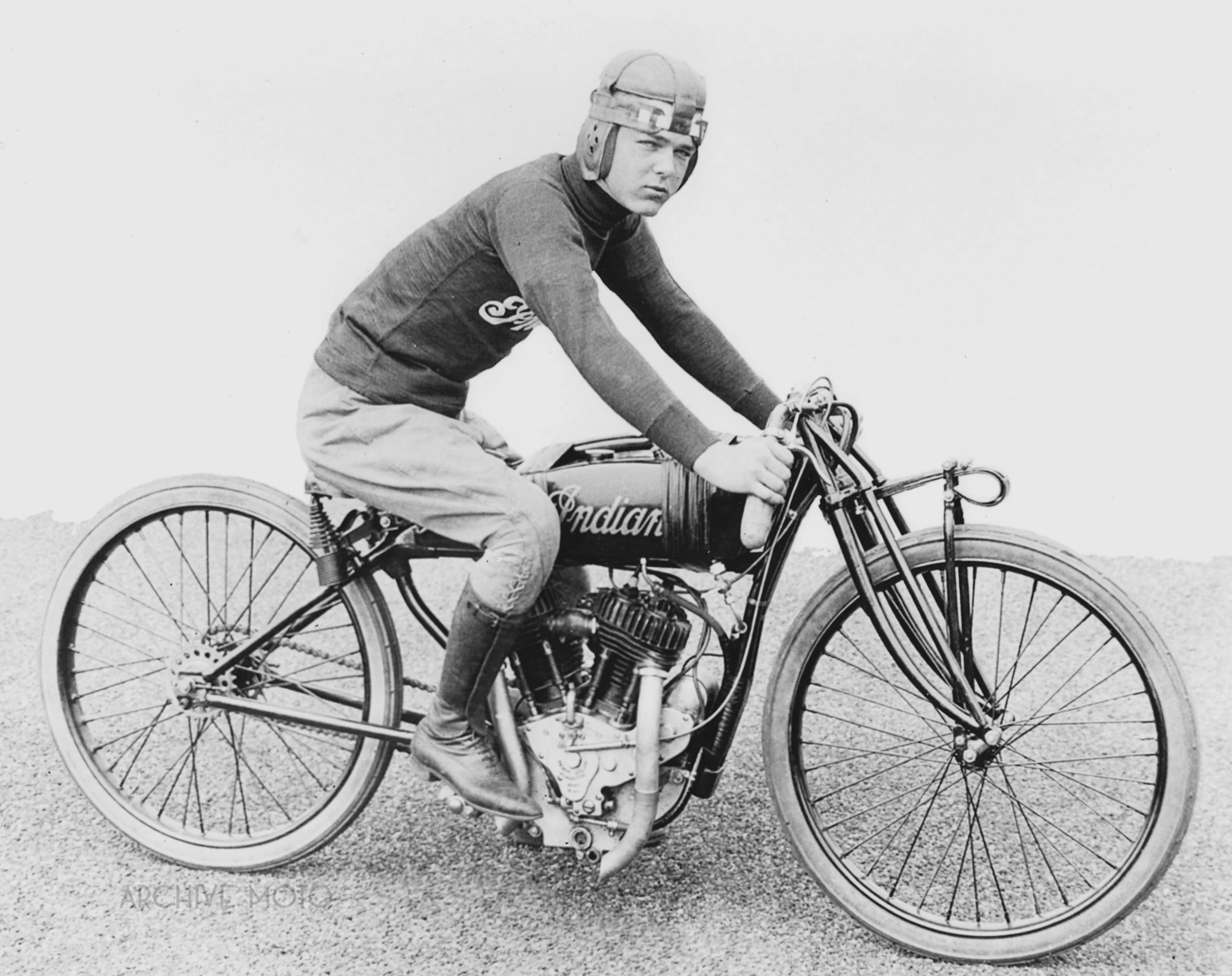
Meet Henry Hammond Springs, the teenage phenom from Augusta, Georgia who kicked up the dirt of American speedways in the late teens. Hammond was yet another remarkable young talent who dedicated his life to racing motorcycles, and like so many competitors from that time he too tragically gave his life in the pursuit of victory. Born in Augusta in 1902, Hammond's family relocated to Atlanta after his father, a firemen died in the line of duty in 1909. Once in Atlanta Hammond began racing his motorcycle, a Harley-Davidson 8-valve at the local tracks including the 1-mile dirt oval, the Lakewood Speedway. He was quickly taken in by local Indian dealer and board track racer Harry Glenn who recognized Hammond's natural abilities and helped refine his skills on the track. Due to the suspension of professional racing during World War I, Hammond was able to hone his skills on local tracks against riders who had already made a name for themselves on the national circuit. Hammond grew tremendously during this time period and by the time he was able to enter his first professional event for with his new Indian jersey on Labor Day of 1920, he found the podium in every race, winning both the 10 and 15 mile open races. Now an official member of the Indian factory team, the 17 year old Hammond began competing across the country in the major events of the day, including the premier 300 mile race at Dodge City. Over the next couple of years, the dashing young Hammond became a top rider at Indian, local hero in Atlanta, and a crowd favorite as he hurled ribbons of dust off the back fire of his Indian Daytona. Tragically though, America's youngest professional motorcycle racer would die a teenager during a race at Springbrook Park in South Bend, Indiana on May 30, 1922. News of Hammond's death hit hard in Atlanta, and when his body was returned to the city to be laid to rest in the historic Westview Cemetery he was escorted by a long procession of motorcycle's, including fellow racers, friends, and APD officers.

Find out more about the fast life of Hammond Springs in the pages of Georgia Motorcycle History

Comment