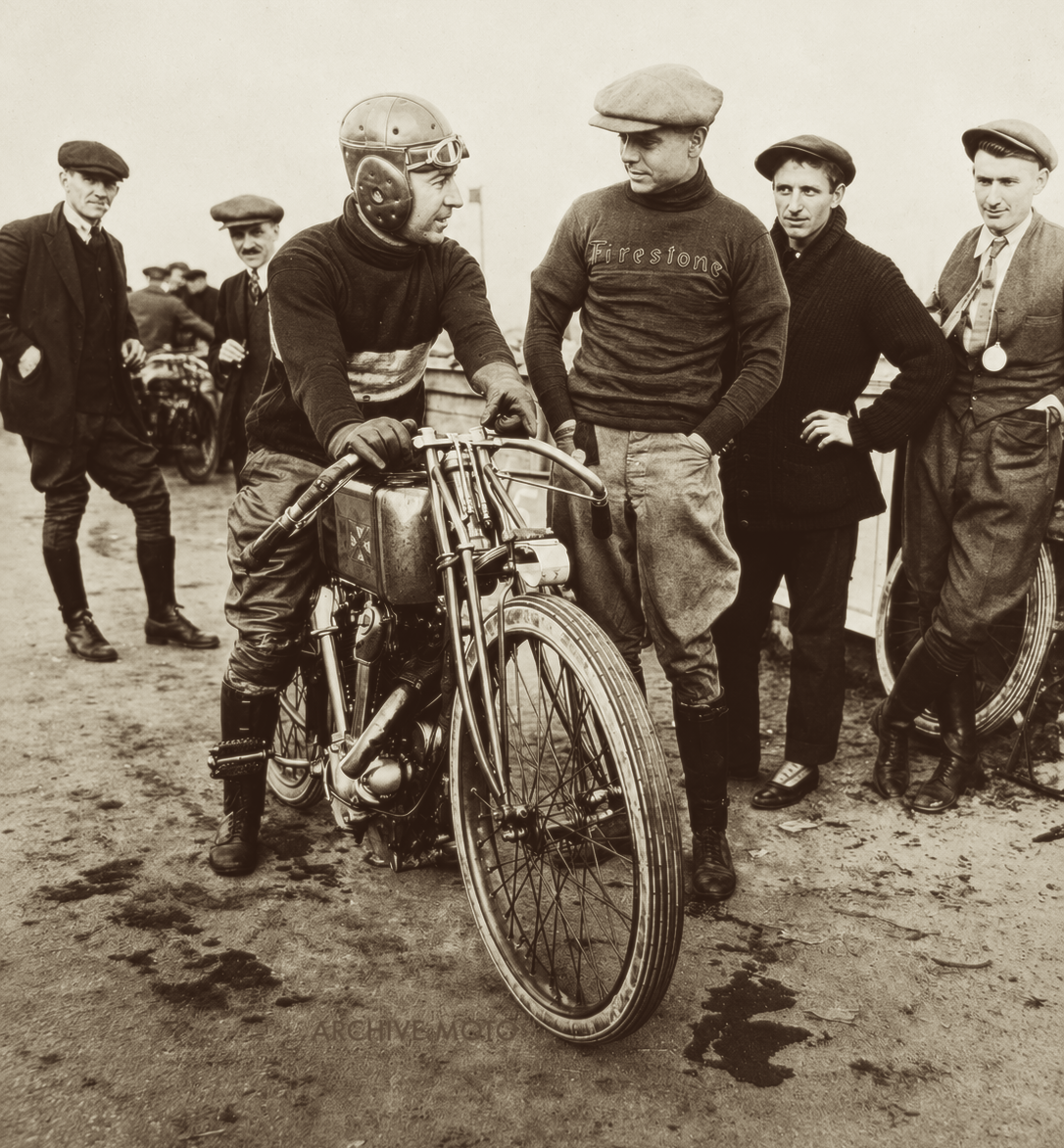
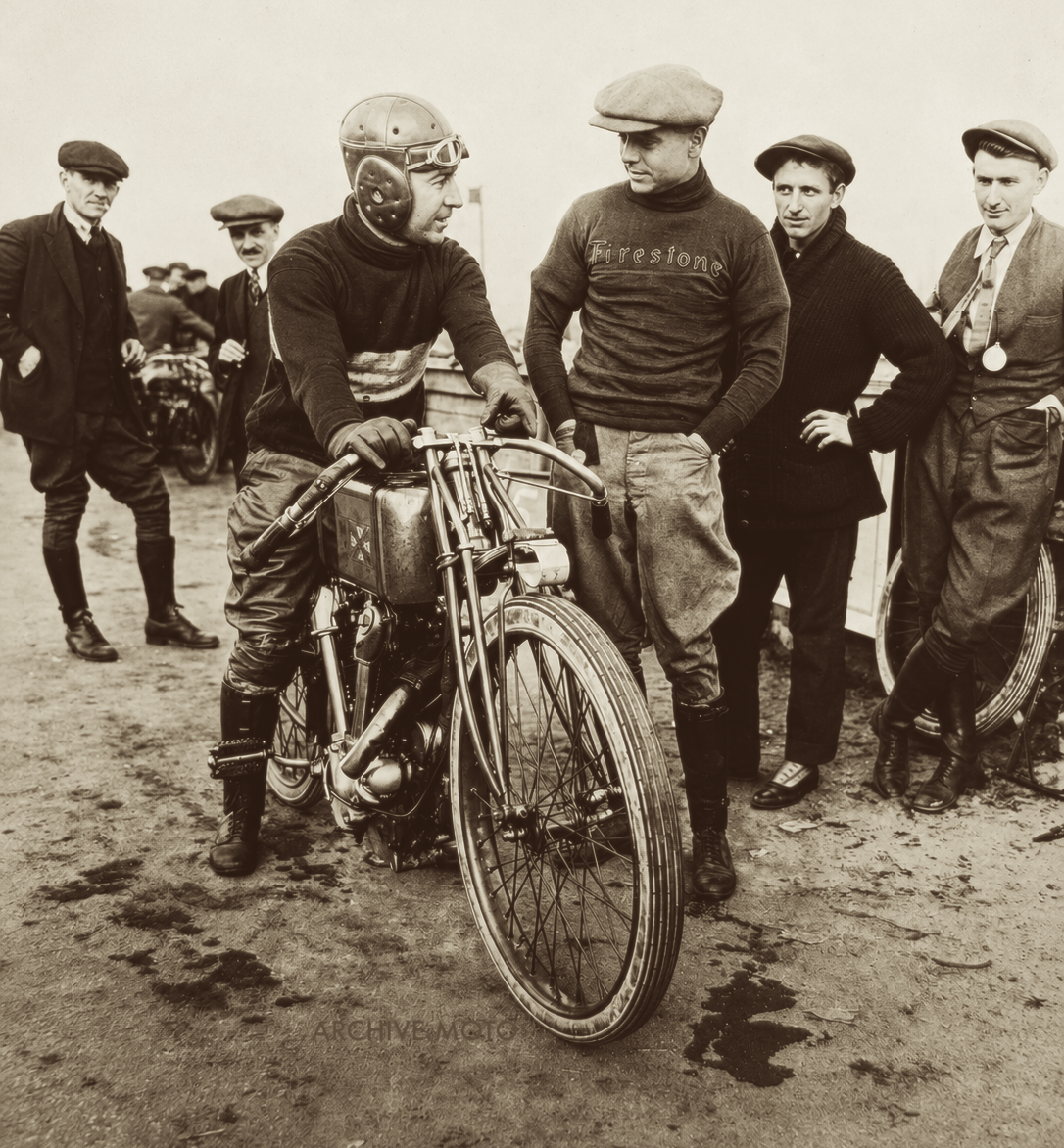
“Farmer” Joe Wolters onboard one of six, highly specialized Overhead-Cam Excelsiors before the 25-mile M&ATA National Championships at Los Angeles’ Ascot Park on January 11, 1920. Just one week prior, his teammate, beloved racer and engineer Bob Perry tragically died on another OHC X at the same track during qualifying for the 100-mile event.
When this brief autobiography of Joe Wolters appeared in the spring of 1920, the racing season had already begun under tragic circumstances for Wolters and the Excelsior factory team. On January 2, teammate Bob Perry was killed while running at full clip during qualifying at Los Angeles’ Ascot Park for the upcoming 100-Mile National, crashing aboard the formidable overhead-cam Excelsior he had helped develop.
For Wolters, Perry’s accident came late in a career that had already spanned nearly the entire history of American motorcycle racing, Wolters himself having survived multiple crashes that could have easily ended the same as Perry’s, and though he was back in the saddle one week later, retirement was drawing closer to focus. “Farmer Joe,” as he was known, was one of the sport’s founding fathers; prolific, decorated and profoundly influential during an era when motorcycle competition evolved from improvised local contests to the sensational board track motordromes, massive wooden speedways and increasingly sophisticated factory racing programs. His autobiography touches on only a few highlights, but Wolters’ fingerprints appear across most moments and milestones of the sport’s formative years.
Denver’s Joe Wolters with hometown brand Apache, built by the Brown and Beck Company in full racing spec for 1907.
His racing career began in 1906, when he competed in one of Denver’s earliest motorcycle contests. As the sport grew, so did Wolters’ reputation. He helped develop the Excelsior 7, one of the first serious challengers to Oscar Hedstrom’s dominant stable of racing Indians, and became a fixture during the rise of professional motorcycle competition.
Wolters was among the pioneers of board track motordrome racing, going elbow to elbow with some of the most fearless men in the country on steeply banked wooden tracks. He also survived some of the era’s most severe accidents, an accomplishment in itself during a period when high-speed board-track racing regularly claimed the lives of those daring enough to compete.
Harley-Davidson’s William Ottaway handpicked the country’s finest riders in early 1915 to help launch the Motor Co.’s first factory racing program. Here, Leslie Parkhurst, Ottaway’s first hire and Joe Wolters, who raced and worked with Parkhurst back in Denver, test the latest 11KR and 11KT factory racers prior to the start of the 1915 season.
As the sport transitioned into the larger board-track speedway era, Wolters followed. He held National Championship titles between 1911 and 1915 and, when Harley-Davidson finally entered organized factory racing in earnest in 1914, became one of the early recruits to William Ottaway’s formidable Milwaukee factory effort.
By the outbreak of World War I, Wolters was already an elder statesman of the racing fraternity, with more than a decade of competition behind him. During the wartime interruption he curiously worked as a figure skater while, another life-long passion while continuing to experiment with motorcycle design, eventually returning to Excelsior and becoming involved with the company’s new overhead-cam racing machines developed by J.A. McNeil and Bob Perry.
It was one of those machines that Wolters was riding when this photograph was taken at Ascot Park on January 11, 1920. Just over a week earlier, Perry had suffered his fatal qualifying accident aboard a similar OHC Excelsior. Wolters, Perry, Wells Bennett and McNeil had been entered as part of the Excelsior effort, but following Perry’s death the team withdrew from the 100-mile race.
Wells Bennett, Bob Perry, J.A. McNeil, and Joe Wotlers and a OHC X at Ascot Park, January 2, 1920, shortly before Perry’s fatal accident during qualifying for the 100-mile National.
McNeil, Bennett and Wolters returned to Ascot the following week for the 25- and 50-mile National Championship races. McNeil produced the team’s best result with a fourth-place finish in the 25-mile event, while Wolters narrowly escaped another serious accident. Coming down the final straight, he narrowly avoided the burning wreckage of Indian rider Bill Church, who’s thrown tire resulted in a fiery crash right in front of Wolters, who then laid down his OHC X and tumbled for a hundred yards, though he escaped without injury. True to his reputation as one particularly tough S.O.B., Wolters returned for the 50-mile event, though his OHC mount was barred from running and he was forced to retire on the 44th lap when his older Excelsior Big Valve ran out of fuel.
The following autobiography was published in Motorcycle and Bicycle Illustrated on April 15, 1920, and captured Wolters at an unusual moment: still an active factory racer, but already looking back across a career that reached almost to the beginning of the sport itself. The following year, after approximately 15 years of competition, he finally retired from professional motorcycle racing.
Wolters exited along with many of racings old guard in the early 1920s but remained in the culture long after leaving the track, holding positions that included work as an engineer for Schwinn bicycles, a tester for General Motors, and continuing to devote himself to his other longtime passion, figure skating, both as a competitor and instructor. Eventually retiring to Tucson, Arizona, Joe Wolters died on May 10, 1964, one of the very few founders of the sport to survive its often violent growing pangs and a man who embodied the spirit of an American motorcycling icon.
“LITTLE JOURNEYS INTO THE LIVES OF THE MOTORCYCLE RACING MEN”
Joe Wolters
Motorcycle and Bicycle Illustrated April 15, 1920
“The first experience I ever had with motorcycles was back in 1905 when walking down 15th street in Denver. I met a fellow who was having a lot of trouble with his machine, an old Armac, minus a carburetor with a surface feed vaporizing system that required a red hot bolt pushed into the intake manifold and a good fast push down a hill to get it started. It was a great machine. After talking with him for a while, I asked if he wanted to sell it, to which he replied “yes." He wanted $125 for it, but I "talked" him down to $100 an so we closed the deal at this figure.
The next day being Sunday, I decided to take a trip on my new mount, so picked out Play Canyon, a place about 20 miles from Denver. It was a great ride, but the darned thing fell apart and I was forced to stop and rivet the flywheel back on the shaft with the aid of cobble stones. Not long after this experience some of the Denver dealers got together and decided to hold a race, from Denver to Brighton, a distance of 25 miles. The fellows kidded me about the race and told me I had a fine chance to win so I decided to enter and on Labor Day, 1906, with 18 other entries, I faced my first starter pistol. It was some race astride my mount that had an oil capacity of ten miles, but with a flask of oil in my hip pocket, an extra shoe string for a belt, and a derby hat for a helmet, I finished ninth, the spent two hours convincing the judges I had not cut the circuit short.
Wolters and his pre-Schwinn Excelsior Auto-Cycle special which he converted to chain-drive.
The next year I changed my mount and rode in the only race that was staged in the vicinity of Denver. I rode well in this race which put me in good with the dealers. It was about this time that the first ported machine put in an appearance so I changed again to the Apache, a machine made in Denver. The first event I entered with this machine was a ten-mile handicap. I won and established what was then the record for ten miles on an oval dirt track. The following year I rode well, so the Excelsior dealer engaged me to ride the Chicago-built Excelsior. My first Excelsior mount was a single ported belt drive machine that was good for a mile a minute, until the belt became oily and slippery, and then it was good for nothing. This feature did not appeal to me, so after considerable argument I succeeded in changing it to a chain drive, and was able to do eight seconds better than with a belt.
This was the first chain drive "X" to make its appearance and was capable of doing a mile in 52 seconds. Next came the board tracks, two of which were put up, one at White City and the other at Tuilleries, Denver. Up to this time I had never ridden a saucer track, but am none the worse for my experience. The most serious accident happened when Fleckenstein removed all his spokes on part of my machine, but the fall was not serious. I cleaned up all six races on the card.
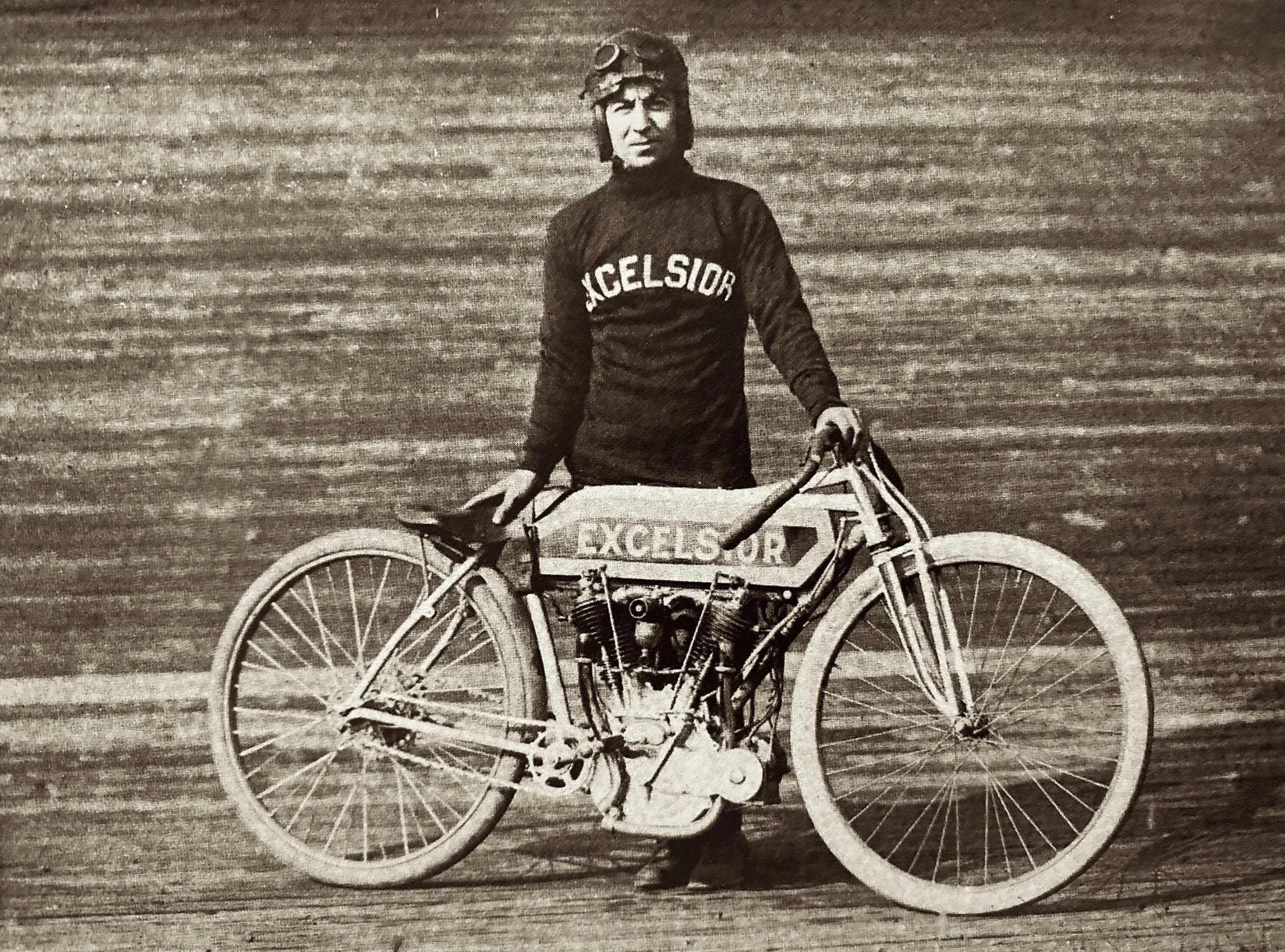
The first Excelsior 7, designed in-part with Wolters’ help following the increased resources brought to the brand by Ignaz Schwinn at Chicago’s Riverview motordrome, 1911.
The next day the other saucer opened, and I won the five-mile Colorado championship. There was a considerable amount of dissatisfaction on this track, and, after the manager presented me with an unfair contract, we mixed fists and I went over to Tuilleries. Things here were not altogether to my liking, because the managers owned most of the machines and they wanted to have their own machines win. Finally, becoming disgusted, I boarded a train for Chicago, where the Riverview Motordrome was under construction. I arrived in the Windy City June, 1911, and went to the Chicago factory and persuaded them to build me a seven-horsepower twin, and with this I cleaned up some firsts and many seconds on my first night's riding. In the meantime the factory had built another machine, and with this I cleaned up most everything for the rest of the season. At the close of the Riverview Motordrome in October, I went back to Denver and rode for two weeks, until the track closed, then I went to Sacramento, California. At the California State Fair I cleaned up everything, made the one-mile dirt track in 49 3/5 seconds, thereby breaking the track record.
Wolters on Taco Tuesday following one of his many close calls.
During my riding career I have had many falls and narrow escapes. When riding in a race at San Jose, Cal., my ground wire broke and I lost control of my machine. Realizing that I was going to hit the fence, I slid from my machine and escaped with a few scars and bruises. During the same season, I was riding at Oakland track and, as an added feature, Lincoln Beachy flew his airplane over the track while the meet was in progress. in those days airplanes were not reliable, and Beachy was forced to make a hurried landing on the edge of the track. Ray Seymour and I were engaged in a race and doing about 85 to 90 miles per hour. Seymour was on the outside and had time to clear the plane, but I could not. Straight through the wings of the plane I went, the propeller striking the handlebar, and at the same time something struck my head which put me out for a long time.
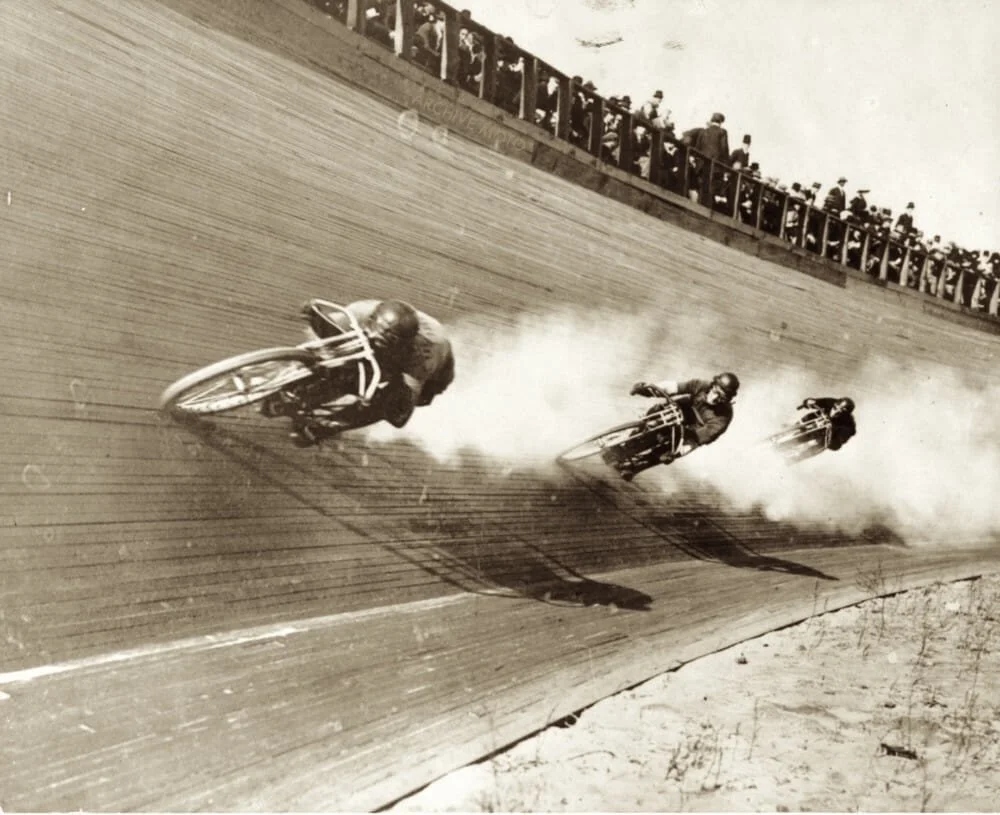
Wolters leading Jacob DeRosier and Charlie Balke at the LA Stadium Motordrome, 1912.
A week later I was riding the same track, the had become slippery and greasy from the automobile races. Just as I was within 100 feet of the finish, my machine skidded from under me and I finished the rest of the distance sliding, my back gathering up a few splinters, but nevertheless sliding into first place. Immediately after this race I left for Los Angeles where, the next day, I gave a five-mile exhibition. I stayed on the coast the balance of the winter, and with the reopening of Riverview track came back to Chicago, where I was very successful the remainder of the year.
Wolters and his 11K during his debut season with the newly formed Harley-Davidson factory racing program at the massive board track speedway at Maywood in Chicago, September, 1915.
The year of 1913 was a hard one for every league rider, but, nevertheless, with good luck I came through without any serious mishaps. At Sioux City, early in the fall, during the 250-mile sweepstakes, I showed the way for the first 150 miles and opened up a lead of 12 miles win the next man, which later came in handy, when I had to stop and adjust my compensating sprocket. I was a quarter of a mile behind Klack, who had assumed the lead, but found that my sprocket still threatened trouble when I pushed my machine too hard, so I accepted pace from Klack for the last three miles of the distance and only opened up the machine in time to beat Klack over the tape. The next season I was extremely successful, winning first place at Grand Rapids. I also rode at Dodge City and Detroit. During the war I did figure skating in the winter and spent the summer at my summer home. At the close of the war I returned to the Excelsior factory. The first race that I entered in this year was at Ascot, but I expect to enter many more before I am through.
Farmer Joe Wolters and his Excelsior OHC special on January 11, 1920 during the M&ATA National Championship races at Ascot Park in LA.