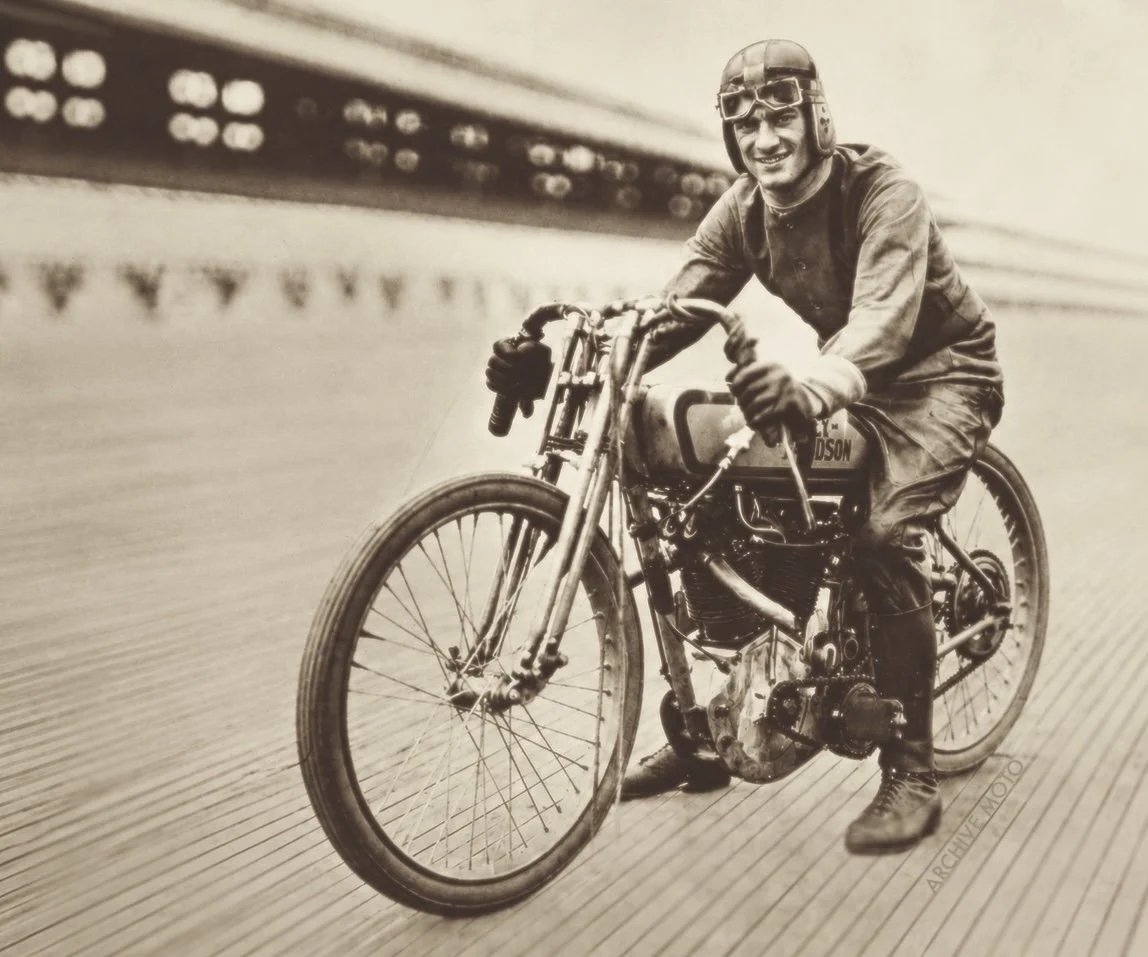
Leslie “Red” Parkhurst and his new Harley-Davidson factory 8-Valve racer on the boards of the Sheepshead Bay board track speedway on July 4, 1916.
One hundred and ten years ago, in 1916, as America celebrated its 140th Anniversary, Harley-Davidson was busy building momentum as one of the world’s best motorcycle brands. Leading the charge was the Bar and Shield’s first racing star, Leslie “Red” Parkhurst, who spent the day sending shivers through the grandstands in Brooklyn, New York, with his blistering speed. Running one of Harley-Davidson’s first overhead-valve factory racing machines, Parkhurst thrilled the crowd of 18,000 at speeds well in excess of 90 mph at the massive 2-mile-long board track super speedway at Sheepshead Bay. His efforts earned him both the 2-mile FAM National Championship and the title in the 100-mile race and set a new 50-mile record. Legend goes that the lanky 6-foot-4-inch “Red,” who was so named after his fiery hair color, began racing ponies against local Native American kids when he was a boy in South Dakota before throwing his long leg over a motorcycle in 1909 at just 13 years old. Harley brought him on board in April 1914, just as the Motor Co. began experimenting with a factory racing program under the direction of the brilliant William Ottaway. By the time Red let loose on the boards at Sheepshead Bay two years later, he had become one of the most beloved racers in the country and one of the cornerstones of a new and dominant Harley-Davidson racing team.
On Independence Day, 1916, Parkhurst rode one of Ottaway’s latest creations, a first-generation 8-Valve racer set into a new keystone frame, which Parkhurst himself helped debut a few weeks prior in Detroit. With the wrinkles ironed out from those first runs, Red quickly claimed the 2-mile National Championship in front of a crowd of over 18,000, making the single lap around the wooden oval in 1 minute, 19 seconds, a speed of 91 mph. When it was time for the race of the day, a 100-mile, 50-lap, all-out battle, the crowd stood on its toes as Red blasted around the track. Only 20 miles in, he had already lapped the field, and by the 50th mile, he had opened up a 4-mile lead, having lapped the field at least twice. It was also on the 50th mile that he broke the existing record set by teammate Harry “Otto” Walker by 1 minute, 40 seconds. Reports say that if it weren’t for an unexpected pit stop to replace a blown plug on the 66th mile, he would have knocked out the 100-mile record as well. Nonetheless, he crossed the finish line in just over 68 minutes, at an average speed of 88 mph, on wooden strips, wearing a leather cap and a wool sweater, 100 years ago today.
Parkhurst was joined that day in Brooklyn by teammate Bill Brier, one of Bill Ottaway’s go-to engineers/machinists at Thor, an avid racer who joined the factory racing effort in Milwaukee in September 1914, as Ottaway first began testing his 10K and 11K prototypes. Brier piloted another 8-Valve to a 90 mph victory in the 10-mile FAM professional race, as well as 2nd place behind Parkhurst in the 100-mile, and 3rd in the 2-mile National Championship. Brier and Parkhurst were the toast at Sheepshead Bay, but not the only victors to hail from Milwaukee that July 4th. Having full confidence in his vets in Brooklyn, Ottaway accompanied a team of 7 to the big 300-mile race in Dodge City, looking to repeat the utter decimation they had unleashed the year prior after closing out 6 of the top 7 spots. Fifteen hundred miles away, in the dusty heat of Dodge City, Kansas, Irving Janke jockeyed one of Ottaway’s new 8-valve racers to victory, running at an average speed of 80 MPH for nearly 4 hours to win the country’s biggest motorcycle road race of the year, his teammate Ray Weishaar closely behind in 3rd. Harley-Davidson had made it abundantly clear since their debut at the end of 1914 that they were to be the team to beat, and though a looming war was on the horizon, which would interrupt professional racing in America, a legacy that would last a century had been born.