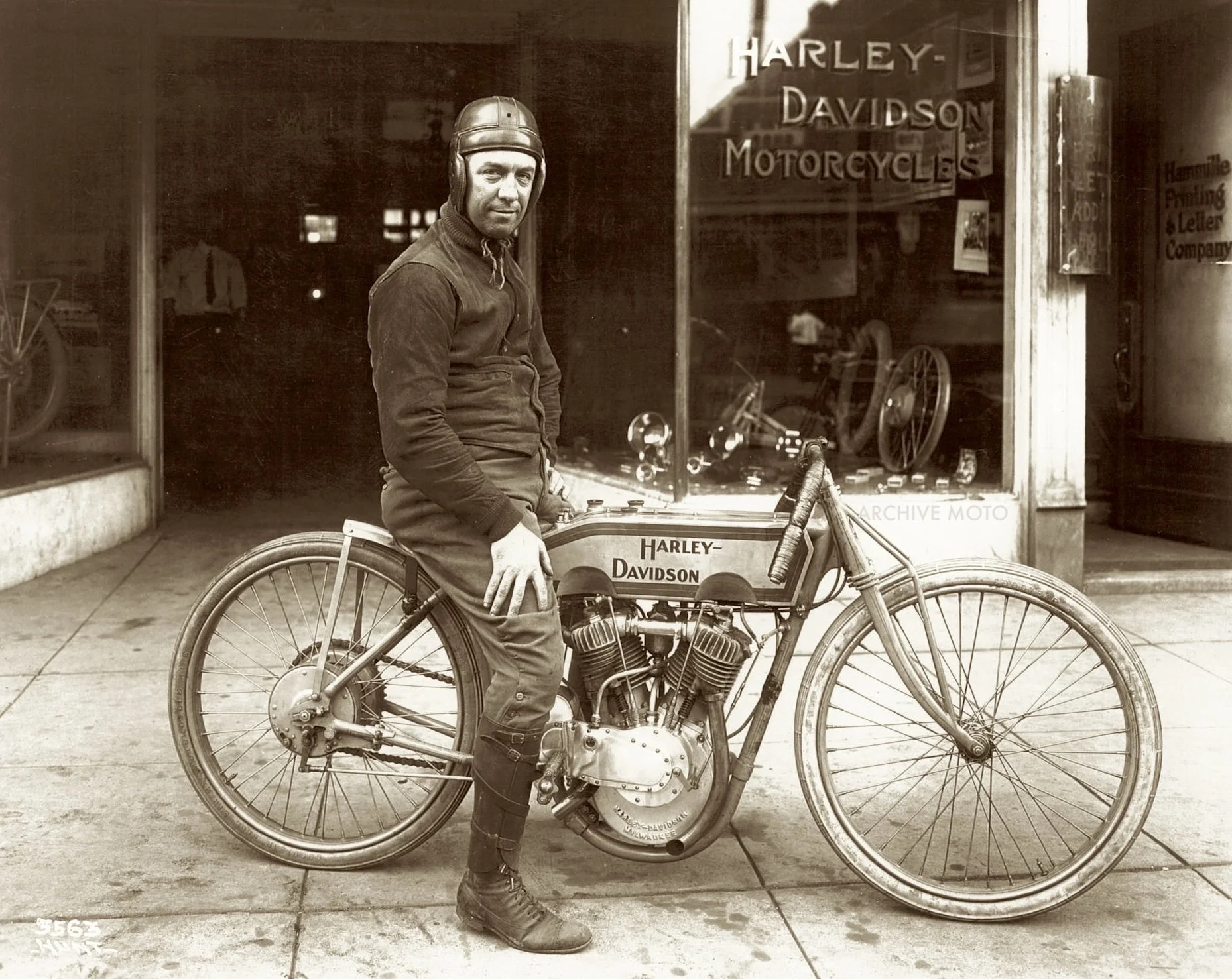
New Orleans native and pioneer American motorcycle racer Arthur Mitchel onboard a brand new Harley-Davidson 11K factory racing prototype outside William Specht’s dealership in Birmingham, Alabama, October, 1914. The 11K was sent by the Motor Company’s William Ottaway with Red Parkhurst who was in town competing in the F.A.M.’s One-hour National Championship race.
The Bulldog
Pioneer American motorcycle racer Arthur Joseph Mitchel Jr. was a tenacious sportsman at the turn of the 20th century whose fearlessness and resilience had earned him the nickname “The Bulldog” even before the first board track went up. A native of New Orleans, Louisiana, Mitchel was born April 19, 1881, and began racing bicycles as a teenager in the late 1890s, joining the ranks of professional cyclists by the first years of the new century. Like so many of his generation, he found himself at the crossroads between pedals and engines when America’s cycling craze gave birth to the motorcycle, first cutting his teeth on the motorized pacing machines that had begun to captivate the cycling crowd.
Even Mitchel’s name has been muddled by history. “Mitchell,” with two Ls, appears throughout newspapers, race reports, and even later histories, but the single-L spelling was no accident. In 1911, Bicycling World went so far as to print a correction after an advertisement mangled his name, pointedly reminding readers that “Mitchel” was the proper spelling for a man by then familiar throughout the trade.
Perhaps acquaintances of Mitchel’s during his Northeastern start, Allen Reid on his Orient takes a second to glance back at William Cornwell on his Indian nipping at his heels at Weequahic Park, New Jersey, December 10th, 1904.
By 1905, Mitchel had relocated to Newark, New Jersey, then seated firmly in the cradle of American cycle racing and the emerging motorcycle industry. There, he split his time between working as a salesman and competing at regional tracks. Cycle races still took place on dirt ovals and wooden velodromes, the latter the more professional venues where motor-pacing machines quickly gave way to motor-only exhibitions and some of America’s earliest motorcycle races. While bicycle stars turned entrepreneurs like Oscar Hedstrom, Joseph Merkel and Glenn Curtiss moved from the track to the workshop to develop motorcycles of their own, riders such as Jacob DeRosier, Fred C. Hoyt, Carl Ruden and A.G. Chapple were among the first to climb aboard the increasingly capable motor-pacers. Mitchel followed them into the new game, with later accounts placing his first motorcycle competition in 1905.
The paper trail around Mitchel during these years is every bit as complicated as the sport itself. In the 1905 Newark census, he listed himself as single despite having married Marie Lydia Livaudais in 1900 and fathering their daughter, Addie Marie, the following year. In 1904, Elizabeth “Bessie” Lovelace of Newark gave birth to another of Mitchel’s daughters, Helen Isabell. No clear record of the first marriage's termination has surfaced yet, though Mitchel and Bessie married in 1907. His domestic life would ultimately prove almost as restless as his racing career: four marriages, seven children, one divorce and the deaths of two wives would follow him through the decades.
For a moment it appeared the Northeast had soured on him altogether. An October 1905 trade report claimed that Mitchel, frustrated by poor fortune and what he called the tricks of the “Yankee” racing scene, had returned south to establish the Mitchel Cycle Co. at 1430 Canal Street in New Orleans. Yet little evidence suggests the venture became a lasting concern. Instead, Mitchel kept appearing in northeastern racing circles, working as a salesman and increasingly sharing tracks with Jacob DeRosier, the ferocious former cyclist who had become one of Indian’s first true racing stars. That put Mitchel in the right place as professional motorcycle racing began transforming almost overnight.
A rare glimpse into the board track a Clifton, modern-day Patterson, New Jersey during one of the first motorcycle only races.
In the summer of 1908, British cycling pioneer and velodrome builder Jack Prince completed a new wooden track at Clifton, New Jersey, wider and somewhat more substantial than the traditional bicycle track and designed with increasingly fast motorcycles in mind. At an F.A.M.-sanctioned meet that July, riders Walter Goerke, A.G. Chapple, Fred Huyck and Charles Gustafson mixed it up on the boards, while DeRosier electrified the crowd with a prototype Indian prepared for the new style of banked-track competition. It was one of the moments when the old bicycle racing world visibly became something new, and Arthur Mitchel was there for the transition.
By that fall he was racing an Indian at Clifton and being advertised as one of DeRosier’s principal rivals. His daring, skill, and performances caught the attention of the American interests behind German manufacturer N.S.U., then trying to establish the marque in the United States through competition. In late 1908, Mitchel signed a deal with N.S.U. via their New York distributor in preparation for his upcoming trip out west. Prince, meanwhile, had seen enough in New Jersey to justify his next grandiose idea and headed west in January 1909 to build something more audacious in Los Angeles: a board track expressly suited to motorcycles.
Leaving a heavily pregnant Bessie behind in Newark, Mitchell boarded a train bound for California in February; his son, Arthur Adelbert Mitchel, was born back in Newark shortly after on March 3. The timing could hardly have been more dramatic. On February 28, the Los Angeles Herald announced Mitchel’s arrival under the heading “Champion Southern Professional,” describing him as DeRosier’s “most formidable rival” and reporting his warning that the Indian star had better be ready for 40-second miles if he hoped to hold onto his records.
Morty Graves and Arthur Mitchel with their N.S.U. twins in Los Angeles, 1908
Waiting for Mitchel was another rising star, teenage Californian Morty Graves, who had joined the N.S.U. effort along with a pair of gleaming white 61 CI V-twin racing machines unlike most anything then appearing on American tracks. Prince’s new Los Angeles Coliseum was unlike anything American riders had seen: a 2/7-mile wooden oval with 48-degree banking at each end, built to allow extraordinary speeds. During early March practices, Mitchel and Graves reportedly pushed their cumbersome German twins to 75 mph while men like Paul “Daredevil” Derkum, DeRosier, Fred Huyck, and Charlie Balke watched from the rail. On March 14, 1909, the Coliseum opened to the public and the age of the American motordrome was underway.
As manufacturers still experimented with belt and chain drive assemblies, the big N.S.U. carried an almost comical-looking 3.5-inch belt drive and a pulley reportedly more than five inches wide. Graves later recalled that the arrangement gave the machine an unexpected trick. Leaning deeply into the steep banking, the enormous pulley could contact the wooden surface and support the motorcycle at an angle that would send a more conventional machine sliding down the track. The technique destroyed belts in short order, but for a few furious laps it gave the N.S.U. riders a spectacular advantage. Contemporary recollections of Graves confirm that he intentionally rode against the belt in the turns to gain additional traction, though looking back today one wonders if that was just a bit of marketing.
Mitchel, however, needed no gimmick to attract attention. A Los Angeles Herald description captured the image that would follow him through history: he possessed “all of the appearance of a bulldog and the grit of a man who knows no fear.” The nickname fit. Thick-set, square-jawed and already a veteran compared with many of the teenagers flooding into professional racing, Mitchel looked less like a jockey and more like a man prepared to wrestle his motorcycle into submission.
For the rest of 1909, he established himself as one of the first recognizable class of professional American motorcycle racers. He ran elbow-to-elbow with DeRosier, Derkum, Graves, Balke and the West Coast regulars at the Coliseum, Fiesta Park and other regional tracks, competing primarily for N.S.U. while occasionally turning up aboard Indian, Merkel, Reading-Standard and Thor. Still, unlike DeRosier, Mitchel was seldom the man who completely owned a meet. Still, he was persistently there, in the money, on the podium, and making for an honest day’s work for whichever factory star happened to line up beside him.
Mitchel and his new Merkel mount, Los Angeles, 1911.
In 1910, Mitchel left behind the ungainly N.S.U. and appeared aboard Indians for a short time before joining the Merkel squad, racing in Los Angeles through the spring before the Coliseum's seasonal closure sent many riders north and east. That July he joined the all-star field assembled for Jack Prince’s new Wandamere Motordrome in Salt Lake City, a one-third-mile wooden bowl with continuous 42-degree banking and arc lights for nighttime racing. Nearly 10,000 spectators packed the opening program to watch DeRosier, Ray Seymour, Charlie Balke, Mitchel, Lon Claflin, Fred Whittler, and the Samuelson brothers try the new saucer. On July 2, Mitchel produced one of the most important victories of his career, winning Wandamere’s inaugural 50-mile handicap feature and besting a field that included DeRosier. From Utah, he followed the circuit into Denver, where competition at the Tuileries amusement park dirt track mixed local heroes with the traveling professionals. Riding a 7 HP Merkel, Mitchel lowered the 10-mile mark and defeated Denver favorite Erle Armstrong in a three-mile free-for-all. In October he went south to Birmingham, Alabama, for nearly a week of racing against another of the South’s original stars, Robert Stubbs. Over the course of a week, Stubbs and Mitchel traded wins to the elite of the southern crowd. By then, Birmingham was emerging as one of Mitchel’s most important homes away from home. He returned briefly to Los Angeles late in the year, where Bessie gave birth to their daughter Eleanore Clara on December 20.
He began 1911 with his business interests increasingly tied to the South, though a bit farther west, serving as sales manager for the Texas Motorcycle Company in Dallas while continuing to earn his living on the racing circuit. In Dallas, Mitchel kept duking it out with Indian’s Robert Stubbs, as well as local racing favorites like Fred Luther, Wilmer Richards, and an aspiring young racer named Edward Hasha. Mitchel and the teenage Eddie Hasha squared off a time or two in late 1910, in both Birmingham and New Orleans, but as Hasha’s star rose, Mitchel became his veteran mentor. By spring, he was back on the road, competing at Denver’s Tuileries new board track motordrome alongside Hasha, appearing at the Springfield saucer around Memorial Day, and returning to Salt Lake before traveling to one of the year's largest gatherings: the F.A.M. National Championships at Fort Erie, Ontario, in July.
By this point in the sport's development, the National Championships were becoming an important event for the professional class, and anyone worth their salt was quickly signed on by one of the major factory programs. Mitchel joined A.G. Chapple, William Teubner, Morty Graves and the rest of a formidable seven-man Merkel squad assembled to take on Indian’s overwhelming factory force. Indian collected most of the weekend’s honors, but Mitchel took third in the 15-mile professional while his teammates marked up 7 additional podium finishes, including his old N.S.U. pal Morty Graves, who won the 5-mile professional national championship title. Though Indian’s factory effort in 1911 was in top form, Mitchel’s place on the Merkel roster shows he was on the short list when a manufacturer wanted experienced professionals for one of the country's most important meets.
A.G. Chapple, Morty Graves, and Arthur Mitchel, signature cigar in hand showing off his Flying Merkel special, Chicago, 1911.
After the Fort Erie races, Mitchel spent time at Chicago’s Riverview Stadium motordrome, where he enjoyed perhaps the finest sustained stretch of his professional career. Through late August he became a fixture on Prince’s grand Riverview motordrome, primarily aboard the 7 HP Merkel twin. He chalked up victories against Charlie Balke in late July, traded wins with Excelsior’s ringer Joe Wolter and the rest of the field in the first days of August, lowered the five-mile record on August 9, and set a new one-mile mark at an average speed just over 85 mph. The timing of Mitchel’s streak was even more impressive as Joe Wolter was simultaneously debuting Excelsior’s fearsome new 7 HP factory twin, a machine that immediately began rearranging the record books. It was these events, racers, and machines that shifted the sport and industry as Wolter and the Excelsior 7 led to Indian severing its ties with its stars DeRosier and Balke, developing the mighty Big Base 8-Valve board track racer in response, and elevating the speed game to its frenzied pinnacle the following seasons. The young guns were getting younger, the motorcycles faster, and the factory programs more sophisticated.
Mitchel, now 30, belonged to the generation that had helped invent the sport they were inheriting. His versatility remained his greatest asset. Photographs from Riverview show him associated not only with Merkel but even astride a bizarre direct-drive Thor racing special, probably one of engineer Bill Ottaway’s experiments from his days with the Aurora Automatic Machine Company. As cold weather closed Chicago, the professionals headed south. Mitchel joined DeRosier, Hasha, Stubbs, and Balke at the Alabama State Fair in Birmingham, where the brilliant new Excelsior 7 and the younger riders proved difficult to overcome. The meet proved as contentious as it was fast. DeRosier battled persistent mechanical trouble while Balke collected the lion’s share of the victories, and tensions between the rival camps boiled over after the October 6 program when an exchange involving Stubbs’ wife, Barbara, and DeRosier reportedly led to a confrontation between the two riders at Birmingham’s Hillman Hotel. Stubbs was detained and fined $10 the following morning, while DeRosier, nursing a gash to his head, publicly charged that Stubbs and the referee were conspiring against the Excelsior men in what he called an “Indian town.”
The Bulldog in one of the most iconic photographs in American motorcycle history, looking dapper in his U.S. Tires jersey and his Flying Merkel special taken by O.V. Hunt in Birmingham, October 1912.
The racing itself was hardly calmer. On October 7, a football player wandered onto the track during competition, forcing Balke to kill his engine to avoid him, and two days later Stubbs suffered a violent crash at roughly 70 mph when his rear tire burst, pitching him over the handlebars and leaving him with an eye injury serious enough to end his Birmingham campaign, and, as it turned out, effectively his head-to-head racing career. Rain interrupted the middle of the following week. Still, competition resumed with DeRosier and Balke setting records on October 12 before Hasha protested their Excelsiors after the October 13 25-mile race, prompting both machines to be torn down and measured that night. DeRosier answered by winning the 25-miler the following day, narrowly besting Mitchel in his best performance of the week. With Birmingham racing wrapped, Mitchel and DeRosier continued east toward Macon, Georgia, for the State Fair races, departing for the Farmers’ Day program on October 16. Rain and the arrival of a circus ultimately curtailed the Macon racing, another abrupt end to a particularly turbulent stretch of the southern racing circuit.
Back home in Birmingham, he and Bessie welcomed another child, Arthur J. Mitchel III, on January 10, 1912. Around the same time, the 30-year-old racer began a gradual retirement from full-time professional competition. Bicycling World announced that the former Merkel racer had accepted a position selling Excelsior bicycles and Chicago Cycle Supply Company goods throughout the Southern territory, a natural fit for someone whose career had already made him known to dealers and clubs from Los Angeles to New Jersey and Dallas to Chicago. “Retirement,” however, meant something different to a pioneer racer. The Billboard still listed Arthur Mitchell of New Orleans among the riders at Chicago’s Riverview Stadium in August 1912, entered aboard an Indian alongside Ray Seymour, Joe Wolters, Lee Humiston, William Samuelson, and others.
Mitchel in his referee attire, seen in the back behind an unidentified Indian rider, Excelsior’s Joe Wolter, and Gene Walker in front at the Alabama State Fair Races, October, 1914.
Though his racing career was winding down, Mitchel’s growing involvement with the Federation of American Motorcyclists became increasingly consequential. Years spent moving between local clubs, promoters, manufacturers, and race circuits gave him unusual credibility. He understood professional racers because he was one. He understood dealers because he sold motorcycles and bicycles for a living. And he understood the importance of local clubs because he had spent years among them. No fewer than a half-dozen clubs in the Southeast credit Mitchel with helping them organize or legitimize them while also serving increasingly as an F.A.M. representative and referee.
One such club, the Savannah Motorcycle Club, had never been particularly enthusiastic about taking orders from the F.A.M., and its habit of staging unsanctioned competition complicated efforts to hold a nationally recognized event on the city’s famous Grand Prize automobile course. Mitchel helped align the club before the first F.A.M. 300-Mile American Classic Championship there on December 27, 1913, and then served as referee for the race.
Thirty-six riders started for 27 laps on the 11.25-mile circuit. After nearly five and a half hours and 304 miles of racing, Excelsior’s Bob Perry crossed first, followed by Flying Merkel’s Maldwyn Jones and Thor rider Bert Camplejohn. When Atlanta’s Harry Glenn, friend and fellow motordrome racer, crossed in fifth, Mitchel called the grueling contest complete. However, Mitchel’s work wasn’t over, as a scoring dispute afterward cast doubt on whether Jones had actually completed the distance first, but after review, the official result stood. More important for Mitchel’s story, he had moved from racing inside the chaos to being trusted to control it. By 1914 he was widely recognized as the F.A.M.’s southern referee, yet he remained impossible to keep off a motorcycle.
Mitchel and Johnny D. Aikens poses onboard his 1914 Harley-Davidson Model 10F, muddy and satisfied, having just returned to downtown Birmingham with a perfect score for the second day in a row during the July 4th FAM Southern Championship Endurance Race of 1914.
In May, he and Bessie welcomed another daughter, Gilda McCoy, to their family, and by July he officiated the ambitious Southern Championship Endurance Run, the so-called Ledger Cup, which sent riders from Birmingham through north Alabama and Georgia to Atlanta and back over a punishing multi-day route. The event became embroiled in controversy when Harley-Davidson accused Indian of following its riders with mechanics and spare parts. Mitchel declined to uphold Harley’s protest, and the Milwaukee squad withdrew before the final stages. Both Indian and Harley subsequently ran advertisements touting their victory in the event, but by October Mitchel had a hankering to once again turn another lap or two.
At the time, Harley-Davidson was quietly transforming its attitude toward professional competition. Following a disastrous soft launch at the Dodge City race in July, 1914, Engineer William Ottaway had been developing a short-coupled, narrow-case 61 CI racer designated. Between August and October, the company distributed experimental prototypes to select dealers and veteran privateers to expose weaknesses before the Motor Company committed to a full factory campaign. Among the men entrusted with the prototypes were Bill Brier, Irving Janke, and Leslie “Red” Parkhurst. For the F.A.M. One-Hour Championship at the Alabama State Fairgrounds in Birmingham on October 5, Ottaway sent Red Parkhurst south with one of the latest prototype racers, dubbed the 11K.
Mitchel, perhaps inspired by the elegant new racer he was photographed on outside William Specht’s Harley dealership, decided to throw his leg over a machine for the event as well. He wasn't on any official team; instead, racing reports listed him as the Alabama referee and a privateer for the event. The main event belonged to Parkhurst. Young Birmingham Indian star Gene Walker took the lead in the opening laps, with Joe Wolters circulating on the Excelsior and Gail Joyce aboard Indian. Still, Parkhurst eventually forced the new Harley to the front and covered roughly 64 miles over the hour. Mitchel retired with engine trouble around the fifteenth mile. Parkhurst’s win was a crucial regional victory that convinced Harley-Davidson its new racer was ready. The following day, in the 5-mile stripped-stock contest, Parkhurst won again, while Mitchel brought another Harley home second, proving he still had plenty to offer in the dirt. Within weeks, Harley-Davidson committed to the Thanksgiving Day Savannah 300 with its first official factory racing team, Mitchel again acting as the official for the historic debut.
Mitchel onboard' Red Parkhurst’s new Harley-Davidosn 11K, perhaps the first photograph of the factory racing special which was taken in front of William Specht’s dealership in Birmingham, October 1914.
For the Bulldog, the Birmingham appearance was an almost perfect coda to his racing career. He started when motor pacers gave way to motorcycles, little more than reinforced bicycles. He had been at Clifton when wooden tracks first began accommodating motorcycles, and at Los Angeles when Prince’s first true motordrome opened. He raced N.S.U., Merkel, Indian, Thor, and now an embryonic Harley-Davidson factory racer. His friends included the greats DeRosier, Balke, Seymour, Hasha, Baker, and Wolter, among countless others. The motorcycles beneath him had evolved from primitive belt-drive singles into specialized competition pure breeds capable of sustained speeds that would have seemed absurd when he first climbed aboard. And still, there he was, one of the sport’s most recognizable regional ambassadors, mixing it up on occasion with the speed-addicted youth.
Meanwhile, his personal life entered a difficult chapter. On October 15, 1915, Bessie gave birth to their daughter Elizabeth Eunice before succumbing to complications, passing on November 20, 1915, baby Elizabeth only making it to July 1916. Just over a year after Bessie’s passing, on December 19, 1916, Mitchel started a new chapter and married for a third time, taking widow Sarah Adeline “Addie” Keith of Birmingham as his bride. By 1917, he was again earning his living on the road, reportedly serving as a southern representative for the Pierce line through Baltimore’s Henry Keidel Company. Whether that position involved motorcycles, bicycles, remaining Pierce inventory, or a combination of trade goods remains less clear from the surviving record. Still, it fit the pattern of Mitchel making his living around the industry that had grown up with him. His racing days, however, seemed behind him, and as the F.A.M. transitioned during the war years into the M.&A.T.A., Mitchel’s involvement in the culture seemed to fade as well. Tragically, in November of 1925, Sarah died in Birmingham, leaving Mitchel widowed for a second time. He packed his bags and relocated back to New Orleans, meeting and eventually marrying Laura Viola Verneuille by 1930, completing a complicated personal history that had ultimately included four marriages and seven children.
During that time, professional motorcycle racing moved through the factory wars, the great board tracks, Class A, and into a new era of Class C competition. As if mirroring his personal life, the sport waned through the 1920s, then experienced a renaissance in the mid-1930s, but by then Mitchel was in his 50s and in no condition to return. It is unknown how involved he remained in the sport or culture in his later years until April 8, 1946. Arthur Joseph Mitchel Jr. died in his home in New Orleans, eleven days shy of his 65th birthday.
Measured strictly by national championships, Mitchel will never stand above his friends and fellow pioneers DeRosier, Wolter, or Parkhurst, but that is the wrong measure of the man. His significance lies in the extraordinary amount of early American motorcycle history he passed through, the number of times he helped push it forward, and the young men he helped refine along the way, who themselves further defined the culture. Among the icons that molded the sport in its formative years, racers like Morty Graves, Eddie Hasha, Maldwyn Jones, and Eugene Walker all credit Mitchel as a key influence in their careers. Perhaps that is why the old description remains more revealing than any ledger of victories. Mitchel was like a bulldog in more than just his features; he raced like one, not always the fastest in the fight, but extraordinarily difficult to shake loose.