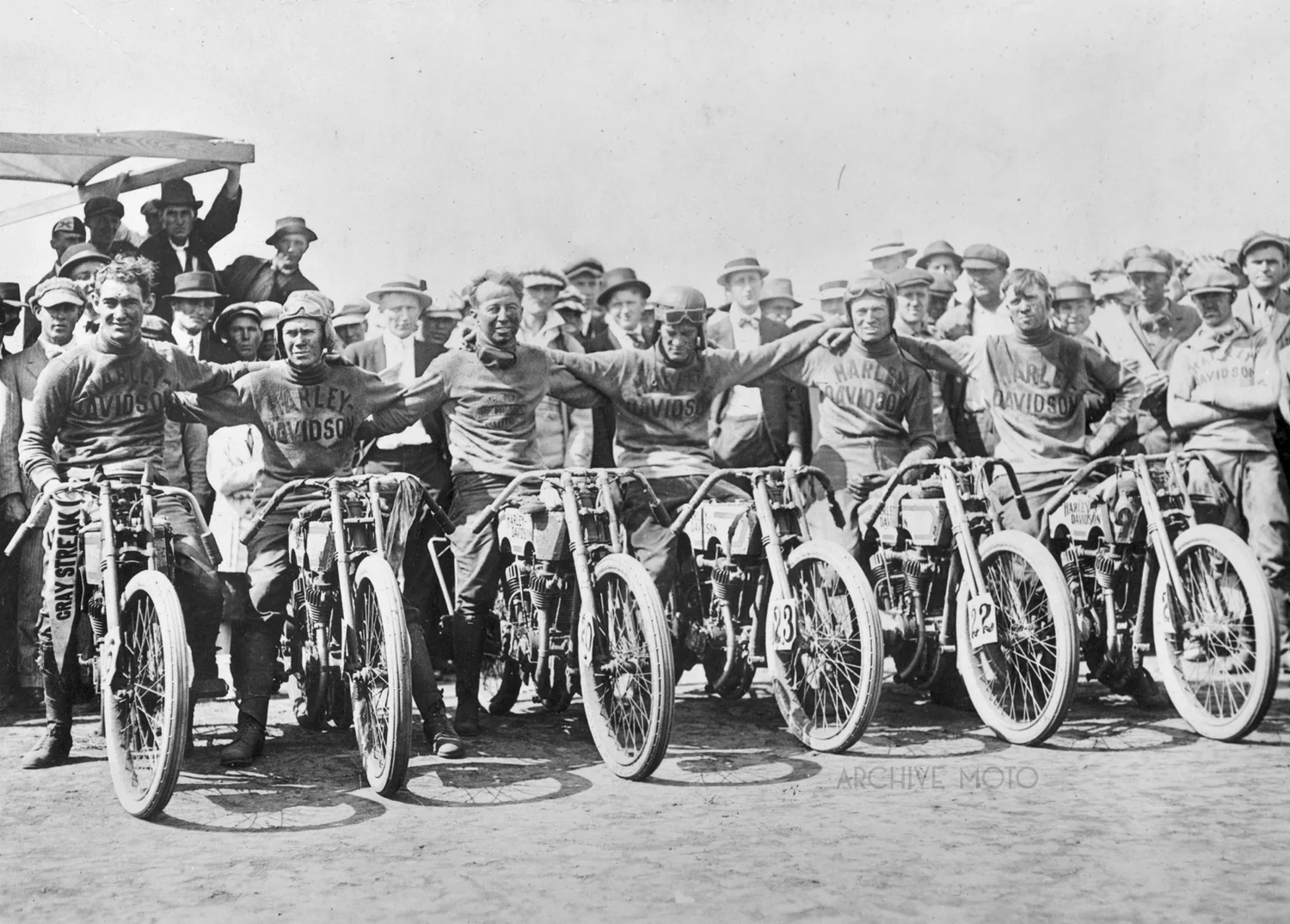
For too long, the life and accomplishments of Ray Seymour, one of America’s most successful pioneer motorcycle racers, have gone unacknowledged. Like so much of the remarkable history of American motorcycle racing, Seymour’s story has largely been lost over time. Perhaps it is because of his steady and reserved personality compared to his more bombastic and temperamental contemporaries like Jacob DeRosier or Charlie Balke. Maybe his avoidance of tragedies like those that cut short the lives of countless young racers, like his close friend and teammate Eddie Hasha, shielded him from a similar infamy. Unlike later generations of professional racers like Jim Davis and Joe Petrali, Seymour was among the first class of motorcycle racers, long since out of the game by the time the sport reached its height. Still, he was in his prime at the height of the infamous age of board track motordromes and excelled because of his skill, athleticism, and temperament, outliving many of his pioneering friends and conquering nearly every podium and record of his time.
Archive Moto, the little research project that began with Georgia Motorcycle History has grown yet again! I am excited to now be producing videos in a continued effort to preserve and share the remarkable history of American motorcycle culture. It is a new chapter for the project, supported by enthusiasts who have become members of the Archive Moto Patreon. Both the Patreon community and the Youtube channel are young but growing, and if you enjoy the articles, videos, and books, consider helping support the project by Subscribing to the channel, liking videos, and sharing them. If you would like to support this research and help keep quality content rolling out, considering joining the Archive Moto Patreon community for as little as $5.
Beyond that, the mission is to preserve and share this history, so the best thing you can do to help is simply enjoy reading and watching, and share what you like with the folks who’d like it too.
As it did around the globe, the Great Depression served as a grand a catalyst within American motorcycle culture. Both the sport and the industry were forced to adapt to the economic decline in and the changes spawned an entirely new culture. Indian and Harley further refined their smaller 45 cubic inch models, packing them with value, and leaning into a focus on design to weather the storm. With the addition of the American motorcycle Associations professional 45 class, both companies newest machines became American favorites. Still, the financial crisis marked the end of the road for Excelsior Motorcycles, one of America’s Big Three manufacturers who had been in business since 1908. Despite having found success on both the road and the track, including being one of Indian’s fiercest competitors in the golden age of the motordrome, Excelsior shuttered its doors in 1931, leaving Springfield and Milwaukee to duke it out for supremacy.
The early years of the roaring twenties represent the first high water mark in professional motorcycle racing. It was a period when sophisticated machines were let loose by men of true and unrelenting grit. In the previous decade, motorcycle racing had bloomed into several forums, and the spectacle enthralled the country. By the early 1920s, racers had kicked-up tails of dirt and dust on flat tracks, kept the enthusiasts breathless on the edge of the motordrome bleacher, and stretched the capabilities of iron and rubber on the colossal board track speedways to their limits. Still, by the latter half of the decade, the sport, as well as the industry, was in significant decline, and the high waters of the golden age of motorcycle racing began receding.