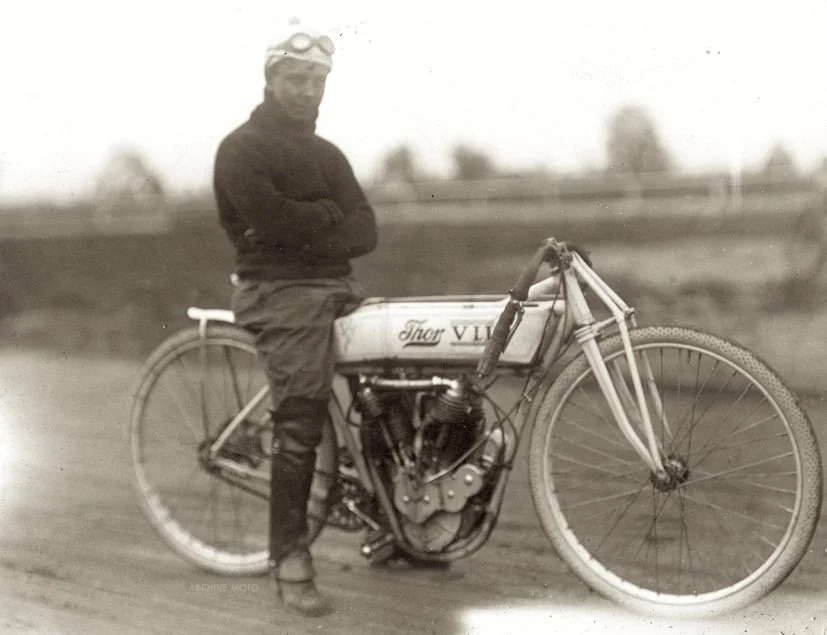
It is said that death rides a pale horse, but if you were racing motorcycles against a white Thor in around 1912, it wasn’t death but Shorty Matthews chasing you down. E. W. “Shorty” Matthews was a slight man, standing at only 5 feet tall and weighing in at around 110 pounds, his build was that of a Bull Terrier, and he was just as tenacious. Born outside of Denver just before the turn of the 20th century, Matthews made his way to California and began working as a mechanic before taking up motorcycle racing. He started running single-cylinder machines, most often made by Thor, around dirt tracks like L.A.’s Agriculture Park, but as soon as Jack Prince’s first board track motordrome, the Los Angeles Coliseum, opened, Matthews was on the line. With his small stature and steel nerve, Matthews took to the dirt and the boards equally well as one of the pioneers of the sport. Before long, his success captured the attention of the Aurora Automatic Machine and Tool Company, makers of the Thor brand, and Matthews began racing as a trade rider for the company in 1910.
Still a teenager in his first year of competition, Charlie Fearless Balke had experienced both the thrill of victory and the tragic potential of the perilous sport. His reputation at Agriculture Park had been firmly established. Even though the sport had only begun to take shape, the money he earned justified leaving his job at the Diamond Rubber Company to pursue life as one of America's original speed kings. Agriculture Park soon became a hotbed for racing in its earliest days, and riders across the country came to Los Angeles to compete. Charlie Balke, the scrappy and diminutive local sensation, was the man to beat.
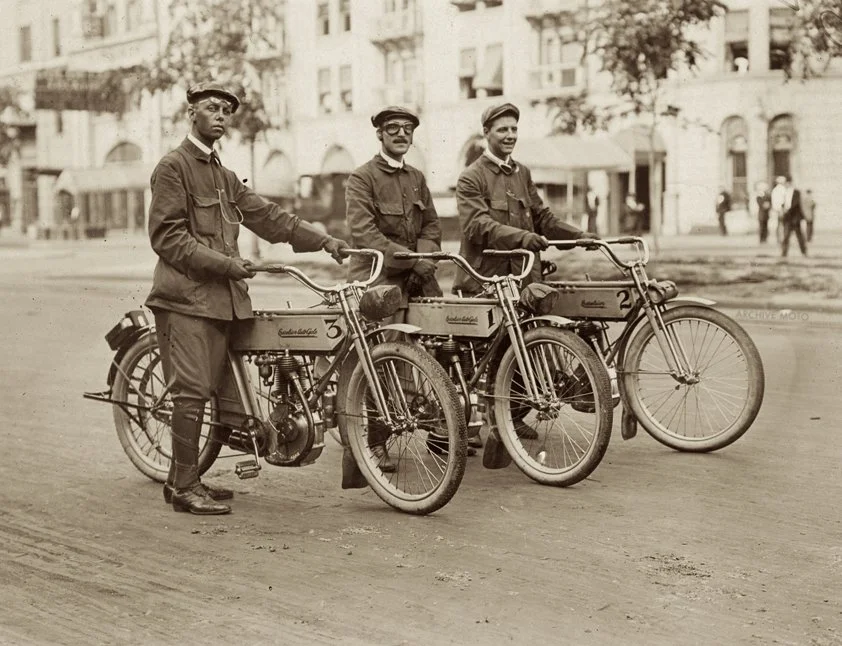
American motorcycling in 1908 was a whirlwind of excitement and opportunities. Throughout the country, new manufacturers flooded a hungry marketplace with ever-more capable machines. Motorcycling technology fueled an intensely competitive industry as novel features like coaster brakes, mechanical valves, multi-speed clutches, V-twin engines, and a loop frame chassis first emerged. The trade magazines overflowed with advertisements from budding companies, though most still focused on individual components rather than turnkey machines. Still, the earliest motorcycle manufacturers, brands like Light, Excelsior, and Thor, challenged the mighty Indian Motocycles, who dominated the industry seemingly from the start. In 1908 alone, Indian produced over 3,200 motorcycles, while other makers, like Milwaukee's Harley-Davidson, had yet to clear 500.
It was in May 1911 that Hedstrom's first "valve-in-head" racing special, commonly known now as the 8-Valve, debuted on the dirt tracks of the Northeastern circuit. Still, that August, Excelsior's new racer, the Big Valve 7, created in part with the expertise of the company's star rider Joe Wolters quickly challenged the perennially dominant Indian at the races. With Wolters in the saddle, the Excelsior 7 racked up victories, stealing record after record from Indian with its prowess on the timbers of America's motordromes. Hedstrom returned to his machine shop determined to return with a contender, and in November 1911, a new breed of 8-Valve, specifically engineered to lay waste to any who challenge debuted at the new saucer in Oakland, CA.