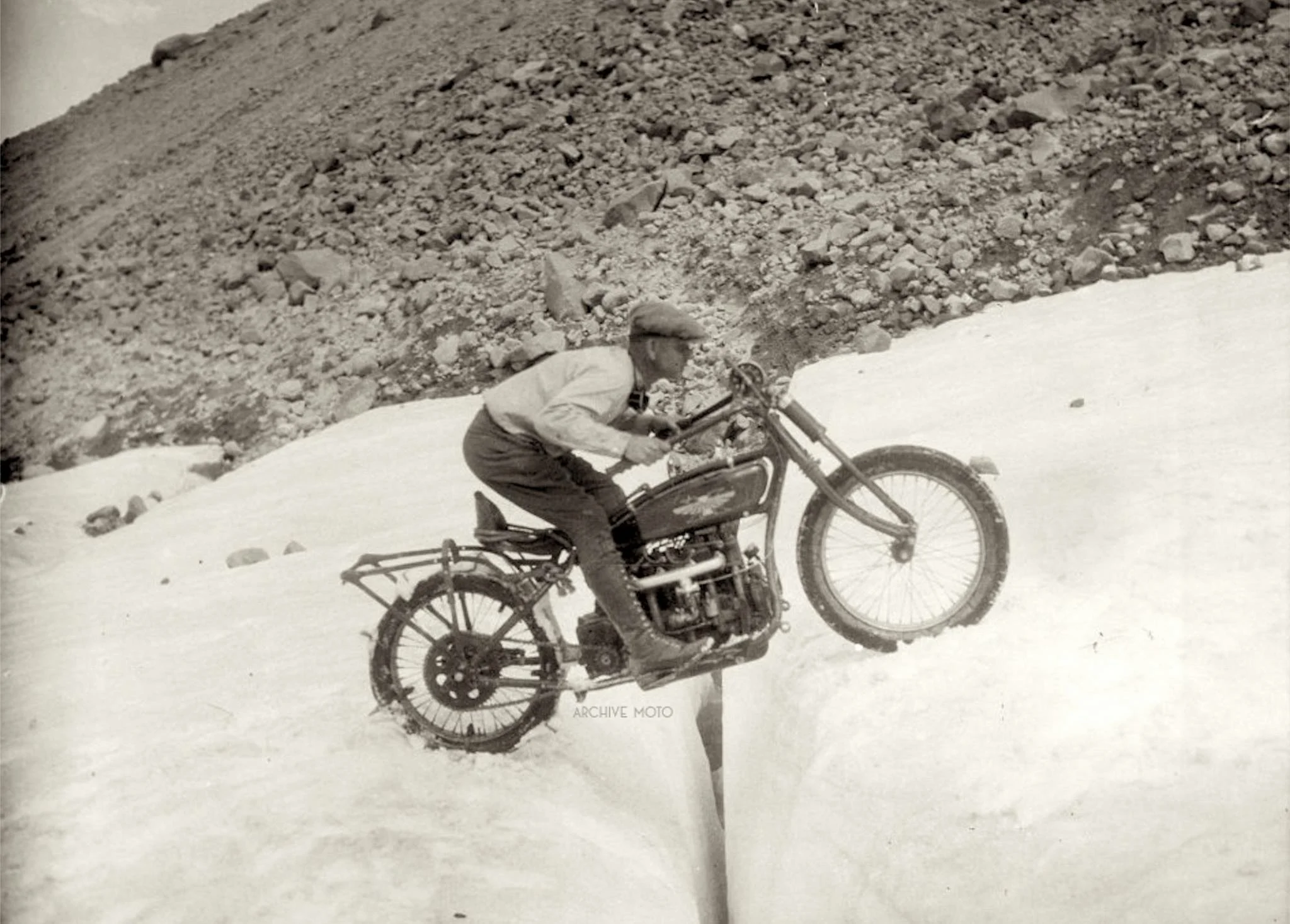
William Wells Bennet, Mt. Hood, OR, August 1924

1 Comment

William Wells Bennet, Mt. Hood, OR, August 1924

IMG_1103.JPG

Here’s a quick followup to this week’s post on Wells Bennett which also just so happens to tie in perfectly with the One Motorcycle Show in Portland this weekend. I won’t be up there but I know a ton of great folks that are so if you are in the area definitely head that way.


Having taken on the flat tracks as a teenager back in Kansas, and then rising to fame conquering America’s infamous motordrome circuit, Wells Bennett could have easily retired from the sport no less a legend, but he was far from done. With the suspension of professional racing throughout America’s involvement in WWI, Bennett found himself keeping busy with cross-country record runs and stunt riding for filmmakers in Hollywood. When professional racing resumed in 1919 Bennett got right back to work onboard his trusty Excelsior. Gone were the circular motordromes on which he had made his name, replaced in the early 1920’s with +100 mph speed records, high speed flat track racing, hill climbs, and transcontinental records. Bennett conquered them all, claiming trophies and smashing records in nearly every format in post-war American motorcycle competition, including a 24 hour record that stood nearly to WWII. His well seasoned grit in the saddle along with his knack for publicity became Bennett’s signature on the culture, but as one of the few pioneers to actually live to confront retirement Bennett began to look outside of the race track for his living. So, as the original legends each began to pull back from competition so too did Bennett and he retired by opening an Excelsior/Henderson dealership in Portland, Oregon.

Just after his 33rd birthday, in August of 1924 the veteran racing icon from Wichita, Kansas decided to again try his hand at the impossible in favor of two-wheeled adventure and set off to the icy slope of Mt. Hood. The plan was for Bennett to reach the 11,200 ft., snow-capped, and craggy summit of Mt. Hood onboard his trusty 28HP Henderson DeLuxe Four. Not satisfied with the traditional southern route of the annual American Legion climb, Bennett decided to attempt his climb on the more treacherous northern face of Mt. Hood. Three of Bennett’s men from the dealership, Joe Walker, Ard Pratt, and Roy Jones, as well as a camera man from Fox News Weekly accompanied him on the journey, clearing a trail the best they could and standing by to catch the machine in the event of a spill. As reported in the local paper following the attempt, Bennett’s journey was “Gallant though unavailing,” and he only managed to make it to Cooper Spur, about 8,500 feet above sea level. However, though the summit was not captured that day the publicity certainly was and Bennett enjoyed the fruits of his efforts for many years to come. Though Excelsior remained one of the major motorcycle manufacturers throughout the great atrophy of the teens and 20’s, the company could not outrun the great depression, and as they closed their doors Bennett moved on to a position within the sturdy Ford Motor Company. William Wells Bennett later retired to a ranch at the base of his old geographical friend Mt. Hood until he passed at the age of 78, truly an icon of our culture.


1 Comment

William Wells Bennett, St. Louis Motordrome Summer 1914

Comment

William Wells Bennett, St. Louis Motordrome Summer 1914

It was during a 15 day, 1,100 mile tour from Kansas to Colorado that a 20 year old man from Wichita named William Wells Bennett arrived at the Tuileries Motordrome in Denver on August 19, 1912. A notable flat track racer in his home state, Bennett had never seen a track quite like the wooden saucer at Tuileries.  Built just the summer before, the 1/3 mile Tuileries Motordrome was only the 3rd circular wooden motorcycle racetrack in the country and featured a constant banking of 47 degrees. Despite his experience and comfort racing flat tracks back home in Kansas, Bennett claimed to have been quite intimidated by the steep and terribly fast boards at Tuileries, but as in any of the great pioneer racers, the spirit of the challenge got the best of him.

After watching in awe the spectacle of the 61ci, twin cylinder races Bennett made his way into the pits to get a better understanding of the sport. Curley Fredericks, who was running a factory Excelsior 7 had just won both the 3 mile match and 5 mile open events and was no doubt the target of the aspiring racer from Kansas. With the encouragement and guidance of racers like Fredericks, Bennett consulted the official, acquired an Indian 30.50ci single, and decided to give it a go. A last minute entry, Bennett was billed to the crowd as the “Kansas Champion” for the 2 mile 30.50ci event and lived up to his reputation. On that hot August afternoon, without ever having set foot on a steeply banked wooden motordrome track before, much less having had a practice lap, Wells Bennett threw his leg over and charged the boards at nearly 70 mph, taking the checkered flag and besting two experienced local professionals.

From that moment it seems Bennett was convinced that he was meant for such a life. Within a month he and his new wife Maggie packed up and left Kansas for Los Angeles, where Bennett quickly established himself as one of the top board track racers in the country. This image of Bennett was taken a couple of years later in 1914, the final days of the American motordrome, a time when Bennett was touted as one of the best riders in the country. Having only seen his first motordrome less than two years ago that fateful day in Denver, Bennett had become a a top factory rider for Excelsior and had traveled the country racing ever since. He was contracted to captain the Detroit Motordrome’s “Tiger Squad” team during the summer of 1913, and as such Bennett spent the majority of 1913 and 1914 running motordrome races throughout the midwest. Seen here inside the insanely steep 62.5 degree boards of the St. Louis Motordrome at the age of 22, an iron-jawed Wells Bennett sits atop his considerably modified Excelsior 7 factory board track racer in the summer of 1914. 

Comment

Flying Merkel's Maldwyn Jones and Cleo Pineau, Savannah, GA December 27 1913

Comment

Flying Merkel's Maldwyn Jones and Cleo Pineau, Savannah, GA December 27 1913

Maldwyn Jones and Cleo Pineau, two prolific pioneer American motorcycle racers prepped and ready to charge the the sandy roads of Savannah, GA for the 1913 American Classic 300-Mile Road Race. The original Milwaukee motorcycle manufacturer, Merkel had a stake in the sport of motorcycle racing for nearly a decade by the time this photograph was taken, having fielded machines and racers since 1905. Without question the champion of the brand, Maldwyn Jones, seen on the left had helped to establish Merkel as a worthy competitor to the resoundingly dominant Indian factory program. A more recent addition to the Merkel team, Cleo Pineau remained one the company’s most loyal racers until their last days, continuing to compete on Merkels until founder Joseph Merkel left and the company shut its doors just before the Great War. Together the two men remained a stronghold for the brand into the mid-teens amidst a shrinking American motorcycle market and the increasingly fierce and well financed competition departments of Indian, Excelsior, and a eventually Harley-Davidson. 

Though even the most casual antique enthusiast will recognize the unique signature orange paint for which Flying Merkel is famous, many do not know that Merkel’s racing team announced their presence at the track with a different shade. Known as The Yellow Jackets, the Merkel squad often ran machines painted yellow, the riders themselves wearing jerseys and pants to match, there is even mention of painted helmets and boots. Both staple men of the Yellow Jackets, Jones and Pineau would also both enlist for service come WWI. Jones served US Army Air Service at McCook Field where he would be able to continue his passion for racing on the weekend which resulted in him establishing a new relationship with the Harley-Davidson program. Pineau shipped off to the front lines as a fighter pilot in the Royal Flying Corps, becoming one of the elite few American Aces. It is said that, much to the bewilderment of his fellow pilots, Pineau kept a grimacing yellow wasp painted on the sides of his plane throughout his deployment, a tribute to his Yellow Jacket team back home and his loyalty to the once great American motorcycle company who had help start it all. 

As for the day that this image of the pair was snapped on board their sleek, fully suspended Flying Merkel racers. The young Pineau pushed hismachine too hard while coming around a sandy corner on the 11th lap, snapping his handlebars off during a tremendous spill in front of the grandstands. Jones however put on a clinic, leading the race for a couple hundred miles at an average speed nearing 70 mph. With only 2 laps to go Jones’ chain snapped which caused him a 19 minute delay in order to repair, Excelsior’s Bob Perry made up the time and claimed the $500 1st place prize, Jones trailing not far behind to claim 2nd place.

For more about Flying Merkel, Jones, Pineau, the Savannah 300, and countless other unique stories and old photos in the pages of Georgia Motorcycle History, available HERE!

Comment

Ray Seymour, Big Base Indian Columbus Motordrome, July 1912.

Comment

Ray Seymour, Big Base Indian Columbus Motordrome, July 1912.

There is a sweet spot in the pre-WWI era of American motorcycle competition. A time when the technology, the industry, the tracks, and the riders all hit a stride simultaneously and America’s enthusiasm for the sport hit a fever pitch. By 1912 Jack Prince’s fabled board track Motordromes were popping up across the country on what seemed like a monthly basis. Each new track was a refinement of design, a result of the race to accommodate the incredible speeds of rapidly evolving pure bred factory racing machines. This was the golden age of the board track, and for pioneer racers like Ray Seymour who were some of the first to start racing years before on dirt horse tracks like Los Angeles' Agriculture Park, it marked a time of great opportunity.  

A champion seemingly from the start, Ray Seymour made himself known as a serious competitor as a teenager in Southern California. The pride and joy of the Reading Standard racing program, the freckle-faced boy wonder racked up a number of records before the Pensilvania based company pulled back from the racing game in the spring of 1910. Seymour was then taken under the wing of Indian's Jake DeRosier, arguably the most famous and capable racer of the day. It was DeRosier’s famous No. 21 factory machine that the young Seymour piloted when he became the FAM National Amateur Champion at Philadelphia in August that same year. Seymour, now an official rider for the mighty Springfield factory team charged into his most triumphant years, officially entering professional competition in February 1911. Seymour spent the majority of his time honing his skills on the Salt Lake City saucer at Wandamere under the continued tutelage of DeRosier just as he had done the year before. However, the young California Wonder also began criss-crossing the country, often opening Prince’s newly constructed motordromes and setting new records as a rising national star. 

For the 1912 season Hedstrom had reproached his relatively new overhead valve design for the factory team. The new direct drive configuration featured larger cases and flywheels set into a slightly modified chassis, a distinct design feature which earned the rare machine its nickname as the Big Base series of Indian 8-Valve racers. Hedstrom initially built two of the new 7HP Big Base 8-Valves and delivered them to Los Angeles in late January 1912 for the opening of Prince’s newest track, the LA Stadium Motordrome. Ray Seymour and the young Texan Eddie Hasha were the lucky riders who were chosen to pilot the powerful machines, putting them at the top of the class in American motorcycle racing.

In February 12, 1912 Seymour and Hasha mounted their new factory 8-valves and ripped up the boards of the 1/3 mile LA Stadium Motordrome with its 50 degree tilt. The two proved their mettle as they finessed the power of the new cutting edge Class A machines, hitting speeds over 90mph, establishing a new standard that competitors and manufacturers alike would be chasing down over the coming years. Seymour and his Big Base continued on their warpath throughout the 1912 season, running wide open in LA, Chicago, and Oakland, and setting new professional speed records at playa Del Rey. 

This photograph of Ray Seymour and his Big Base beast comes from inside the Columbus Motordrome, a larger than average 1/2 mile motordrome with 48 degree boards. On the Fourth of July, 1912, Seymour and Hasha duked it out during the opening races at Columbus in front of a massive crowd of 27,000. Taking place amidst a national FAM rally, the opening races were divided into two parts, half taking part as an afternoon festival until sunset, then a lavish fireworks display followed by the excitement of nighttime competition. Both Seymour and Hasha matched each other in setting a new 1 mile record of 37 seconds, nearly 97 mph on the rough 1/2 mile saucer , but it was Seymour who won each of the main events against his partner that day. Competition continued and within two months, both young racing stars would arrive in New Jersey to continue their domination of the 1912 season at the new Vailsburg Motordrome. On September 8th, as Seymour lead the pack at Vailsburg, Eddie Hasha lost control and the tragedy at Vailsburg unfolded, claiming the life of Hasha, Indian teammate Johnny Albright, and another 6 spectators. It had only been 7 months since Seymour and Hasha had pulled their Big Base 8-valve machines out of the shipping crates together back in Los Angeles. 

Despite the loss of his friends and teammates at Vailsburg Ray Seymour continued his racing career, though the weight of the risk would only continue to grow heavier over the  years as many of his fellow racers met similarly gruesome fates, including his mentor Jake DeRosier in February 1913. Seymour would live through his professional racing career, retiring a few years later and living out the rest of his days a legend of the golden age.

Comment