Going Like Hell Towards Heaven, Oscar Hedstrom, July 18, 1905

1 Comment

Going Like Hell Towards Heaven, Oscar Hedstrom, July 18, 1905

On the first of February, 1904 former cycling star turned upstart motorcycle entrepreneur Oscar Hedstrom boarded a train in Ormond Beach, FL, bound for the comfort his workshop in Springfield, MA, discouraged yet undeterred. Despite clocking a respectable top speed of just over 56 mph during the 2nd annual Carnival of Speed, Hedstrom’s latest experiment, a dual-engined, DeDion powered prototype motorcycle suffered a debilitating mechanical failure. Hedstrom was forced to return home empty handed having being beaten out by fellow pioneer Glenn Curtiss and his more refined v-twin design. Within only five months from returning home from Florida Hedstrom had conceived, drafted, cast, and machined his own proprietary v-twin power plant and was eager to unveil his new creation, the very first Indian v-twin.

Mounted in a standard production frame, his first 42 degree v-twin produced 3 1/2 horsepower and was introduced as more of a prototype racing machine than a production model. In-house electrics, twist grip throttle, a new streamlined torpedo style tank along the top frame tube, a rigid fork, chain drive, coaster brake, and toe clips rounded out the configuration. On July 30, 1904 Oscar Hedstrom unveiled his new creation, tearing up the rough sand 1.125 mile course at Sachuest Beach in Newport, RI. Hitting a top speed of 46 mph onboard his new elegant Indian v-twin, Hedstrom won the event and took home a $75 silver bowl trophy. He continued his work on the design and performance, running the new 26ci twin again at least twice in competitions throughout New England as well as constructing a second sister v-twin prototype machine.

With the new year approaching, Hedstrom again packed up and headed south for the 1905 Carnival of Speed at Ormond Beach. Despite being the only motorcycle entrant he threw a leg over the new “heavy” Indian twin determined to overtake previous records set by himself and Glenn Curtiss. The combination of poor weather, rough surface conditions on the beach, and a slightly underpowered machine the new twin prototype couldn’t seem to break the minute mile mark, falling short of existing records, and hitting only a shade over 55 mph. Hedstrom’s machine proved itself quite capable and resilient however, its features were streamlined, refined, and classic, setting a new high standard within an industry that was trailing far behind. It is worth mention that by this time Indian production had reached 1,000 machines and Hedstrom had produced a number of racing specific prototypes with which he had earned several records, Harley-Davidson had made less than 10 machines total and the American motorcycle manufacturing boom had not yet begun. It would be a few years before the innovations Hedstrom developed with his v-twin prototype would make it into production models, but he continued to enter it into competitions and with each win a new marketing strategy took hold in Indian’s business model, victory equals sales. 

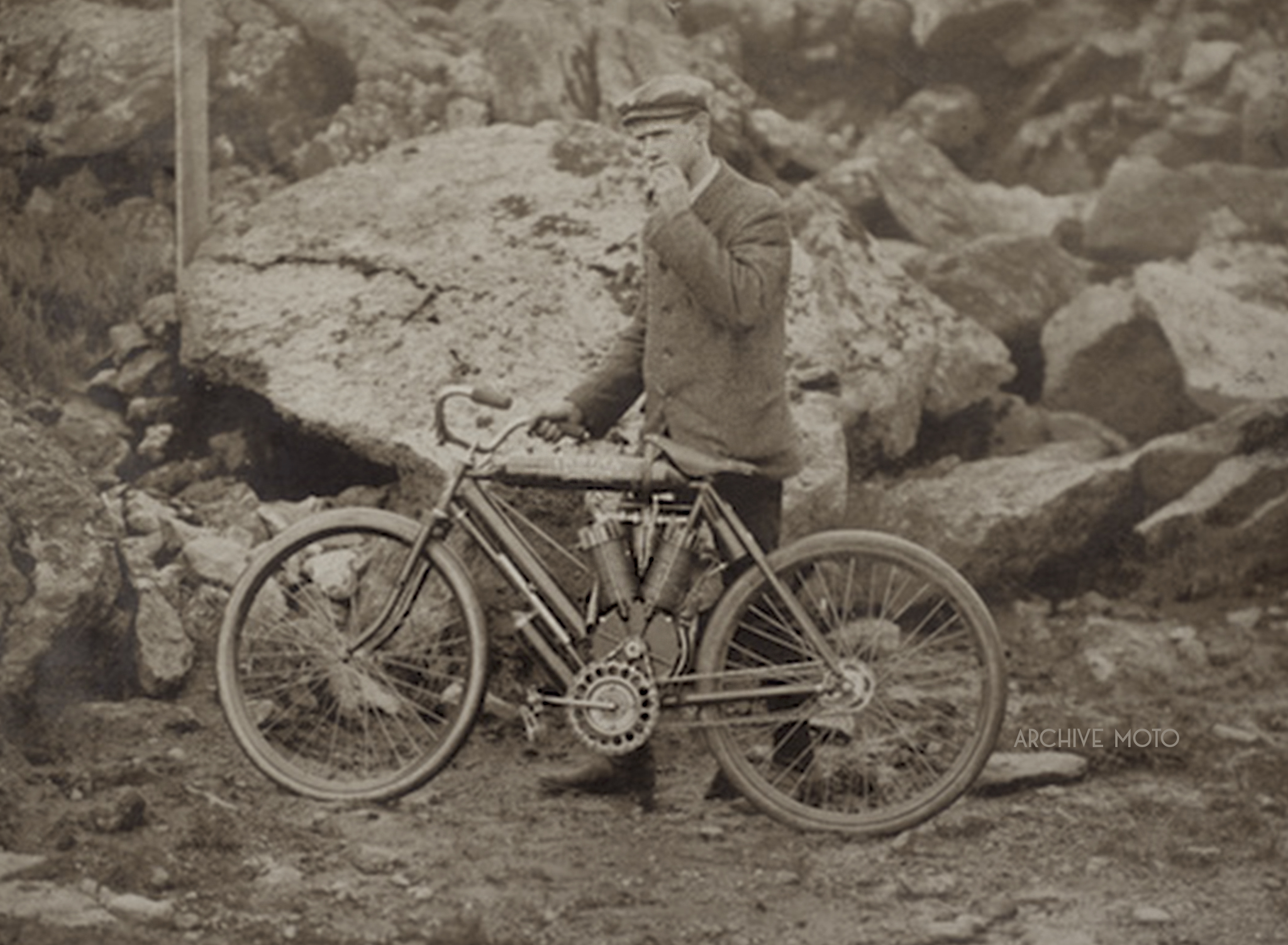
This image of Hedstrom with one of his two 1904 streamlined v-twin prototypes comes from the “Climb to the Clouds” hillclimb at Mt. Washington, NH, July 18, 1905. Both Hedstrom and his close friend Stanley Kellogg made the rough and rocky 8 mile ascent which featured grades over 20% in sections. Kellogg initially shattered the standing time by 8 minutes on a standard production Indian single before W. Hilliard in a 60hp automobile reclaimed the record by dropping another 5 minutes. Due to the weight of the prototype v-twin it was only allowed to run in an unrestricted class, a frequent issue at the time. Despite a spill Hedstrom came within a minute of beating the big auto, which boasted over 20 times more horsepower than his hardy little Indian twin, and Kellogg fell short by only 4/5 of a second. This remarkable moment, this man and this machine embody every aspect of American motorcycle culture all at once. The industry, the innovation, the drive, the competition, the enthusiasm, the grit, the engineering, the determination, and the spirit of gasoline fueled freedom. 

1 Comment

Archive Icon: Eddie Brinck

Comment

Archive Icon: Eddie Brinck

Edward Jeffra Brinck, a man so dapper that he more consistently looks like a Hollywood playboy posing for a photo-op rather than a rough and tumble prohibition era AMA Champion. His well kept appearance is misleading though, as Eddie was one of the elite few who began his motorcycle racing relationship with Harley-Davidson before the outbreak of WWI and continued to snatch up national championships throughout the 1920’s.


Early in life Brinck spent his time tinkering, familiarizing himself with all things mechanical, his interests eventually leading him to a career as an engineer. As the Great War chewed through Europe, the 20 year old from Dayton landed a job as a performance motor engineer and wind tunnel technician at the US Army’s experimental aviation department at McCook Field. It was there that Brinck befriended fellow employee and pioneer racing icon Maldwyn Jones. The two shared a fascination with engine tuning and efficiency and Jones soon began to mentor Brinck on flat tracks around Ohio each weekend. It was Jones, who had only recently been recruited into the might Harley-Davidson factory program that convinced the Motor Co. to bring his protege onboard as well, the condition being that Jones would be held responsible for Brinck’s machine. However, the pair’s proficiency for getting the most out of the small, half-mile motors resulted in the factory allowing them to tune their own racing motors, even sending them components directly, a rare privileged within the Class A powerhouse team.


A dirt track racer in the age of the massive board speedway’s, Brinck didn’t share in the same limelight that the stars of the Wrecking Crew did in the early 20’s, he even jumped into the Indian camp for a bit, but Brinck continued wringing out his little singles in the dirt. By the mid-1920’s, as the big money days of the Class A era began to fade Brinck, a flat track wizard stepped into his glory days. Running toe to toe with legendary racers like Jim Davis, Ralph Hepburn, and Joe Petrali, Brinck proved himself a brilliant competitor. In the fall of 1925 at the AMA Nationals in Syracuse, NY Brinck won the first of many national titles, even becoming an international record holder when he sailed to Australia to compete in the winter of 1926. 


Upon his return to the states his old friend Maldwyn Jones, the man responsible for his racing career suggested the it was time for Brinck to join him in retirement, offering him a position at the Schebler Company. However, as the story too often unfolds with these early racing icons, Brinck turned down the offer at a slower paced life opting instead to continue chasing down victory, a decision that proved fatal. On August 13, 1927 while competing in the AMA Nationals at Springfield Brinck’s front tire gave out sending him down at full speed. Joe Petrali, who was trailing just behind collided with the pile in front of him injuring Petrali, but the debonaire racer from Dayton with the brilliant mind for motors died as a result of injuries sustained.


Here is Eddie Brinck, the gentleman star of the dirt and one of the small racing motors that he loved, a 1927 Harley-Davidson 30.50 ci OHV “Peashooter.”

Comment

Albert "Shrimp Burns & Otto Walker, Ascot Speedway, Los Angeles, Jan. 11 1920

Comment

Albert "Shrimp Burns & Otto Walker, Ascot Speedway, Los Angeles, Jan. 11 1920

After several attempts to put into words the significance of this image it has become apparent that there remains too much backstory to sufficiently cover in a short article. However, I have been kicking an idea for a new project around for quite sometime now and this attempt may have given me the last push I need to pursue it. There is more to this story, but you will just have to stay tuned.

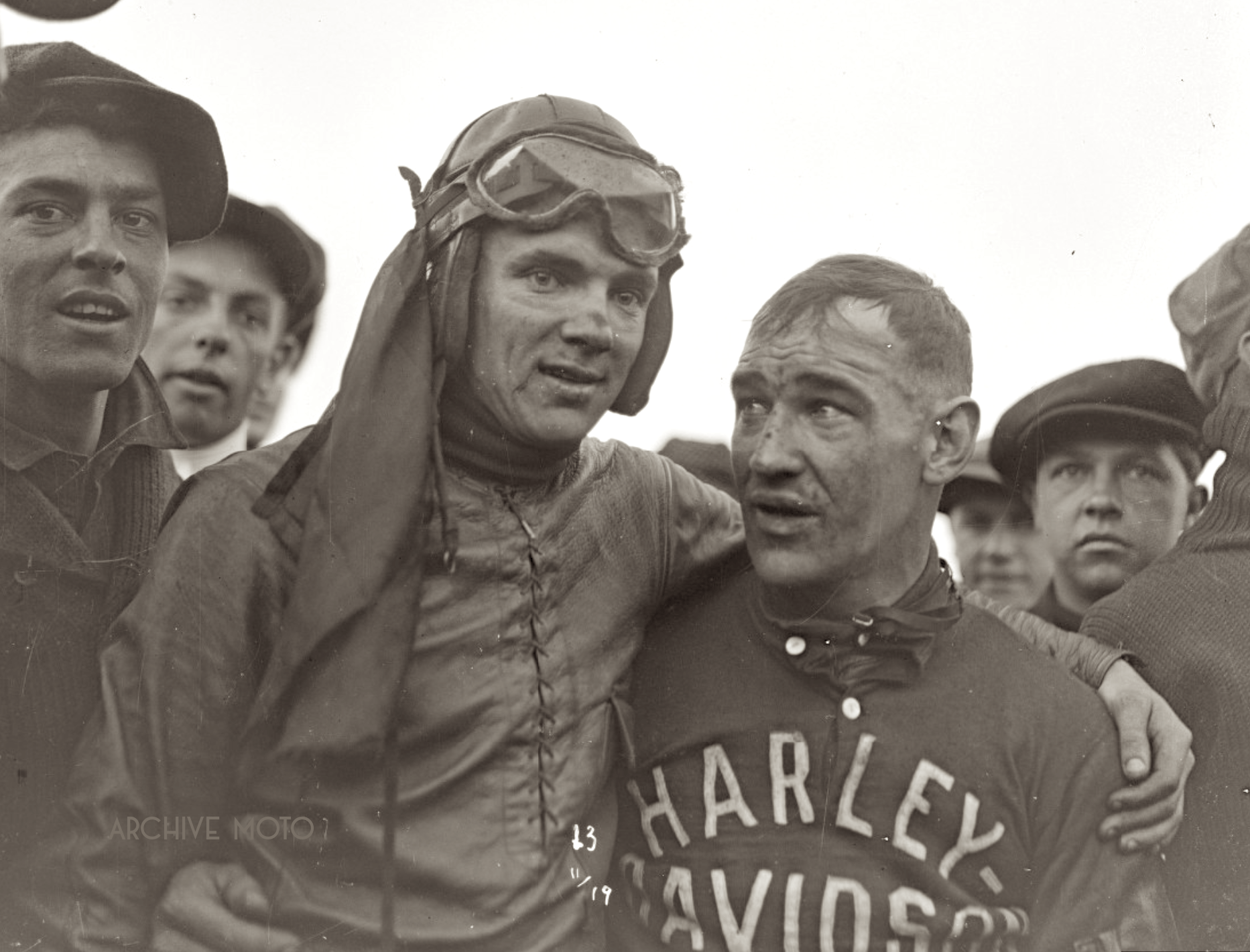
An embrace between Albert William “Shrimp” Burns and Harry Otto Walker, respected competitors, former teammates, rivals, and two of the most fearless, passionate, and iconic founding-fathers in American motorcycle racing history. The moment was captured at the championship races held at Los Angeles’ Ascot Park on January 11, 1920. Burns had just abruptly left the Harley-Davidson factory team and made his debut the Sunday prior as the newest member of the Indian factory team. Reportedly, tensions between Burns and acting Harley team captain Otto Walker were a factor in his decision to split from the mighty Milwaukee team, who had given him his first professional racing contract just one year before. Walker, who had only recently returned from a tour of duty in France during WWI had only been back at the races since Labor Day when he made his post-war return as a veteran of the Harley-Davidson’s Wrecking Crew at the road race in Marion, IN. 

Burns, who had a rough debut the week before at Ascot with a Wigwam stable plagued with mechanical issues returned on the 11th with the tenacity of a man with something to prove. The slight Californian took first place in the 25 mile race at an average speed of 81 mph, becoming the first M&ATA National Champion of 1920. His former teammate Otto Walker was actually leading that race, but after wearing the tread off of his rear tire he had a terrible slide and tumble on the final turn, allowing his old rival to shoot past him for the win. Undeterred, Walker still managed to remount his pocket valve Harley and come in 3rd place. For the 50 mile Ascot Championship, a pocket-valve only race, Walker regained his wits and claimed the victory while Burns and another former teammate Fred Ludlow scrapped in Walker’s dust for second, Ludlow pulling ahead by only 2/5’s of a second at the line.

It is uncertain after which race this photograph was taken, though I like to think that it was a moment captured after the 25 mile race, just after Walker’s spill which no doubt stirred uneasiness in its similarity to another fellow racer, Excelsior’s Bob Perry’s tragic death during practice at Ascot only days before. To whatever extent the reports of their rivalry are true, the fact remains that both men had the fortitude and drive to risk everything for their sport, qualitiesthese men assuredly admired in one another. This moment seems to capture that mutual respect, the general concern these pioneering gentlemen racers had for one another regardless of criticisms or complaints.

Comment

Chatham Motorcycle Club, Savannah, Georgia, 1934

1 Comment

Chatham Motorcycle Club, Savannah, Georgia, 1934

I just returned from a quick trip down to Savannah, a city busting at the seams with beauty, charm, and culture. This magical old town also boasts a long running heritage of motorcycling and a rich history of racing. With one of the oldest motorcycle clubs in the country, Savannah’s dusty roads and cobblestone streets, lined with noble oaks dressed in Spanish moss have been a favorite for riders since the turn of the century. With the completion of the Grand Prize Circuit in 1908, America’s first Grand Prix racing course, local enthusiasts grew to become fierce competitors and the city became one of America’s earliest racing capitals. Beginning in 1913, nationally sanctioned GP races were held on the aging Grand Prize circuit, bringing legendary names like Maldwyn Jones, Cannonball Baker, Ray Weishaar, and Joe Wolters to Savannah. American racing icon Jim Davis recalls watching that race as a teenager in that year after having traveled to Savannah with his father who was there on business in 1913 and credits watching Maldwyn Jones blast around the sandy roads at that first races as a major inspiration for his own racing career. The same event the next year brought the first ever officially backed Harley-Davidson factory racing team, along with their first official podium with team rider Irving Janke finishing 3rd, a monumental turning point in American motorcycle racing history. 


As the years marched on local men continued racing on the Grand Prize Circuit as well as ringing out their machines on the long, flat, wide stretches of sand on the nearby barrier islands. By the 1930’s a new class of racer began to emerge, the fizzling interest in robust and expensive factory supported Class A was replaced with the hearty, every-man appeal of AMA Class C competition. In 1932, in an effort to boost sales amidst the depression regional industry owners decided to band together and sponsor another long distance endurance race over parts of the once mighty Grand Prize Circuit. Again top class riders from around the country, a new generation of champions like “Ironman” Ed Kretz, Rody Rodenberg, and Rollie Free arrived in Savannah to compete. It was that event, the 200 mile long road race that began in Savannah which eventually became the beloved Daytona 200 in 1936.  


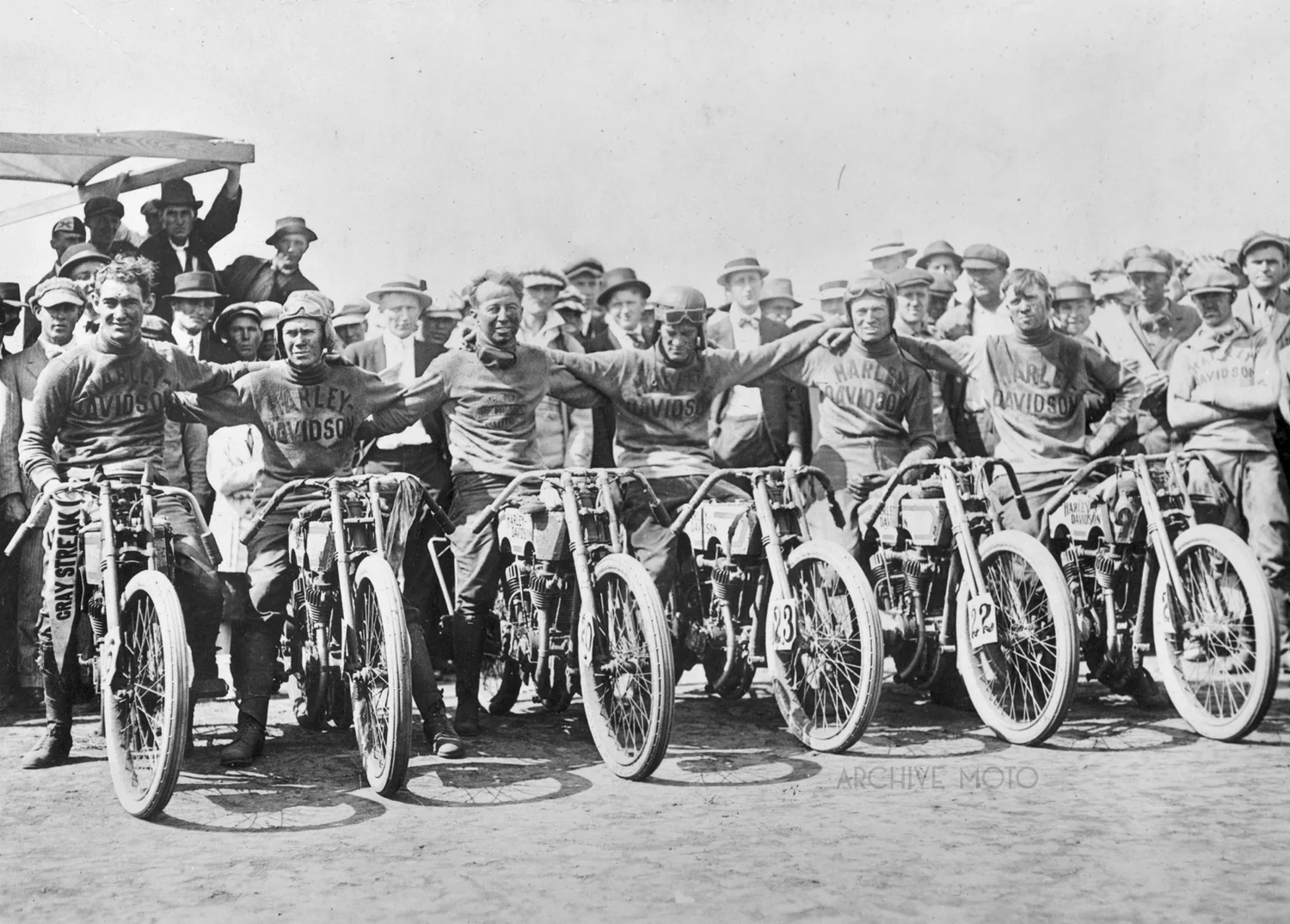
Despite hosting so many milestone events, and perhaps because of the massive shadow cast by the city’s deep local history, Savannah is often overlooked as a historically significant motorcycling hub in America. However, the town remains a time machine for those who know its importance and anyone lucky enough to ride beneath the oaks can feel a direct connection with that heritage, one stretching back to the origins of motorcycle culture in America. Here, a group of likeminded enthusiasts, members of the Chatham Motorcycle Club post up on Bull and E. Perry St. downtown for a picture in 1934. The overly confident man in the middle is a local racer named Breman Sykes, he had just won the 200 mile race becoming the first awarded AMA Class C Champion a few weeks prior. It is also worth noting that another local racing hero named Ralph Edwards, winner of the first 200 mile event in Savannah in 1932, the first champion of what would become the renownedDaytona 200 poses a bit more discretely, with the cap and goggles third from the right.


Learn more about the rich history of racing and motorcycle culture in Savannah in the pages of Georgia Motorcycle History: The First 60 Years 1899-1959, available now HERE


1 Comment