Archive Icon: A.F. Van Order

1 Comment

Archive Icon: A.F. Van Order

The man himself, Mr. Ashley Franklin Van Order posted up on his good friend Otto Walker’s factory racer at Ascot Park, January 1920. A child of the great American midwest, Van moved his family to the sun-rich land of Los Angeles in 1911 in order to pursue a life on two wheels. A tenacious yet easy going man, Van was driven to immerse himself in the bustling motorcycle culture of southern California at the turn of the century, and as such became a staple player in the very creation of American motorcycle culture. A master rider, novice racer, and successful salesman, Van’s life was quickly consumed with all things motorcycling. He became an officer of the LAMC, coordinating countless rides and races, often acting in whatever role was lacking at the event. Sometimes he was an official for the FAM, or manned the flags and stopwatches, if needed he even held things down in the pit crew for his professional racer pals. 


The first half of Van’s life was spent in the saddle pursuing good times, that familiar motivation in which we all share a stake. Van then dedicated his remaining years to preserving and sharing the stories of those early days so that future generations would know right where they came from. By the 1930’s Van had begun trying his hand at journalism, recounting the glory days of American motorcycle racing for Motorcyclist Magazine, illustrating his articles with images snapped and collected over the years past. It is those images, amassed by Van Order over decades, combined with his drive to preserve the stories of his culture that has given us such a rich understanding of our heritage. His collection of photographs define the spirit of American motorcycling and his efforts as the first great champion of our culture have earned him his place amongst the founding fathers of our sport.


I have been honored with the opportunity to tell Van’s story and share his remarkable collection of photographs in my next book. His is a legacy to which we are all indebted and I am excited to move into the next phase of this project, hopefully having a release date in the middle of next year. Until then keep an eye out for #TheVanOrderCollection tag in my IG posts for an exclusive peek at the iconic photographs from the project.

1 Comment

Cleo Francis Pineau, Toledo Ohio, June 9, 1914.

Comment

Cleo Francis Pineau, Toledo Ohio, June 9, 1914.

Fascinations can easily get away from you once you begin digging into the details of early American motorcycle racing. Those first decades overflow with icons and legends, unique characters with unbelievable lives and undeniable grit. It is this man however, a diminutive New Mexican with a quintessentially French name that I cannot seem to keep from studying. Cleo Francis Pineau was so eager to jump balls deep into life that he dropped out of school in 6th grade, dead set on beginning his remarkable adventure. He lead a life so full that it would take a Tolkienesque effort to recount his exploits, far to much to dig into in one of my little posts, but I hope to one day get to tell his story in full. 


Not only was he a pioneer of the dirt track and the motordrome, but he was also one of the earliest to thrill audiences inside attractions like the wall of death. He was a staple member of the Yellow Jackets, the competitive factory team of Flying Merkel in the early teens despite his career being interrupted at its peak by WWI. In yet another example of his continuous exceptionalism Pineau enlisted for service in the Royal Flying Corps when the war broke out and trained to be a pilot. With less than 100 flying hours under his belt he shipped out to France where, in less than a month of active combat he distinguished himself as one of the top pioneer fighter pilots in the world shooting down 6 enemy aircrafts. After becoming one of an extremely small group of American Ace’s Pineau was himself shot out of the sky only to survive and spend the remainder of the first world war in German POW camp.  


He returned to the states with a chest made heavy from medals from several different countries and jumped right back into the saddle. He later became an executive representative for Indian before starting his own steel company which is still in operation today. He spent the remainder of his life being counted among the close personal friends of American aviation icons like Wiley Post, Charles Lindbergh, and Amelia Earhart. This man in the photo, Cleo Francis Pineau onboard his Flying Merkel factory racer, a blanked off OHV twin setup for the races in Toledo, OH, June, 1914, is in my opinion one of the most fascinating people in American history.

Comment

William Lawrence "Young" Stribling, Macon, GA, ca. 1930

Comment

William Lawrence "Young" Stribling, Macon, GA, ca. 1930

William Lawrence “Young” Stribling and his wife Clara onboard their cherished Indian motorcycles in Macon, GA, ca. 1930.

One of the greatest Heavy Weight Champions of all time, Georgia’s own William Lawrence Stribling was also a man infatuated with machines. An avid aviator and motorcycle enthusiast, “Young” Stribling as he was known was born in a small south Georgia town into a life of consumed with travel, so it is no wonder that he was drawn to all forms of transport. The son of a traveling vaudeville family, Strib grew up criss-crossing the globe performing balancing acts and gymnastics. His mother began training him and his younger brother to box before they could even walk, and the shows eventually featured the 4 year old Strib and his 2 year old brother sparing a round or two for the audience at the end of the show. By 17, the 6 foot tall, steely blue-eyed Stribling became an instant boxing sensation, fighting in no less than 75 professional bouts in his debut year. A devout and moral man, Strib led a clean life without smoking or drinking and insisted on promoting a fair and gentlemanly sport across the country. In 1925 he married the love of his life, Ms. Clara Kinney of Macon, GA, and together the would welcome 3 children into the world. Strib continued to be a wildly successful fighter and an icon in the sport, winning most of his matches by knockout within only two rounds. Out of his 286 professional fights, Young Stribling lost only 12, and only once by a TKO while on tour in Europe. 

On October 1st, 1933, while riding his beloved Indian 4the heavy weight champ was struck by an automobile as he returned to the hospital in Macon, GA to be with Clara and their newborn child. The young sensation, a celebrity in every sense of the word, a man who helped shape the sport of boxing into what it is today succumbed to his injuries two days later on October 3rd, 1933, his dying words were a loving greeting to his wife as she entered his room with their newborn son. 

Comment

Ascot Park, Nov. 30, 1919

Comment

Ascot Park, Nov. 30, 1919

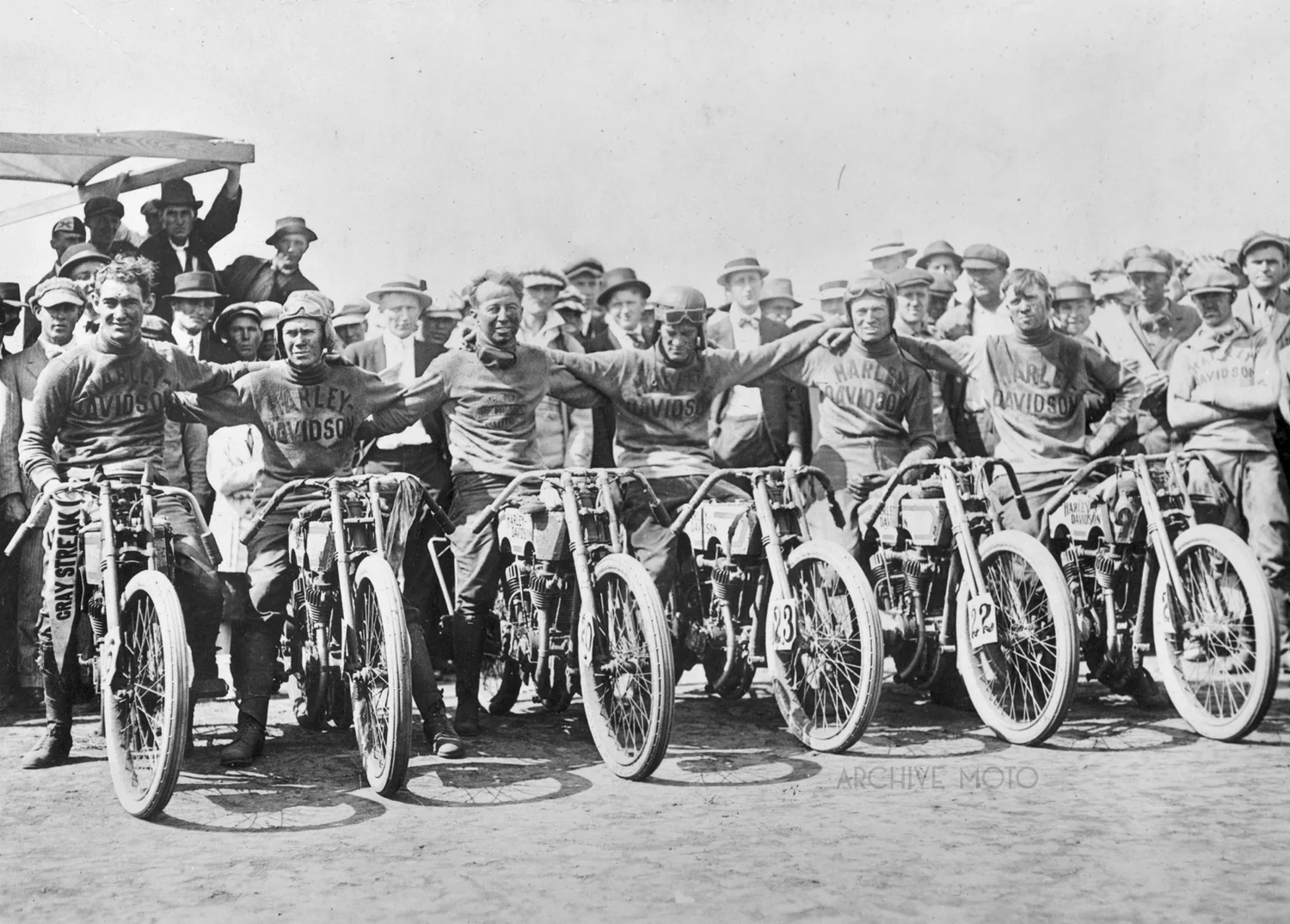
Nine of the finest motorcycle racers America has ever produced kicking up the dust at Los Angeles’ Ascot Park on November 30, 1919. This was the beginning of the great rebirth in American motorcycle racing, the years following WWI when the line between risk and reward became razor thin, and top speed was the name of the game. The era of the motordrome, the small circular board tracks which once enraptured America’s enthusiasts had vanished, having given way to enormous board track speedways and the hair raising hornet fights on the dirt mile. This was the age of 8-valves, fast tracks, and homeric stars; these were the glory days of the Harley-Davidson Wrecking Crew.

Still reveling in his victory after becoming the 2-Mile National Champion, having hit 96 mph on the boards of Sheepshead Bay just a few weeks before, Harley-Davidson’s Otto Walker took the top spot at Ascot that day during the 50-Mile America’s All-Star Motorcycle Sweepstakes race, his young teammate and Wrecking Crew team rival Shrimp Burns just behind him in second. As the pack flew by the grandstands, which were still draped in star-spangled banners from the country’s first ever Veterans Day celebration, Walker is easily spotted front and center due to his distinctive crested German aviators helmet, a trophy collected during his own service as an aviation mechanic in France the year before. Not only did 1919 mark the return of professional motorcycle racing in America, but it was the year that Harley-Davidson, determined to stake their claim as America’s greatest motorcycle manufacturer simply dominated at the track, racking up wins, national titles, and new speed records at Marion, Ascot Park, and Sheepshead Bay. A new era of professional motorcycle racing in America had begun, and Harley-Davidson was leading the way.

Comment