A Brief History of Speed: Part VI

Comment

A Brief History of Speed: Part VI

The Depression acted as a grand a catalyst. Both the sport and the industry were forced to adapt to the economic decline in America and the changes devised spawned an entirely new culture. Indian and Harley further refined their smaller 45 models, packing them with value, and with the addition of the AMA professional 45 class these new machines became American favorites. Dealerships and clubs rallied together, creating events in hopes of driving new sales. Local races that allowed men to be competitive on their lightly modified stock machines, like the Jack Pine Enduro and the reemerging Gypsy Tour races saw a spike in popularity. The decline of factory-backed Class A racing forced the AMA to introduce a new class in 1933, one that they hoped would foster wide spread participation and bring more people back to the sport, it was Class C. Lightly modified, stripped-stock 45 and 74c.i side valve machines were now a part of three new categories, dirt track, TT, and road race, with three divisions each, novice, amateur, and expert. For the first time racing was accessible to everyone as any AMA member could ride in, race, and ride out, it was just the injection of participation that the industry needed. This marked a turning point in racing history and became the foundation for the second renaissance in the decades to come. 

As the AMA developed their new Class C in 1933, the Southern Motorcycle Dealers Association devised a scheme of their own to drive business, once again bringing the thunder of American racing to the southeastern coastline. The group sponsored a 200 mile race on Savannah’s old Grand Prize circuit, the same course that once hosted the Vanderbilt Cup and where Harley-Davidson’s first factory team debuted in 1914. Over the next five years the 200 mile race would move between courses in Savannah and Jacksonville Beach, FL, before finally settling in at the new 3.2 mile semi-paved course in Daytona Beach. In 1937 the inaugural Daytona 200 was held and became a marquee race for the next 80 years.  Racing was again halted for a war in 1941, but the culture was healthy and would return even stronger just as it had after the first World War. Class C flat track became the backbone of American motorcycle racing and the sport grew more popular than ever. The AMA’s membership boomed as soldier’s returned home seeking freedom and adrenaline. A proliferation of new motorcycle clubs strengthened a growing community full of new events, tracks, and rallies, while an influx of surplus machines and a flood of new import brands produced a frenzy of new racers, mechanics, and customization. Once again, having come full circle, the eyes of America focused intensely on the warm sands of Daytona Beach to see who was going to wear the crown of the fastest, a new Golden Age had begun.

Here, New Jersey’s Al Wilcox (#138) tucks into his Harley-Davidson on the beach straightaway during the 1948 Daytona 200 as Canadian Norman Teleford (#161) stretches out like Rollie onboard his Indian Sport Scout.
Comment

A.F. Van Order

5 Comments

A.F. Van Order

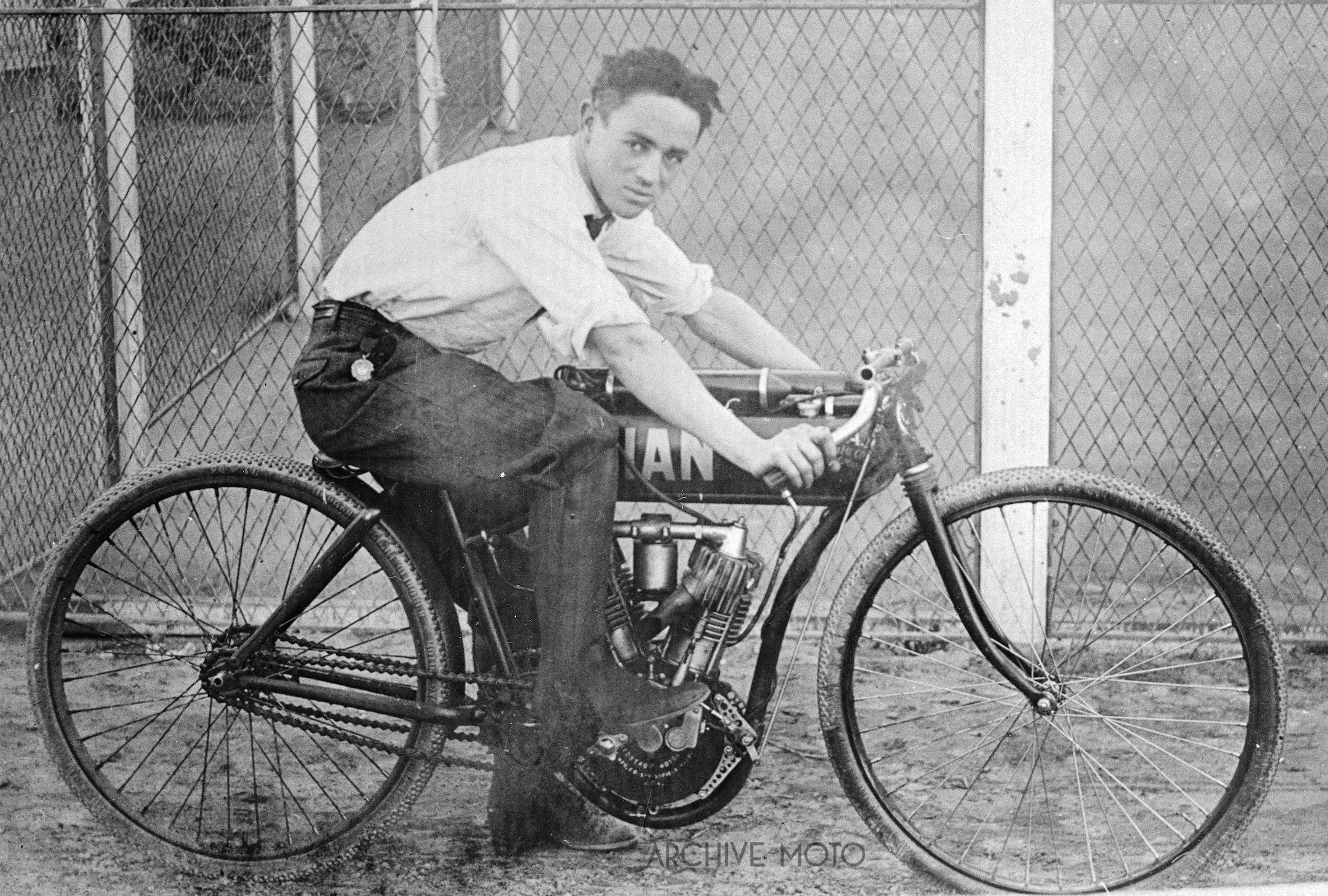
One of the founding father of American motorcycle racing, Chicago's Freddie Huyck sits atop one of the rarest prototype Indian factory machines ever made shortly after arriving at Los Angeles’ Agriculture Park, arguably the birthplace of professional motorcycle racing in America. However, the rider, the venue, nor the rare machine is the focus of my upcoming project, what will soon be my second large format book. It is the photograph itself that has occupied my focus for the last 2 years, just one from a collection of over 250 rare and largely unpublished photographs belonging to one of the most important men in American motorcycling history, Ashley Franklin Van Order. Van Order was not only an active participant in the Golden Age of American motorcycle racing, but he later became the first great champion of our history, spending the last half of his life dedicated to preserving and documenting those early days of this great culture. 


Van moved from Illinois to Los Angeles just in time to witness the birth of the Motordrome frenzy. Initially trying his hand at racing, he soon began snapping photographs at the races, quickly becoming close friends with the pioneers of the sport. By the 1920’s, Van was traveling the country and was so chummy with the boys of Harley-Davidson's legendary Wrecking Crew that he could have been considered an unofficial member of the team. In the decades that followed Van went on to recount the glory days of racing in articles for Motorcyclist Magazine, and still found time to form an organization of pioneer enthusiasts and racers in 1936 that would become the Trailblazers Motorcycle Club, a group that continues to preserve our history today. A photographer, a racer, an enthusiast, a salesman, a collector, a writer, and an ambassador, Van dedicated his life to the sport of riding motorcycles and helped preserve many of the iconic photographs that we all admire today. A.F. Van Order was our first historian and without his commitment and passion we would have considerably less knowledge of our own beginnings. I am truly honored and humbled to have the opportunity to share the remarkable story of Van's life and the images that define our culture.

5 Comments

Morty Graves and NSU

Comment

Morty Graves and NSU

19 year old Morty Graves and 29 year old Arthur Mitchell with their factory NSU racers at the Los Angeles Coliseum, America's first board track motordrome in early Spring, 1909. 

19 year old Morty Graves and 29 year old Arthur Mitchell with their factory NSU racers at the Los Angeles Coliseum, America's first board track motordrome in early Spring, 1909. 

One of my absolute favorite pioneer American motorcycle racers, Morty Graves was often times the man to beat in the earliest days of professional competition. With his refined natural skill and hollywood charm, Graves competing for the best manufacturers, and the young man they called “Millionaire Morty” piloted many of what would become the most rare and iconic racing motorcycles in the world.


Graves initially began riding motorcycles in 1906 and almost immediately began racing stock machines. In 1907 he acquired a factory tuned Indian racer from Hedstrom's shop, and though he would sport a number of different manufacturer’s jerseys throughout his career, Indian seems to have been his most favored. He quickly became one of the regulars at Los Angles’ Agriculture Park, the white-hot nucleus of American motorcycle racing just before the big bang of racings golden age. Naturally, when famed cycle champ and velodrome builder Jack Prince came to LA in early 1909 to construct America’s first board track motordrome, Graves was assured a spot on the line.


German motorcycle manufacturer NSU was a relatively new import in the US market at the time. Billed as the Mercedes of motorcycles, the machines were highly engineered and powerful, though cumbersome, and the brass at NSU was eager to capitalize on victory on American tracks. Having been racing motorcycles since 1905 following a successful cycle racing career, Arthur Mitchell was a veteran rider by 1909 and a forefather of the LA racing scene. Mitchell had secured a contract in late 1908 to ride for NSU, Graves was brought onboard shortly thereafter and the two awaited delivery of their new racing machines from the German company for the start of the 1909 season.


Prince’s grand experiment, the Los Angeles Coliseum was a 2/7-mile wooden oval with 48 degree banking on each end, it was America’s first motordrome. In late February, early March 1909 Mitchell and Graves received their new 61ci, glowing white NSU racers. The first practice session at the newly completed Los Angeles Coliseum was held in early March and the pair put a lump in the throats of the top riders as they hit unofficial record speeds upwards of 75 mph. America’s first professional racers Paul “Daredevil” Derkum, Jake DeRosier, Fred Huyck, and Charlie Balke watched the cumbersome NSU team rocket around the new board track in amazement. On March 14, 1909 the Coliseum opened its gates to the public and the age of the American motordrome began.


Having a large 3.5" belt drive assembly, with the pulley reportedly measuring over 5 inches wide, the NSU provided the wily young Graves an unique advantage. In his own words, Graves described how the abnormally wide pulley allowed him to enter into the Coliseum's banked corners at nearly full clip, and at a much steeper angle than other riders could. When most would slide out the NSU’s pulley would catch the track and hold the weight in the turn, allowing Graves and the top heavy machine to take corners at speeds over 70 mph as he laid the bike low onto its pulley. As a result, the 19 year old Graves was a crowd favorite, consistently landing somewhere on the podium, including a few first place finishes, and setting a handful of world’s records onboard his bulky but fast NSU.


This photo comes from that very moment in time, when a 19 year old hot shot and his veteran mentor just so happened to be standing on the very spot where it all began. Morty Graves, a young man with a beastly machine established himself in the dayS following this photograph in the Spring of 1909 on a thrilling new track that allowed men to take flight on two wheels. Graves would move on from his contract with NSU by May of 1909 to ride for the premier motorcycle racing team in the world, Indian Motocycles, but it was his antics onboard the NSU at America’s first motordrome that earned him his place amongst the founders of America motorcycle racing.

Comment

A Brief History of Speed: Part V

Comment

A Brief History of Speed: Part V

The early years of the roaring twenties represent the first high water mark in professional motorcycle racing. It was a period when sophisticated machines were unleashed by men of true and unrelenting grit inside colossal stadiums. The later half of the decade saw the waters of the sport recede, taking with it the days of the large-displacement behemoths, the fiercely competitive factory teams, the national stars, and the splendor of the board track speedway. A movement towards smaller displacement machines, which began with blanked off twins in 1922 eventually led to the development of single cylinder racers and a focus on 1/2 mile dirt track competition.


By the end of the 1920‘s the AMA granted some smaller displacement classes National Championship titles including 21, 30.50, and 45 c.i. engines. Both Indian and Excelsior were quick to develop engines within specifications, resulting in a considerably larger presence in the winners circle at the decade’s end. Simultaneously, hill climb competitions, which dated back to Southern California in the mid-teens had matured throughout the 1920‘s. By 1930 the thrilling spectacle of men onboard odd mutant marvels, wrapped in chains and rocketing up steep walls of earth had become the most popular sport in the country. In 1931 the AMA sanctioned separate championship hill climbs on each coast for the first time, ushering in the golden age of the hill climb. With Class A racing rapidly wilting Harley-Davidson and Indian both decided to focus their attention on the grand ascent, each producing highly-specialized hill climb machines. Excelsior had shifted more factory attention towards hill climbs in the early 1920‘s, but the Chicago based manufacturer, one of America’s big three fell victim to the crash and ceased production in September, 1931.


The new developments of the 1930‘s sparked a cultural shift in racing from a national level to a more regional focus. Local 1/2 mile races and larger dirt speedways like the Springfield Mile, Langhorne, and Laconia rose in popularity while regional heroes took the place of national superstars. As the decade drew to a close the once mighty board tracks were long gone and Europeans held most of the speed records. As it did in nearly every aspect of American life, the Depression Era brought about an unprecedented amount of change within the motorcycle industry and the sport of racing. The decade was essentially the death rattle of Class A competition, but the extreme circumstances also laid the foundation for what would arguably become the most significant and beloved form of racing in the country’s history, one which reignited the intense rivalry between America’s most iconic motorcycle brands, AMA Dirt Track Class C.


Indian and Excelsior already had 45 c.i. platforms as well as specialized hill climb bikes by the late 1920‘s, once again Harley-Davidson arrived late to the race. Their response however debuted in 1929, the purebred 750cc OHV DAH hill climb machine. With its elongated braced frame, small tanks, and distinctive trailing fork linkage the DAH was a fiercely competitive machine and became one of the most rare and highly prized motorcycles that the company ever produced. One of roughly 25 ever produced between 1929 and 1933, the single down tube frame identifies this DAH as an earlier model.

Comment