A Brief History of Speed: Part IV

Comment

A Brief History of Speed: Part IV

In the years prior to WWI American motorcycle racing had grown from low speed matches on local horse tracks to unrestrained, factory supported, death-defying speed blitzes across motordromes, flat tracks, and super speedways. With Harley-Davidson entering the sport in 1914, the two major competing brands Indian and Excelsior found themselves in a three way battle against a well funded adversary. Local dirt flat tracks continued to rise in popularity and the Dodge City 300 became the sport’s premier race, but as the gates of America’s infamous motordromes closed a new breed of track emerged. Inspired by the success of the large dirt super speedways in Indianapolis, Atlanta, and Dodge City, Jack Prince’s latest board tracks expanded the idea of the motordrome to the scale of the speedway in efforts to accommodate increasingly popular automobile races. Prince had experimented with the idea in 1910 with the 1 mile Los Angeles Motordrome at Playa Del Rey, and once more at the 1/2 mile track in Elmhurst, CA the following year. However, these new multi-mile long, wide, wooden ovals, with their flat straightaways and highly-banked turns would be mammoth construction efforts consisting of board feet of lumber numbering in the millions and hundreds of tons of nails. In June 1915 fans poured into Chicago’s massive new 2 mile wooden oval at Speedway Park, America’s first board track speedway. Similar tracks followed in Tacoma, Omaha, Des Moines, and Sheepshead Bay in 1915 alone, 17 more were completed by 1928. In 1916 professional motorcycle racing was suspended because of WWI, and many of the country’s top competitors enlisted for duty. The FAM, America’s sanctioning body since 1903 dissolved and a new organization, the Motorcyclists & Allied Trades Association (M&ATA) took its place in 1919, eventually becoming the American Motorcycle Association (AMA) in 1924. Racing returned that same year with a season bookended by 2 spectacular 200 mile races in LA’s Ascot Park and Marion, IN, both of which were dominated by Harley’s reassembled factory team. In the years to come thoroughbred machines, world class venues, and factory teams overflowing with superstars made for some of the most ferocious and exhilarating racing the country had ever seen as the battle between Harley-Davidson and Indian intensified. These were the years of Harley-Davidson’s fabled Wrecking Crew, a factory team stacked with legends who defined the quintessentially American brand. However, the team itself was only together for three years before Harley-Davidson pulled the plug on their racing program in 1922. A few retired, some signed with other teams, and a handful continued racing Harley’s either under special contract or onboard machines that they purchased after the 1921 season. At first the prohibition era was a time of purebred, Class A competition in which fearless men consistently pushed what was thought possible on two wheels. However, the 1920’s also signified the end of the first major era in American motorcycle racing as the decade ended with smaller engines, abandoned tracks, and fewer heroes. By the stock market crash of 1929, in desperate need of change, the industry pushed forward with innovation in technology, design, and style while the sport of professional racing was reborn with the development of a more inclusive class of racing.

In this photo comes from the high water mark of America's first great era of motorcycling. Here, racers exit a corner of the 1.25 mile long Beverly Hills Speedway during the inaugural motorcycle races held on April 24, 1921. Speeds exceeded 100 mph averages throughout the day with Harley-Davidson’s Otto Walker and Jim Davis each taking a first place finish. Indian’s Albert “Shrimp” Burns took the other two wins despite a nasty crash during the second race. Seen here from front to back are #2 Ray Weishaar, #1 Otto Walker, #5 Fred Ludlow, #3 Jim Davis, #4 Ralph Hepburn, and #15 Curly Fredricks.

Comment

Happy Independence Day

Comment

Happy Independence Day

Cutting it close with all of the festivities this weekend, but I wanted to throw out some love for you guys and this lovely country we get to call home. Happy Independence Day Folks!


A century ago today, July 4th, 1916, Harley-Davidson’s original racing star, Leslie “Red” Parkhurst took one of the factory’s first 8-Valve racers to speeds well in excess of 90 mph at the massive 2-mile long board track super speedway at Sheepshead Bay, winning both the 2-mile FAM National Championship, 100-mile race, and setting a new record for 50 miles. Legend goes that the lanky 6 foot 4 inch Red, who was so named after his fiery hair color began racing ponies against local Native American kids when he was a boy in South Dakota before throwing his long leg over a motorcycle in 1909 at just 13 years old. Harley brought him onboard in 1914 just as the Motor Co. had begun experimenting with a factory racing program. By the time Red let lose on the boards at Sheepshead Bay two years later he had become one of the most beloved racers in the country and one of the cornerstones of a new and dominant Harley-Davidson racing team. 


On Independence Day, 1916, Parkhurst rode one of Bill Ottaway’s latest creations, a first iteration of the mighty Harley 8-Valve racers which Parkhurst himself helped debut a few weeks prior in Detroit. With the kinks worked out from those first runs, Red quickly claimed the 2-mile National Championship in front of a crowd of over 18,000, making the single lap around the wooden oval in 1 minute, 19 seconds, a speed of 91 mph. When it was time for the race of the day, a 100-mile, 50 lap, all out battle the crowd stood on their toes as Red blasted around the track. Only 20 miles in he had already lapped the field, and by the 50th mile he had opened up a 4 mile lead, having lapped the field at least twice. It was also on the 50th mile that he broke the existing record set by teammate Harry “Otto” Walker by 1 minute, 40 seconds. Reports say that if weren’t for an unexpected pit to replace a blown plug on the 66th mile he would have knocked out the 100-mile records as well, but none the less he crossed the finish line in just over 68 minutes, an average speed of 88 mph, on wood strips, with a leather cap and a wool sweater, 100 years ago today. 


Though Red was the star of the day, Harley-Davidson was the big finisher, placing 5 out of 6 top positions at Sheepshead Bay. Harley had also fielded an 8-Valve equipped team that same day at the annual Dodge City 300, with Irving Janke winning the prestigious event and Ray Weishaar taking 3rd place, each on a new factory 8-Valve. It was a grand Independence Day indeed.

Comment

A Brief History of Speed: Part III

Comment

A Brief History of Speed: Part III

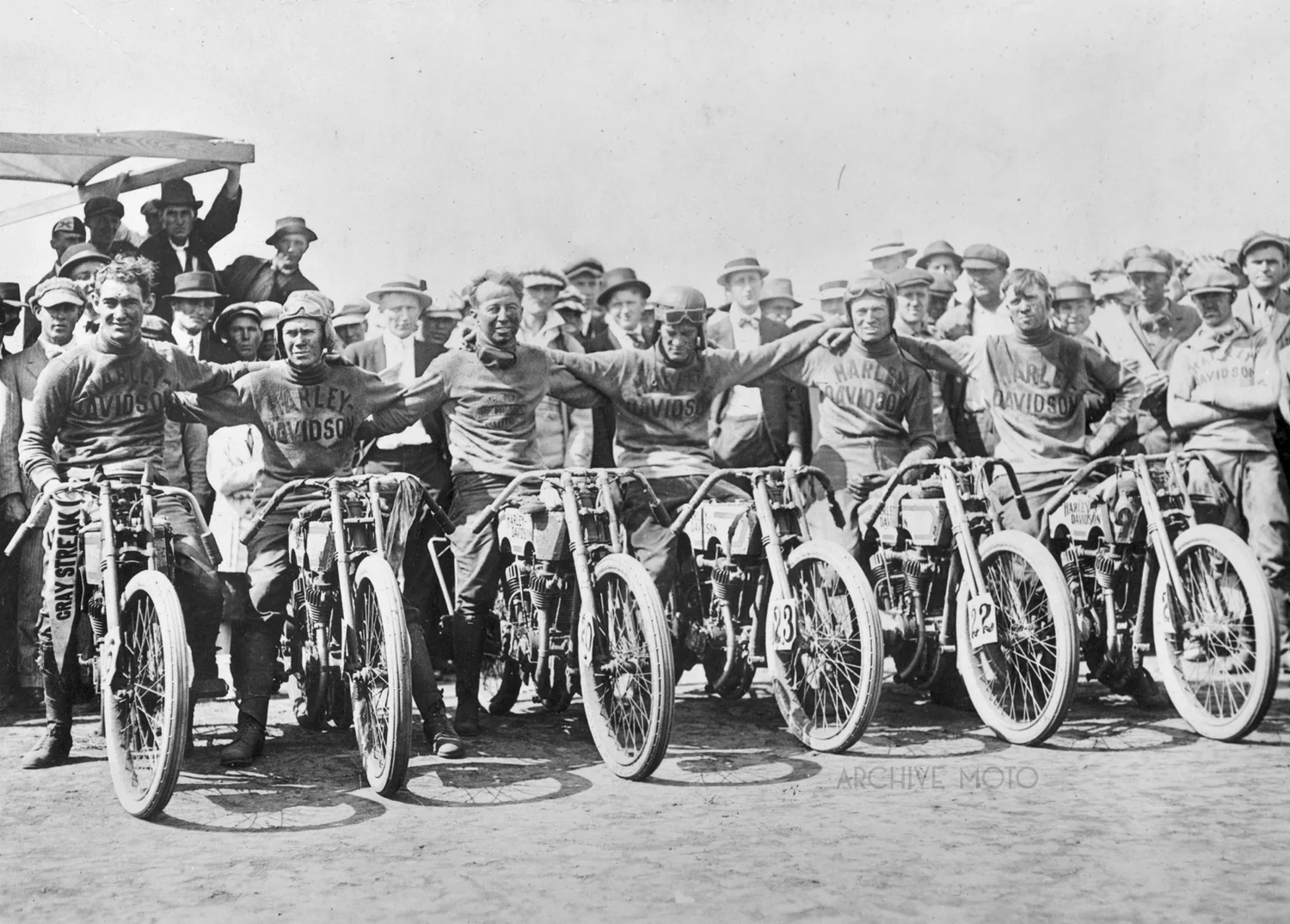
After only a year in the professional racing, the triumphant Harley-Davidson factory team poses onboard their magnificent 11KR’s after a landslide victory at the 1915 Dodge City 300, the preeminent motorcycle race at the time. Left to Right are 1st place finisher Otto Walker, 2nd Harry Crandall, 4th Joe Wolters, 5th Leslie “Red” Parkhurst, 6th Alva Stratton, and 7th Ralph Cooper.

The white-hot excitement of the American motordrome simply could not sustain and in September, 1914 the last board of the final circular motordrome was nailed in place in Omaha, Nebraska. Racing however, continued to flourish. The small horse tracks that first gave birth to motorcycle racing continued to harbor those bent on speed and victory, evolving into purpose built dirt flat tracks in the mid-teens. These dusty ovals, typically 1/2 to 1 mile in length began popping up at local and state fairgrounds across the country, becoming a staple of motorcycle and automobile racing well into the modern era. The popular endurance and reliability runs of the first decade alsotransformed into flat out, top speed, no-holds-barred endurance races that spanned hundreds of miles either on public road courses like in Savannah and Birmingham, or on the few large speedways like Atlanta, Indianapolis, and Dodge City. This was a period of large scale transition as the increasingly high level of competition in professional racing contributed to an atrophy of American motorcycle manufacturers, leaving those who faired well on the track like Merkel, Thor, Excelsior, and the mighty Indian, king of the motordrome to enjoy a prominent status in the marketplace. Harley-Davidson had built their empire thus far away from the racetrack, but in this era of intensified competition the Milwaukee based motorcycle company turned an interested eye towards racing. Building a factory racing program would require specialized skills so in 1913 Harley brought onboard Bill Ottatway, a talented engineer and tuner from Thor who quickly began developing a racing platform using Harley’s 1914 Model 10 production twin. Initially designated the 11K series, Ottaway began testing his new racers over the course of the 1914 season with a handful of unofficial competitors. After a mediocre debut at the 1914 Dodge City 300 Ottaway’s machine began to hold its own, capturing a string of regional wins and national victories in Phoenix and Birmingham. Finally, on Thanksgiving Day, 1914, Harley-Davidson fielded their first factory racing team at the Savannah 300 road race and rider Irving Janke placed 3rd. The team expanded for the 1915 racing season, the machines were further refined, and Harley started the season strong with 1st and 2nd place finishes at the Venice 300 on April 4th. By the time of the 1915 Dodge City 300, just one year after the company’s initial tests began, the Harley-Davidson factory team made a clean sweep of 1st through 7th places, the only exception being Excelsior’s Carl Goudy in 3rd. The motordrome era was over, but as the Golden Age of racing matured a new force emerged, one of American motorcycle racings greatest legacies, the Harley-Davidson factory team.


Comment

Albin K. Longren, 1908 Indian

Comment

Albin K. Longren, 1908 Indian

American aviation pioneer Albin Kasper Longren onboard what appears to be a 1907-08 Indian single as he cruises the downtown streets of Clay Center, KS. A common attribute amongst America’s earliest birdmen, Longren spent his early years behind the counter of a local hardware store, fidgeting with the mechanics of bicycles, automobiles, and motorcycles in his spare time. He first took to the skies on September 2, 1911, in a biplane of his own design, designing, manufacturing, and selling a variety of different aircraft shortly thereafter. A true daredevil, Longren funded his aviation company in those early years with revenues made performing aviation stunt shows and exhibitions across the country as one of the country’s earliest Barnstormers. His entrepreneurial aspirations were interrupted during America’s involvement with WWI and Longren became the chief inspector in the country's first military aviation research program. The program, based at McCook Field in Dayton, OH, hosted many of the country’s most talented aviators as well as a handful of newly enlisted professional motorcycle racers like the legendary Maldwyn Jones. After the war ended Longren returned to his airplane manufacturing company, and though it wouldn’t make it past the mid-1920’s, Longren continued to be an innovative force in the American aviation industry, claiming dozens of foundational patents, and lending his talents to aeronautics firms like Luscombe and Cessna. 


Comment