Tex Richards and the Chattanooga Motordrome

Comment

Tex Richards and the Chattanooga Motordrome

image.jpg

Opening day of the Chattanooga Motordrome was one full of celebration. Jack Prince, the father of the American motordrome had returned to the south in August of 1913 shortly after completing the Milwaukee Motordrome in order to build yet another of his spectacular arenas. The track in Chattanooga was to be his 19th circular wooden stadium, the second in his proposed southern circuit which included the already successful 1/4-mile Atlanta Motordrome, as well as planned tracks in Nashville, Memphis, and Birmingham. At mid-day on September 11, 1913 a grand parade through the streets of downtown Chattanooga kicked off the festivities. By late afternoon a crowd of over 5,000 packed into the overwhelmed Rossville Trolly line and headed to Prince’s coliseum of speed. Larger than any sporting venue in the area the Motordrome was a sight to see, the 1/5-mile wooden track was blanketed in electric light for the opening races, and according to one report the illumination alone was worth the $.25 price of admission.


A card of 8 races fired off at 8:30 pm that evening featuring top riders from around the country. Fred Luther from Syracuse, Tex Richards from Dallas, Harry Swartz from Denver, Henry Lewis from Springfield, “Millionaire” Morty Graves from Los Angeles, Harry Glenn from Atlanta, and George Renel, the star racer from Paris. Each of the riders had come up from Atlanta where they had run the night before, the latest in a season long battle between Graves and Richards in which Graves had just come out on top. Richards, motivated by his loss tore around the brand new boards of Chattanooga, winning both of the two finals and hitting average speeds of 83 mph onboard his crimson Indian. Atlanta’s Harry Glenn provided quite a scene for the virgin eyes of the Chattanooga crowd as he nearly shot off of the track after blowing a tire at 80 mph, sending him crashing hard into the infield. In typical fashion for the day, the hard-nosed Glenn hobbled back to the pits, dusted himself off, and convinced the officials to allow him to run in the final heat. But again Glenn lost a tire at top speed, this time nearly clipping the rear wheel of Fred Luther before safely coasting a full lap to the bottom of the drome. The people off Chattanooga were instantly hooked, Chattanooga’s newest sport was a sensation and a series of nightly races were scheduled for the following week.


This intimate portrait of Wilmer Richards, the lanky Texan, was taken a couple of years after his glory days competing for Indian in the motordromes of Atlanta, Chattanooga, Houston, and Dallas. In 1915, Richards joined a handful of fellow racers in Atlanta when he took a job in Gus Castle’s Harley-Davidson Southern Branch.  As the days of the motordrome spectacle faded across America Richards began competing for the Milwaukee Motor Co. in long distance road races and the increasingly popular flat track circuit, until in 1919 when he returned to racing for Indian.

Comment

Young Hammond

2 Comments

Young Hammond

image.jpg

Henry Hammond Springs, I chose this photo of the young racing prodigy for the cover of Georgia Motorcycle History because, well... the kid was bad. It was taken while Hammond posed onboard his “Daytona” racer on the roof of the Indian factory in Springfield, MA shortly after Hammond’s gasoline-starved run at the 1921 Dodge City 300. Tragically, we never got to see the full potential of the 19 year old crack from Augusta, GA. Just 9 months after sitting for this photo Hammond collided with Harley-Davidson's Eddie Brinck at full clip on a flat track in South Bend, IN, sending him flying out of control and through a fence, ultimately killing young Hammond. The Georgia boy who had cut his teeth during the Great War as he was too young to enlist had, in a very short time risen to be counted among the greatest motorcycle racers in the country.  Though he had only competed on the national circuit for 2 short years Hammond’s death rattled the country, reports were printed in papers from coast to coast. His body was returned to his family in Atlanta where a motorcade of racers, enthusiasts, and officers laid the teenaged star to rest beneath a beautiful monument in West View Cemetery.

2 Comments

Freddie's Big Day

Comment

Freddie's Big Day

image.jpg

Los Angeles’ Fred Ludlow, a staple member of the famed Harley-Davidson “Wrecking Crew” factory racing team on board his 8-valve banjo 2 cam, like the one he ran at the 1921 M&ATA Nationals, which were held in Syracuse, NY. It was there on September 19th, on the dirt mile oval of the State Fairgrounds that Ludlow had arguably the best day of racing in his life. Ludlow closed out every single event on the day’s card in the top spot, winning the checkered flag in the 1, 5, 10, 25, and 50 mile races... a clean sweep. Along with his victories the dapper Californian laid down new record times in the 10, 25, and 50 mile events with an average speed of nearly 80 mph for the day. At the closing of the day, Ludlow collected over $1000 in prize money, what would be nearly $14,000 today. The Wrecking Crew was disbanded by the Motor Co. a few short months later as the brass pulled the plug on their highly competitive racing program for the 1922 season. However, with some of his most recent winnings no doubt Ludlow, along with Wrecking Crew teammates Ray Weishaar, Otto Walker, and Jim Davis each purchased their factory racing machines from the company. This iconic image of 26 year old Fred Ludlow was snapped at the famed board track speedway in Beverly Hills earlier in the year before Ludlow dominated at the dusty Syracuse Mile, September 19th, 1921... Freddie’s big day.

Comment

Man's Best Friend 1912

Comment

Man's Best Friend 1912

image.jpg

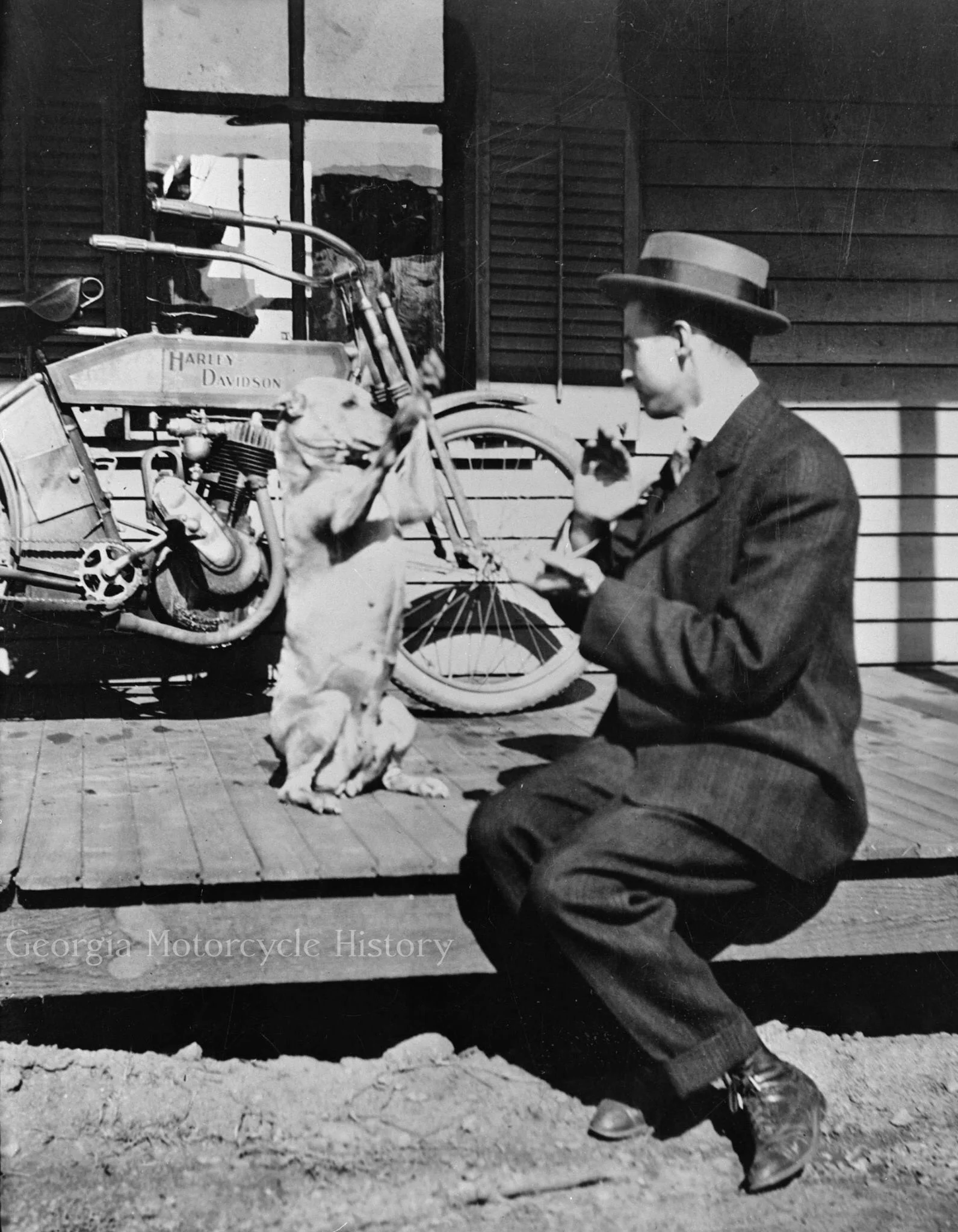
Another one of my favorite shots from the book. Here, a well appointed gentleman teaches his dog a few new tricks on the front porch of his home in Athens, Georgia. In the background sits what appears to be a 1912 Harley-Davidson x8a belt-driven single, affectionately known as the "Silent Gray Fellow" for its Renault Grey paint job and efficient 30ci, 4hp engine. The x in the name indicates that this model was equipped with Harley's brand new "Free Wheel Control" clutch setup, a new feature for 1912 along with the introduction of the "Ful-Floeting Seat," a long spring enclosed in the down tube of the frame giving the seat post and sprung saddle a full 4 inches of travel.


This is just one of the over 200 remarkable and exclusive photographs included in Georgia Motorcycle History: The First 60 Years 1899-1959. The high quality hard cover book details the early years of motorcycling history through rare and never-before seen photos making it a great gift idea for any motorcycling enthusiast. Order yours today in the web store at the top of the page.

Comment