Arguably one of the finest and most recognizable American motorcycle racing legends, “Smokin" Joe Petrali proved more often than not that he was the fastest on any surface; boards, dirt, hills, or sand. A 49 time AMA National Champion, Petrali’s professional racing career spanned nearly 2 decades, and, not unlike superman’s “S,” Petrali proudly bore Harley-Davidson across his chest. However, the iconic Harley-Davidson crusader didn’t begin his love affair of motorcycles with the company, it was a curious mixup, some may even say fate that brought the two together in the summer of 1925.
Like so many great racers, Petrali was born at a perfect time. The pioneers of American motorcycle racing typically were born in the late 1800’s, with 1890 seemingly being the sweet spot. That meant that they could take to the developing machines, and there increasing power while they were still youthful and fearless. The racers born in the last decade of the 19th century cut their teeth on horse tracks as teenagers and created the professional racing culture as we know it on America's fabled board track motordromes. For those who were born in the early 1900’s like Petrali, growing up within a forming culture presented limitless and undeniable inspiration. It was this generation who became young teens at the height of the board track era, able to watch in awe, jaws on the floor, the heroes of the golden age of motorcycle racing battle for first place. Aside from bearing witness to legends, this second generation also had the advantage of more available machinery than their predecessors, being able to hop on the bikes of their friends, family, or neighbors and imagine themselves crossing the finish line.
Petrali, being born in San Francisco in 1904, grew up in the midst of booming American racing culture. The story goes that by the time he was 12 years old Petrali had already begun riding a neighbors Flanders IV. The wide eyed motor head lived near the State Fairground race track and took in every race that came to town. The next year he saved enough money while working at Archie Rife’s shop to buy a old 1913 Indian, and he was off. At 14 he was competing in local economy runs and endurance races, and in 1921 at the age of 17 was given a chance to run a factory Indian against the legendary Harley-Davidson Wrecking Crew at the Pacific Coast Championship in Fresno. Despite his lack of experience, despite having to battle the top professionals of the 1920’s, including a few of his childhood heroes, and despite the fact that he was more or less a guinea pig for Indian’s racing manager who had Petrali run the bike on alcohol (a first in the sport), Smokin Joe crossed the line in second place.
Though Petrali continued to try and find his place in professional racing, it wasn’t until July of 1925 that all of the pieces fell into place. Indian Motorcycles was a wavering company by the mid-20’s. The company that practically invented American motorcycle racing culture, dominated the motordrome era, and produced some of the most seminal and cutting edge motorcycles in the world had lost both of its founders by the mid teens, and lost its market share as well as its track superiority to Harley-Davidson after WWI. Indian was still the second strongest company in America, but it is not hard for one to look back and see the decline of the Springfield company beginning after WWI.
In what could be described as a monumental blunder, Indian sent the machine Petrali was supposed to run at the July 1925 AMA 100-mile championship in Altoona, Pennsylvania to Pittsburg. Without a ride, a distraught Petrali was forced to take in the race from the sidelines until one of the Harley boys intervened. Ralph Hepburn, an original member of Harley's Wrecking Crew took a spill, the story goes that Hepburn approached Petrali and worked out a deal. If Petrali could fix up Hepburn’s damaged machine, he could run it if he agreed to split his winnings. Not only did he win the 100-mile race, Petrali also set an unbroken board track record of 100.36 mph. As agreed the money was split, and Petrali held his head high as he returned to his job in Kansas City at Al Crocker’s shop, the founder of Crocker Motorcycles. Harley tracked down this lightning bolt of a 21 year old and quickly signed him to a contract, but it was a happenstance in July of 1925, on the 1.25 mile long board track speedway in Altoona that a Harley-Davidson legend was born.
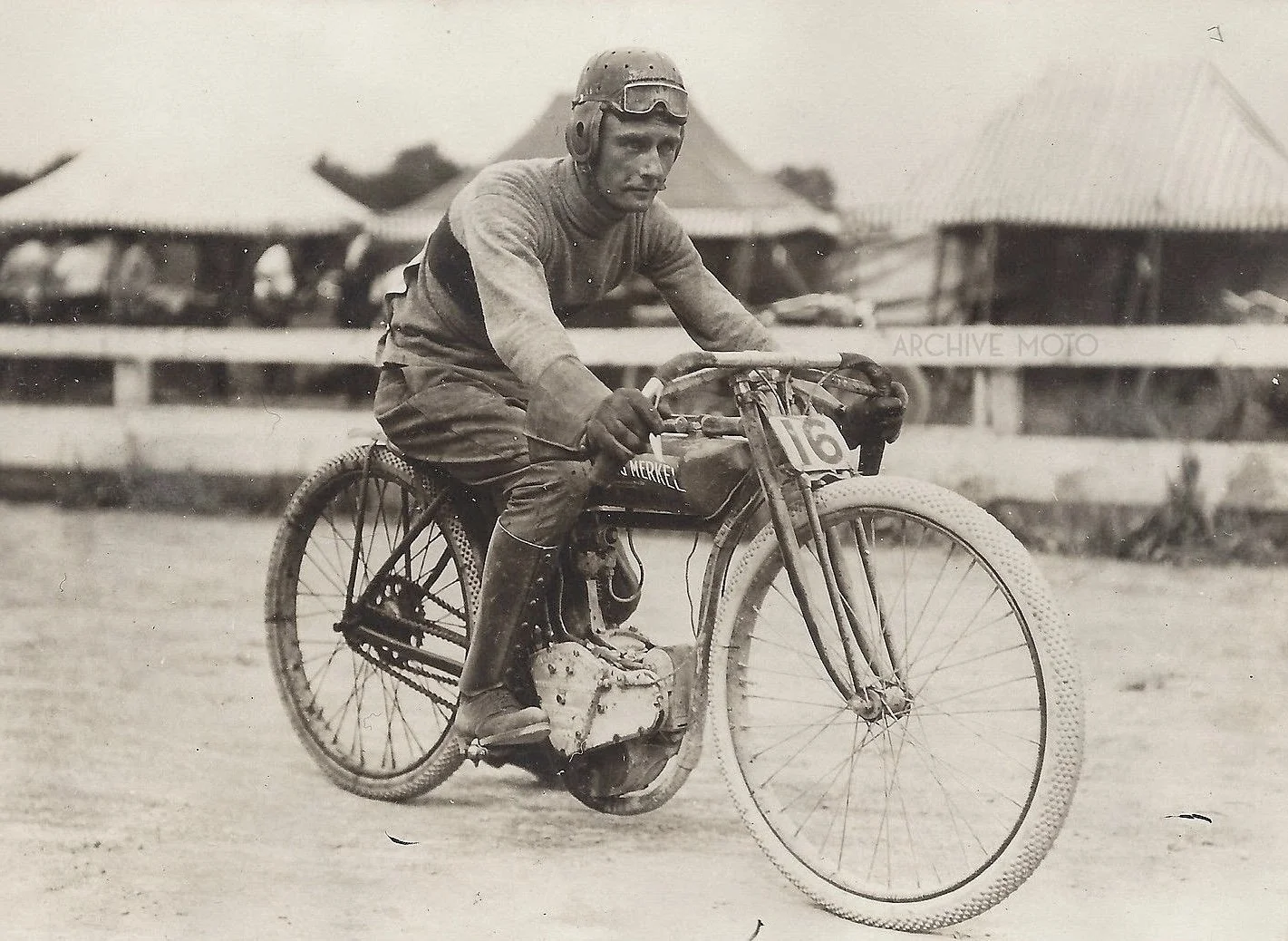
This photo was taken of Joe Petrali, on Ralph Hepburn’s Harley-Davidson two cam, quite possibly with Hepburn’s jersey on in the pits of Altoona that fateful day in 1925.