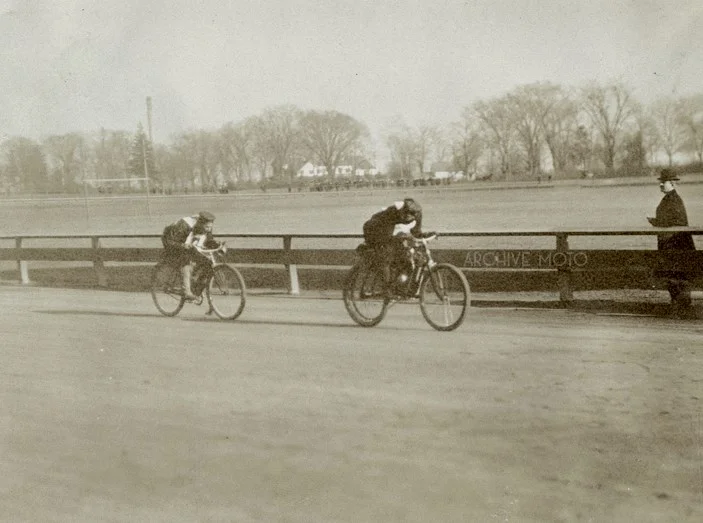
It was the bitter cold on the morning of December 10th, 1904 that kept but a handful of motoring enthusiasts from venturing to the Weequahic Park horse track in Waverly, NJ, but for those bundled few who braved the frigid New England air a great show was in store.
By 1904, the 1/2 mile trotting track, which boasted a 5,000 capacity grandstand had been established as the area’s premier venue for the burgeoning motor culture. The New Jersey Automobile & Motor Club chose the site for their annual event, typically held on Election Day, and as soon as motorcycles made their debut they were given a spotlight in the festivities.
Motorcycles themselves had only recently been introduced, though it was seemingly within the blink of an eye that the first organized race took place. Ralph Hamlin, a former bicycle racer turned shop owner won that first competition, which was held on a similar horse track at Los Angles' Agriculture Park in May of 1901. Hamlin, who recognized the opportunity motorcycles presented became the first motorcycle dealer on the west coast, and it was on one of his Orient motorcycles that he bested the other 3 competitors and won the 10-mile event in 18 minutes, 32 seconds, an average speed of 32.3 mph. Velodrome exhibitions, hill climbs against the clock, and endurance competitions soon became popular events, but it was dirt oval horse tracks, like the ones at Agriculture Park and Weequahic Park that proved to be the perfect venue for spectators to witness the birth of American motorcycle racing.
The cold may have kept the crowds from flooding the grounds at Weequahic on December 10th, none the less three local men took to the frosty dirt and mounted their machines. The competitors were Allen Reid onboard a 4hp Orient, William Cornwell on an early 1 3/4hp Indian, and Roy Geissler sporting a 3hp Tourist. Reid took the first 10-mile race onboard his powerful Orient with an average speed of 38.7 mph. Despite having nearly double the horsepower of Cornwell’s Indian, Geissler’s Tourist simply couldn’t keep pace and he quickly fell out of the running. For the second 10-mile match, Cornwell allowed his friend Percy Johnson to run. Johnson quickly took the lead over Reid, but after leading the first two miles a valve snapped and Johnson was forced to drop out, leaving Reid the only remaining competitor and default victor.
Seen here, Allen Reid onboard his mighty Orient takes a second to glance back at William Cornwell on his Indian nipping at his heels at Weequahic Park, December 10th, 1904.
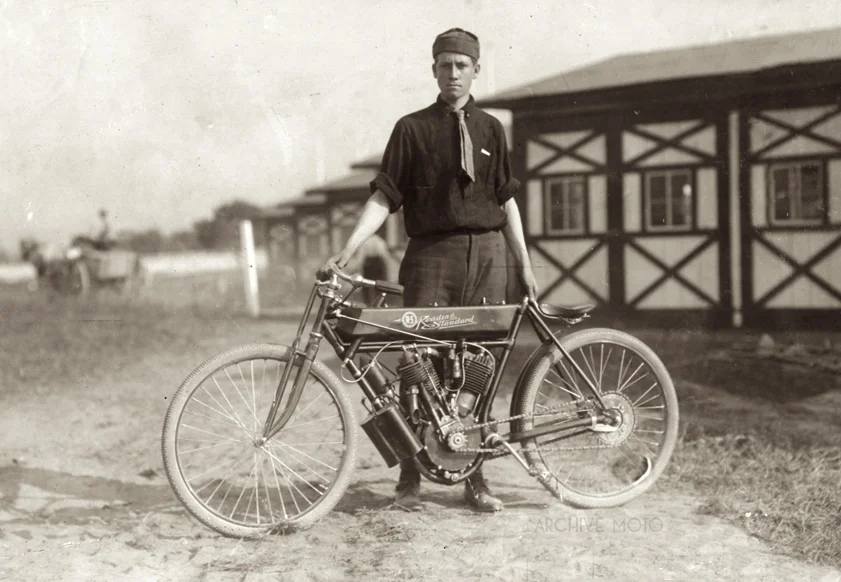
Almost 106 years ago to the day, on August 14th, 1909 the Indianapolis Motor Speedway, America's internationally renowned cathedral of speed opened its gates and it was motorcycles, not automobiles that lined up at the starting line. Today, the world's best motorcycle racers again take to the line as the MotoGP series returns to the hollowed ground of the Brickyard. One of those first competitors to run at Indianapolis was Ray Seymour, one of America's earliest racing superstars and a true American motorcycle racing pioneer. Captured here with his Reading Standard in the garage paddock of the newly opened Indianapolis Motor Speedway, opening day August 14, 1909.
The more things change, the more they stay the same. November 1910.
Today's post is in honor of the MotoGP race being held on the hallowed ground of Indianapolis this Sunday.
This photo captures a moment from the earliest days of American motorcycle racing. Before the massive super speedways and infamous board track motordromes, before the fervent manufacturer arms races and mighty advertising economy, and before sponsorship and stardom daring young men obsessed with speed and victory barreled around local horse tracks in tremendous clouds of oily dust. Motorcycles were less than a decade old, really no more than stout bicycles with gasoline engines strapped on, but already they had become the main attraction at fairgrounds across the country.
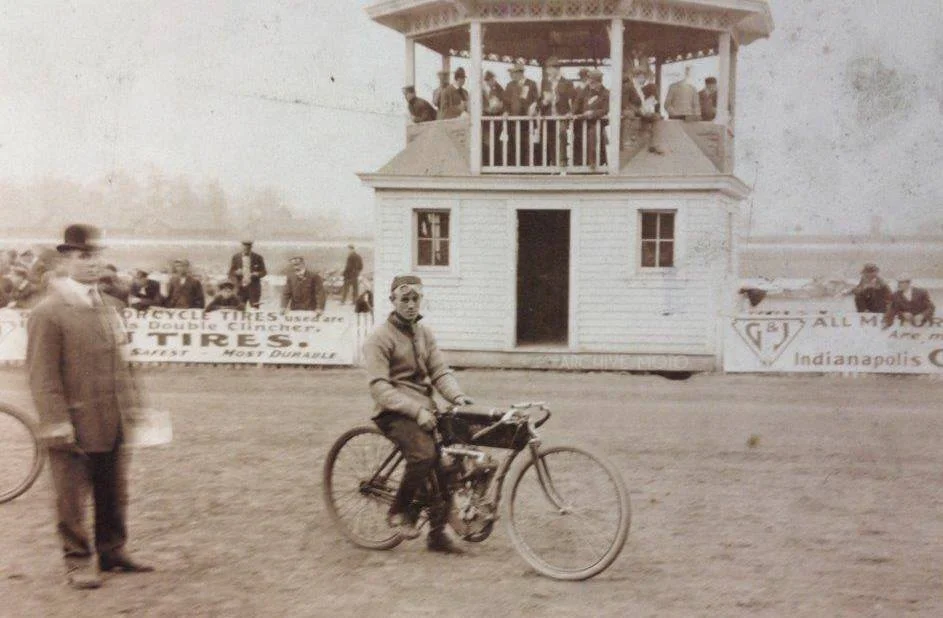
On October 10th, 1908 the Indiana Motorcycle Club held their first event on the 1-mile dirt horse track at the State Fairgrounds in Indianapolis. A large number of daring early motorcyclist arrived to test their mettle, but it was a young Chicago native named Freddie Huyck that would take the day. One of America's pioneer motorcycle racers, Huyck won every race he entered that day and set a new 1-mile record in a shade over 56 seconds. Huyck dominated the large field of competitors on board a very special loop-frame prototype Indian twin, one of only three newly developed that year by Oscar Hedstrom, the innovative engineer at the Hendee Manufacturing Company.
The new design would mark the beginning of a transition, the dawn of the modern motorcycle. Local organizations like the Indiana Motorcycle Club would continue to grow, all the while organizing and promoting motorcycle races. In a few short months the Indianapolis Motor Speedway, America's legendary racing mecca would be constructed a few blocks from the fairgrounds. Within a year Indian signed its first factory racing star Jake DeRosier, soon followed by Hyuck, and America's first board track motordrome was opened in Los Angeles. A new era had begun to take shape, motorcycle racings crowded hour, a time in which competition, innovation, and fearlessness gave rise to a new industry and established one of America's richest cultural strands. Here, mounted on his rare Indian and donning his signature haunting blank stare is Chicago's young star Freddie Huyck on that victorious day in Indianapolis, Oct. 10th, 1908.