Though not as recognizable as many of his iconic peers, Robert Thomas Stubbs, better known as Bob, was a champion pioneer in the earliest days of motorcycle sport at the turn of the century. Hailing from Birmingham, Alabama, Stubbs was the eldest of ten children of Lizzie Gilbert and Thomas Jefferson Stubbs, a Confederate soldier who fought in the battles of Tuscaloosa and Chickamauga. Like many of America's first motorcycle racers, Stubbs was active in the cycling world of the late 1800s, competing in regional events throughout the southeast. His passion for two-wheeled racing soon turned to the exciting new motorized machines as they first appeared in the South. As Indian was among the first manufacturers to establish a firm grip on production and distribution at scale, Stubbs' name became among the first in the American South, just as his counterpart in Georgia, Harry Glenn, to appear beside mentions of the Springfield marque in the earliest local competitions. By 1907, Stubbs had been elected President of the newly formed Birmingham Motorcycle Club, where he organized some of the first track competitions in the region at the nearby dirt track at the Alabama State Fairgrounds, arranging the first ever meet there on July 4, 1907, and sweeping every event.
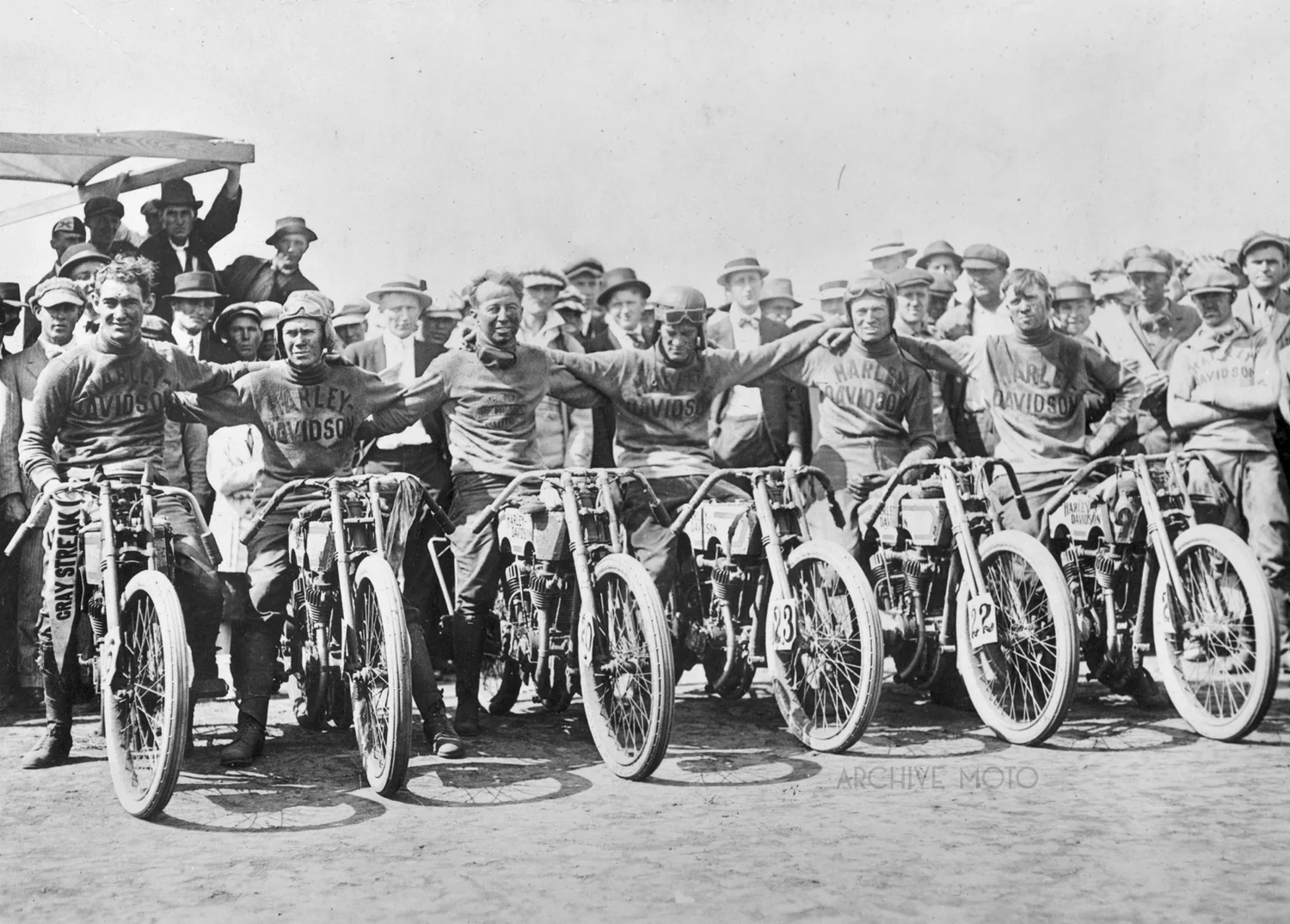
The tail end of 1914 stirred talk throughout the motorcycling world of a new contender in the racing game, and with Harley-Davidson’s victories in Venice, Oklahoma City, and La Grande as the 1915 season began, the rumblings had been proven true. Still, it was at the 2nd annual Dodge City 300, the Coyote Classic held July 3rd, 1915, that the Motor Company staked its claim as the American motorcycle manufacturer to beat. All of the momentum built by the company over the previous decade and the effort put in by Bill Ottaway to create a world-class racing team the year before came to a crest in a small town in the heart of America as the eyes of the motoring world turned towards Kansas.
Seen here is the Harley-Davidson Motor Company in 1906, featuring founders, staff, and customers alongside a handful of its earliest machines. The photo is listed as 1906; however, it may actually be 1907, as it was taken in front of the Chestnut Street factory, the first expansion beyond the Davidson family's shed. This is because Chestnut St. wasn't complete until December 1906, so if this was taken then it looks unseasonably balmy.
Former bicycle racer and American motorcycle pioneer Walter G. Collins onboard his 1908 Indian twin in San Francisco, July 12, 1908. “Mile A Minute” Collins, as he became known after being the first to top the 60 MPH mark at LA's Agriculture Park track onboard a cumbersome French Peugeot twin, was one of the founding fathers of American motorcycle racing. Hailing from LA, Collins had been among the best bicycle racers on the West Coast during the sport’s heyday before quickly transitioning to motorcycles once they first arrived.