Mystery Pope Special, ca. 1913

Comment

Mystery Pope Special, ca. 1913

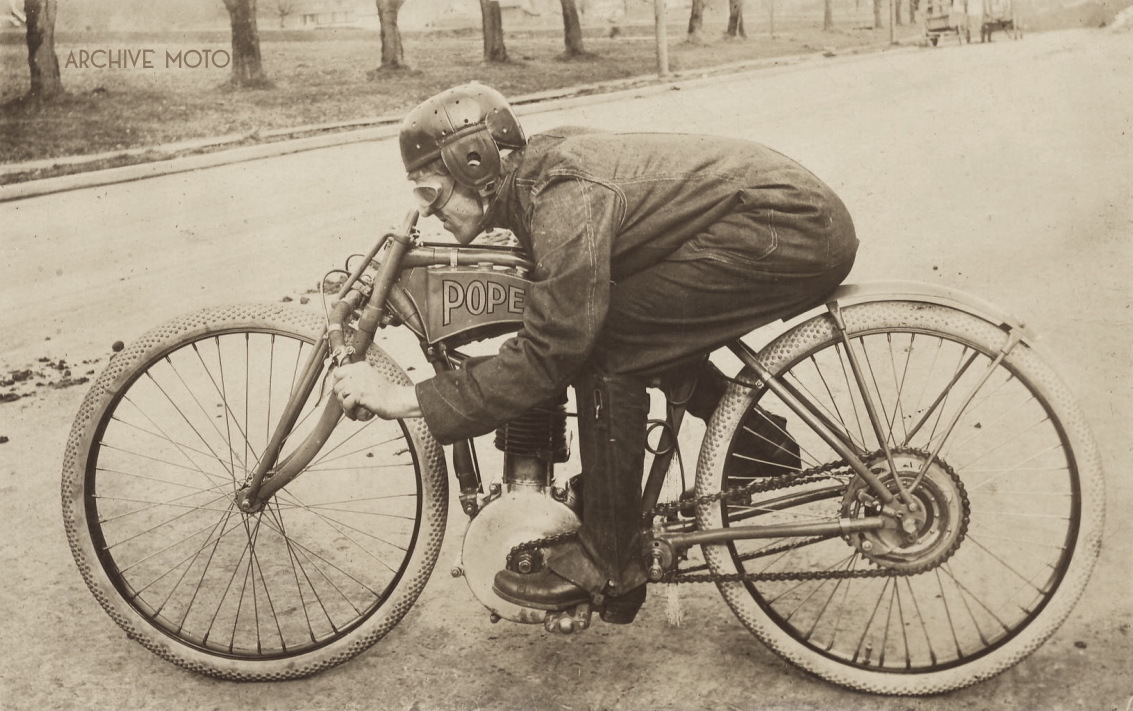
Photographs like this one are what initiated my interest in researching early American motorcycle culture. Most of us have seen it a million times thanks to the internet, but we seem to know so little about it. However, despite it ubiquity the image still pulls out the same feeling as it did when I first stumbled across it. All of the buzzwords apply, but they never quite capture that common feeling that stirs in all motorcycle enthusiasts, shared equally back through the decades. I hope that collectively we can root out the details of this very unique moment in our past, so I throw the challenge out to the community, what do we know about this photo?


What we can surmise is that, based on the livery, this Pope would most likely have come from between 1911 and 1918 based on the Westfield, MA manufacturer’s production years. Though a handful of Pope’s were raced throughout those years, there seems to have been no great factory racing program like those of their competition rivals, and the machines that did pop up at the track tended to be more “stripped-stock” iterations of the production 1,000cc OHV twin platform. Based on the castings of the shortened, keystone frame as well as the modified fork arms, which include what must be the most bizarre handlebar placement in history, this machine was most likely assembled in the mid-teen’s with the 1/2 mile dirt track in mind. The single cylinder, direct chain drive engine is most likely between 2 and 5 HP, though the mag placement behind the cylinder points more towards the 5HP, OHV Model K from 1913. The rider, who seems determined to split his face open from chin to brow is tucked in tight like a seasoned pro, but his coveralls allude to his possible responsibility in the machine’s creation altogether.


Enough with the speculation, what do you guys think?
Comment

Thanks For A Great 2016, Cheers To a New Year!

Comment

Thanks For A Great 2016, Cheers To a New Year!

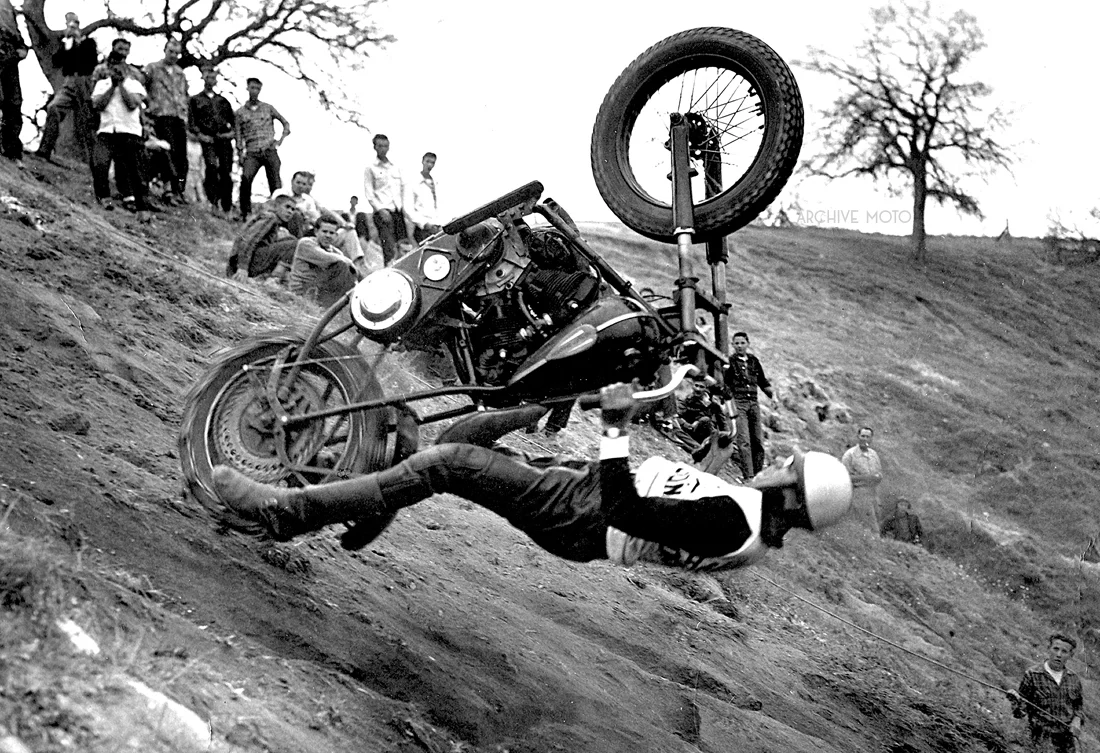
Harold Mathews, 1948 AMA National Hill Climb Champion, Fresno’s Harley-Davidson dealer since 1953, and a passionate life-long motorcyclist having a bit of a 2016-esque moment back around 1949.

What a crazy year. I hope you faired better than old Harold did in this shot, but if not just remember that he went on to become the National Champ so keep on pushing.

I am humbled and delighted at how much this little Archive Moto project has grown so far and I’m excited for what the next year holds. I have some exciting new side projects brewing, a full calendar of events that I’m hopping on the ’41 and rolling out to hang, and with any luck I will be releasing my second book documenting the remarkable series of pre-1930’s American motorcycle racing photographs from The Van Order Collection. The one thing that I’ve noticed as my little history project has grown is how much motorcycle culture is exploding in our own time, and how so many friends are making this one of the best times to live on two wheels.

I do not like printing “I” very often in my posts, but Archive is just me, Chris, so I sincerely want to wish the best for everybody in the coming year and I look forward to the good times to come! Cheers.

Here is to a hell of a 2017.

“… to sleep late, have fun, get wild, drink whisky, and drive fast on empty streets with nothing in mind except falling in love and not getting arrested . . . Res ipsa loquitur. Let the good times roll.” ~HST

Chris 

Comment

1912 24-Hour Motordrome Champ Billy Shields, Atlanta, 1913

Comment

1912 24-Hour Motordrome Champ Billy Shields, Atlanta, 1913

Today’s article comes from my good buddy and fervent motorcycle history hound David Morrill who put together a wonderful piece on a remarkable 24 hour blow out race on the boards of the Stadium Motordrome at Brighton Beach in the fall of 1912. The circular “saucer” track located just south of New York City was 1/3 mile long with a continuous banking of 53 degrees and opened in June 1912. Following the tragedy on September 8, 1912 at the nearby Vailsburg Motordrome in Newark, NJ, the stadium at Brighton Beach closed for a week in observance of the six spectators who died along with racers Eddie Hasha and Johnny Albright. When the gates reopened the management at Brighton Beach decided to draw in the masses with the spectacle of a 24 hour endurance event. Given that most races at the motordromes took mere minutes, with an entire days worth of cards wrapping up in an hour or two, a 24 hour flat-out sprint was a grueling if not impossible idea. As such a massive prize of $5,500 and a large gold cup was put up for grabs to the team who came out the victor. 

Five teams, all riding Indian motorcycles except for one with a J.A.P. mount lined up at the Brighton Beach Stadium in front of a crowd of 10,000 on September 20, 1912. Four hours on end the men rung out their throttles, averaging speeds of nearly 70 mph onboard bare-bones machines meant only for top speed sprints, the machines were taxed but it was the men’s bodies that were really being held to the fire. Burning legs and cracking kidneys began dismantling the teams one by one so in hopes of keeping up the competition the teams were allowed to mix and merge members. However, one team remained unsullied, that of Billy Shields and George Lockner, local boys who determined to take the prize. In the end, after running 4,124 laps, for a total of 1,374 miles on a 1/3 mile long track made of rough sewn 2” strips, Locker and Shields were declared the winners. Both men, along with fellow competitor, a Scotsman named Jock McNeil soon boarded a train bound for Atlanta to compete at Jack Prince’s newly constructed Atlanta Motordrome for the 1913 season. This photograph of the Brighton Beach “Twice-Around-The-Clock” champion Billy Shields comes just after his victory in New York after he had arrived at the Atlanta Motordrome in the summer of 1913.

Make sure to head over to David’s blog to learn more about this remarkable and unique event from the motordrome era at Deadly Dave's Blog

Comment

Maldwyn Jones and Ray Weishaar, Toledo, Ohio, June 18, 1916.

2 Comments

Maldwyn Jones and Ray Weishaar, Toledo, Ohio, June 18, 1916.

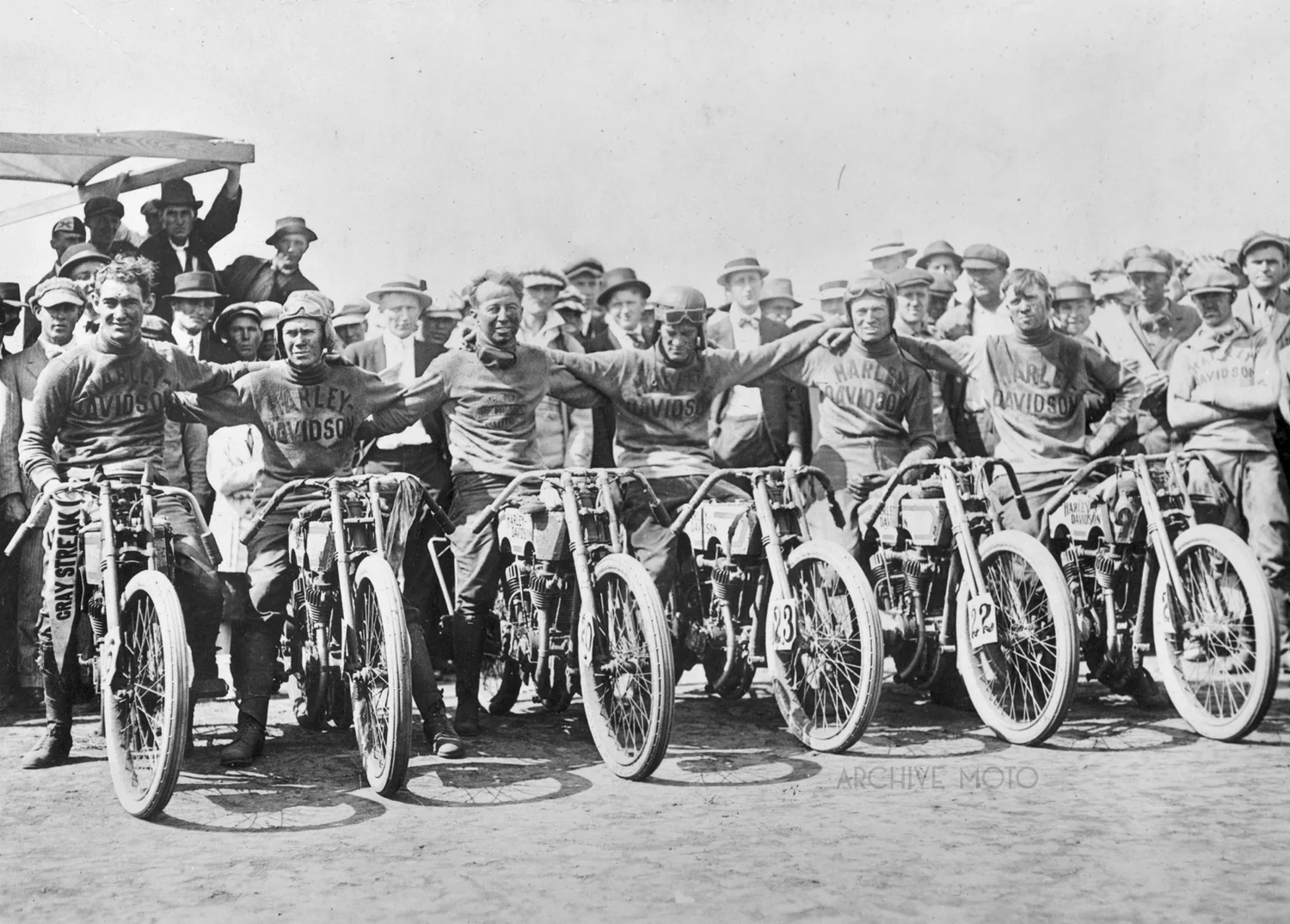
Two founding father’s of American motorcycle racing, and two exceptional purebred Harley-Davidson racers in the country’s heartland just over 100 years ago. The men are, quite simply put, legends and their machines are as rare as they come. Maldwyn Jones stands in the rear of the photo in his homemade, padded leather helmet next to his brand new Merkel/Harley hybrid, while Ray Weishaar, the “Kansas Cyclone” straddles one of two new experimental factory 4-Valve racers at the Toledo 1/2 mile track on June 18, 1916. 


Jones was a well established professional by 1916, however, waining factory support from Flying Merkel had driven the 25 year old Ohioan to leave the company with whom he had started his racing career back in 1910. Jones picked up a steady job in the U.S. Experimental Aviation Engines Department at McCook Field in Dayton, OH with the understanding that he could use his ample time off to continue racing. The visionary of the blossoming Harley-Davidson racing program, Bill Ottaway took note and made sure that the next jersey that jones pulled over bore the Milwaukee livery. The machine that you see next to Maldwyn is the only one ever built like it, a necessary accommodation for the union between Jones and Ottaway which paired Maldwyn’s specially constructed keystone chassis from his glory days at Merkel with a trimmed down, blanked off, 30.50ci single cylinder version of Ottaway’s recent experimentations with overhead valve setups. This race was the machine’s debut, and the first run of many that Maldwyn would make for Harley-Davidson for years to come. 


Ray Weishaar, (pronounced wisher) was the same age as Jones, but hadn’t been on the national stage for quite as long. However, Weihsaar was a veteran of the Harley-Davidson factory racing program having been one of the few selected to pilot their experimental 11K series as a member of the first fully supported factory team for the Savannah 300 mile road race on Thanksgiving Day, 1914. Though similar, the machine that Weishaar was competing on was a full on factory creation, one of two new low slung, short keystone framed, 4 valve single designs that Ottaway had only recently began developing. Weishaar, along with fellow factory rider B.B. Bivins debuted the two factory 1/2 mile machines at races held in Roanoke, VA on April 24, 1916. Weishaar swept the event on his new nimble and lightening fast 4 valve racking up victories in the 1, 3, and 10 mile and only losing to Indian’s “Shorty” Matthews after both his and Bivin’s machine’s blew tires in the 15 mile race.


Though the iconic men and unique machines make the moment captured in this photo quite interesting, the pair unfortunately didn’t fair too well that summer day in 1916. Neither man took the top spot in any heat, though in fairness their competition did include names like Ray Creviston, Cleo Pineau, and Lee Taylor. Weishaar was poised to take the big 25 mile race until his engine failed, allowing Indian’s Lee Taylor to take the victory while Jones was just barely nosed out of second place. Pushing their little 30.50 singles to upwards of 55 mph around the dirt 1/2 mile Weishaar pulled off a second place finish to Indian’s Shorty Matthews in the 10 mile race, what would be the Milwaukee team's best finish of the day. Nonetheless, this image remains a remarkable and unique moment captured in the evolution of American motorcycle racing history featuring two of the greatest racers to have ever thrown over a leg and their remarkably special motorcycles.

2 Comments