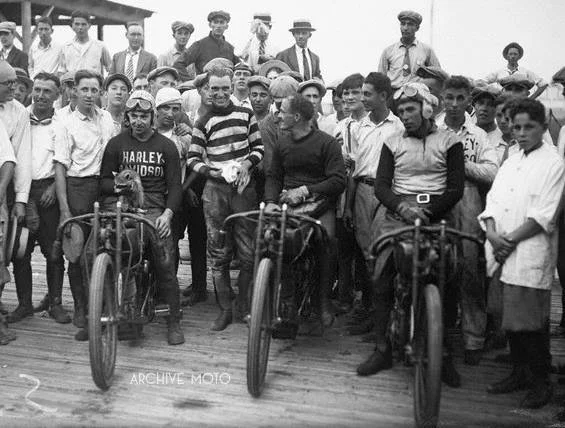
Today's post is an open question to the community. Another forum find, I recently stumbled upon this little gem. It is credited in Rin Tananka's Harley Davidson Book of Fashions as August Walters (August E. "Blick" Wolters) onboard a single cylinder Harley-Davidson racer at the Legion Ascot Speedway, January 8, 1927. However, that is no ordinary, run of the mill factory Peashooter of late 1920's acclaim. It is a blanked-off Cyclone twin in a keystone frame with what appears to be a Merkel fork, a real (fast) frankenstein. So who was August Walters and where did he come across such a wonderful abomination. Was the machine created by Walters, and how did it stack up against legends like Joe Petrali riding the latest overhead valve Harley Davidson factory singles, affectionately known as Peashooters? I welcome any and all information and speculation friends.
UPDATE: Since posting this request for information earlier today those treasured and seemingly all knowing enthusiasts that occupy the web have piped up and filled this machine's truly remarkable pedigree. August E. “Blick” Wolters was indeed a privateer racer in the late 1920’s and manufactured this odd bird on his own. Unable to acquire a factory single “peashooter" from either Harley-Davidson or Indian, Wolters retooled his Cyclone twin by removing the rear cylinder, machining a new barrel and domed piston, and retrofitting an oil pump off of an Indian to the former rear cylinder’s overhead camshaft. Wolters himself was quite the character, having run Henderson’s in Los Angeles area events as far back as 1916. Most notably, Wolters set a new record in March of 1918 by piloting his Henderson 4 up the 9-mile toll road up Mt. Wilson. He covered the distance in 26 minutes 24 seconds despite having a spill halfway up the mountain which rendered his clutch useless and permanently retarded his spark advance. Wolters again made the headlines a few weeks later when he took another Henderson 4 for a couple of laps over the tracks of LA’s largest roller coaster… but I digress. After reconfiguring and down-engineering his powerful Cyclone engine Wolters then squeezed the now single-cylinder power plant into a mid 20’s short coupled Harley Davidson frame, he also added a rigid Flying Merkel fork, a popular front end among speed demons. Thus the machine that a smiling Blick Wolters poses with in this photo from the January 1926 races at the Legion Ascot Speedway was born, but the story does not end there. Wolters continued racing the machine, until it ultimately became a part of the collection at Harrah’s Automotive Museum in Reno, Nevada where it remained for some time. The machine was then restored and the Cyclone engine put back to its original, factory configuration. In the early 1980’s the Harrah’s collection was sold and the machine changed hands between collectors a handful of times in recent decades. In 2012 this odd racer, made by the hands of August E. Blick Wolters was stolen in an unnerving armed home invasion, the machine remains missing.
Thank you everyone who helped fill me in on this amazing story.
How many times have you seen this picture? How much do you know about it? How about a little background on one of the most reposted and iconic images in motoculture?
In February of 1921 Otto Walker, one of the original members of Harley Davidson's legendary Wrecking Crew threw his leg over a state of the art banjo 2 cam 8-valve factory racer and became the first man to win a race at an average speed of over 100 mph on the boards of the Fresno Speedway.
The image is used most often as the quintessential representation of board track racing, however by the 1920's the tight, steeply-banked circular motordromes had all disappeared. Although the 1-mile long Fresno Speedway was surfaced in the same manner as the early circular motordromes, it was oval in shape with flat straightaways and banked corners, as was the standard construction style after WWI. The last of the circular dromes was built 7 years prior in 1914, and the sanctioning body in America, the M&ATA had outlawed races on any tracks less than 1 mile in length in 1919.
Otto piloted his two-wheeled rocket to just over 107 mph in the 1-mile time trail, and won the 50-mile at just over 101 mph. Walker also earned the title of winning the most races at a single event that same day, sweeping all categories at over 100 mph each. One odd detail, after serving as an aeronautic mechanic in France during the Great War Walker acquired a rather unique crested German pilots helmet which he debuted upon his return to professional racing in 1919. In what is arguably one of the most iconic images in motorcycling history Walker's signature helmet is missing, Id like to think for aerodynamic purposes.
Undoubtedly one of the most iconic images from the early days of the Harley-Davidson racing program is the shot of veteran racer Ray Weishaar holding a small pig at the 1920 labor day race in Marion, IN. Many point to those images of Ray and his pet pig as the origin of the Harley "Hog” association, but that story is one readily available from a number of sources. What offers a bit more intrigue are the handful of snapshots capturing other racers with an array of different critters, the ones that didn’t stick. Could it be that during the high stakes relaunch of professional motorcycle racing in America there was a race off of the track, a mascot war? Perhaps it was not so dramatic, but there are a few photographs, like one of Maldwyn Jones holding a coyote pup, or another image of Walt Higley holding a turtle and Ralph Hepburn holding a rabbit at the 1921 Dodge City race that provide another fascinating detail of post-war racing culture. Take a close look at this image and you may just spot such a critter.
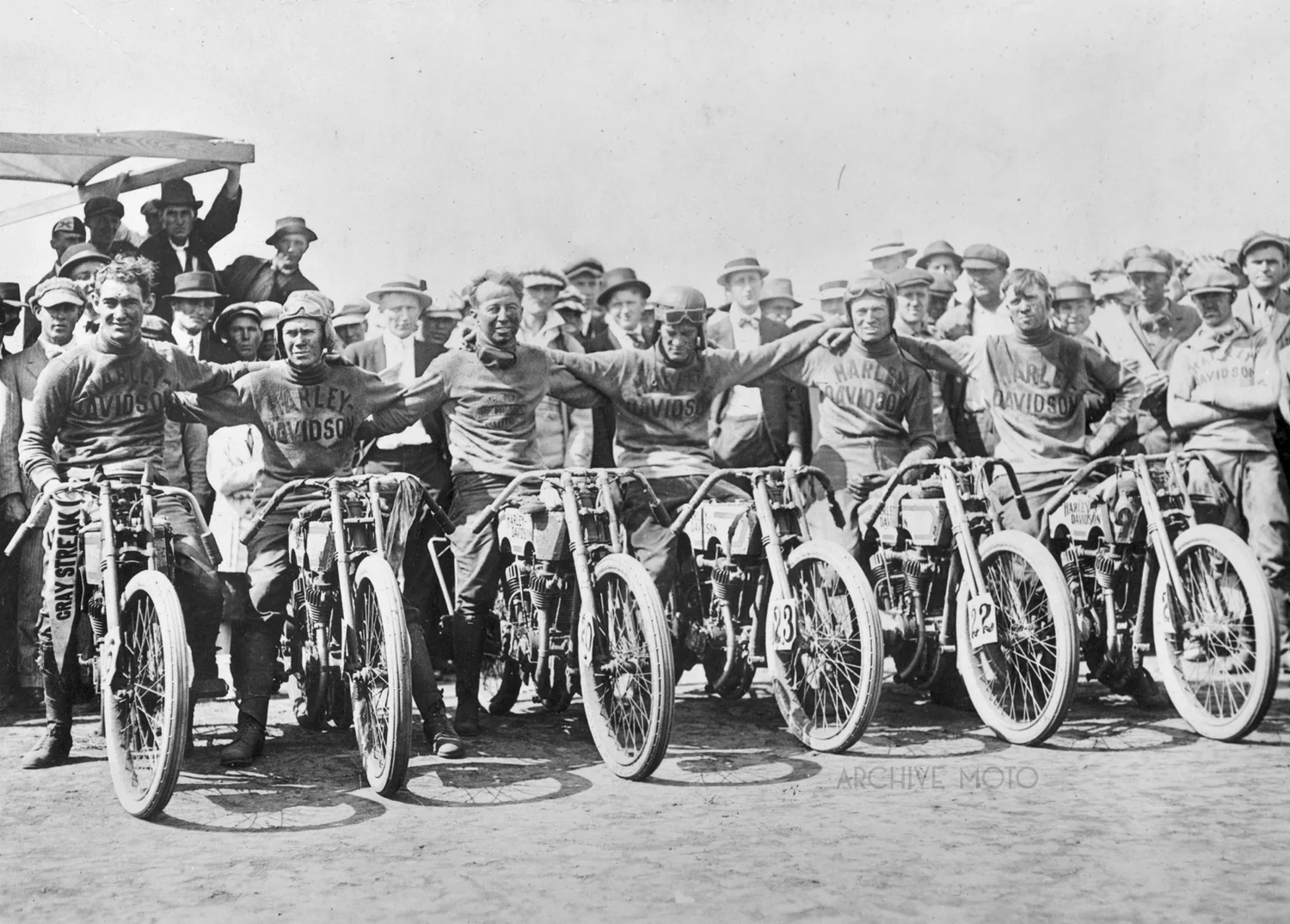
Taken at the massive 1.25 mile long Baltimore-Washington Speedway in Laurel, MD on September 7, 1925, this photo captures the Harley-Davidson team posing for a victory shot yet again as they steamrolled their way through the ’25 season. In a series of AMA National Championship races held on the boards in Laurel, the last gentlemen of Harley’s legendary Wrecking Crew pose on board their powerful factory two cam machines after having put on a clinic for the crowd and competition. Jim Davis and Harley-newcomer Joe Petrali were on a tear, each lowering records as they traveled the country, and the races in Laurel were no exception. Davis took the 5 Mile National Title in a record time of 2 minutes 45 seconds, a blistering average speed of 111 mph. It was Joe Petrali, who had only just joined the crew after a mixup with his Indian machine at the Altoona track two months prior that did the real cleaning up. Smoking Joe took the 10 Mile, the 25 Mile, and the 50 Mile National Championship titles breaking two previous speed records, one of which being the milestone 10 Mile speed of 101 mph set by one of the Wrecking Crew’s founding fathers, Harry “Otto” Walker back in 1921 at the board track in Fresno.
Here we see the victors of the Harley-Davidson crew at Laurel that day, along with a rather odd furry companion. A stoic Joe Petrali is farthest to the right, and Eddie Brinck who came in second behind Smoking Joe in each event is in the middle. Jim Davis, winner of the 5-mile championship title is standing in the stripes, and finally, Bill Minnick, who 3rd place in the 50 Mile race is on the left along with the not-so legendary Harley-Davidson raccoon. Where he acquired his raccoon remains a mystery, but the mammal bandit is yet another mysterious pet in the menagerie of Harley-Davidson team mascots from the early 1920’s.
This image is one of the few that truly captures the thrilling and raw nature of motordrome racing. It appears from time to time, but as is most often the case with these photographs it is circulated with no background information. Though the image still leaves much to be uncovered, here is the little that I know.
It comes from the sparsely documented Houston Motordrome, which was completed in late December 1913 on the corner of Sampson Street and Pierce Avenue. The Houston Stadium Motordrome was one of the last of its kind, the 21st of the steeply-banked, circular wooden tracks built in America between 1909 and 1914. The 1/4 mile long track was opened on Christmas day in 1913, and though I have yet to confirm how steeply banked the track surface was it appears from this photograph to have been on the steeper side between 50 and 60 degrees.
Judging by the fresh paint dripping down the track surface, the large outer posts that have yet to be trimmed, and the lack of seating around the perimeter this frame was most likely taken during a practice session before the track was complete. I cannot identify the individual riders, but it is most certainly made up of gentlemen racers from the initial line up, many of whom had come from a successful 1913 season racing at the Atlanta and Chattanooga Motordromes. They included Morty Graves, Wilmer “Tex” Richards, Fred Luther, Harry Schwartz, Bert Bouggerman, George Lockner, Ray Creviston, Henry Lewis, F. Fleckenstein, and the former Parisian jockey George Renel.
I have not yet completed my research of the Houston saucer, but it is one of the rare few facilities where racers took flight after having lost control of their machines, sending the man and his machine flying clear out of the arena before coming to a violent landing on the grounds past the grandstands. The first of which was a racer down from Milwaukee named Walter Ferch. During a race on February 8, 1914 he collided with the rear wheel of Bert Bouggerman at 85 mph. He then rocketed over the edge, past the safety wire over the crowd, his machine striking a woman in the head before both Ferch and his machine exited the arena in the least desirable fashion. Ferch, who famously chewed on cigars while racing so as to prevent biting off his own tongue in the event of a crash was initially reported dead, but was later found to be in surprisingly good shape. Just one month later on March 22 Wilmer “Tex' Richards from Waco, who had been one of the favorite champions of the Atlanta drome lost control of his machine during a race and again went sailing over the grandstands, landing hard outside of the motordrome. Tex was found unconscious and bleeding from the mouth, again initial reports claimed his injuries were fatal, but he too walked out of the hospital and back into the saddle, later retiring to Atlanta and becoming apart of the APD motorcycle unit.
The prolific track builder and race promoter Jack Prince sold his interest along with all sanctioning rights to the Houston Motordrome in February of 1914, leaving in order to construct the Twin Cities Stadium in St. Paul, MN. that May, followed by the final of the circular board track motordromes in Omaha, NB in September 1914. The remaining story of the Houston Motordrome, as well as all of the other 20th century cathedrals of violent speed is soon to come.