Odin Johnson, Wandamere 1912

Comment

Odin Johnson, Wandamere 1912

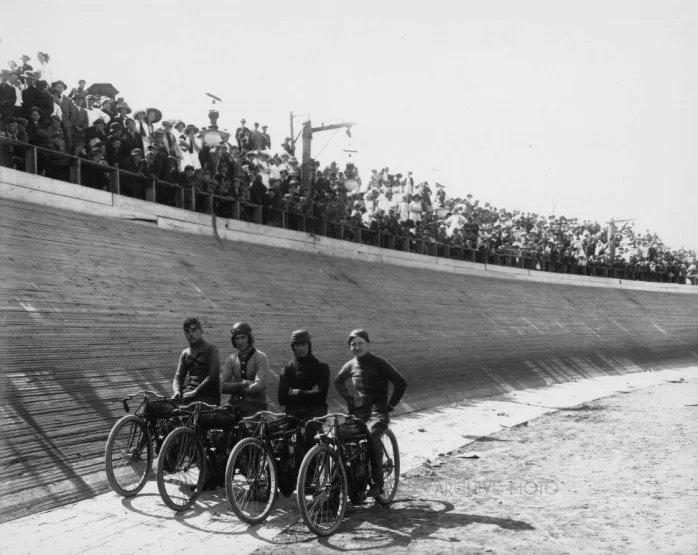
It was on this day, July 30th in 1913 that yet another tragic accident occurred on the boards of an American motordrome, claiming the lives of eight, including that of racing pioneer Odin Johnson. Called the "Salt Lake Marvel," Johnson left his career as a lineman for a telephone company in Salt Lake City to began racing motorcycles in the spring of 1911. Right away Johnson became no stranger to incidents on the boards, within his first year of racing Johnson was involved in several fatal accidents on his local track, the Wandamere Motordrome. 

At the end of a race in June of 1912, Johnson was drifting back towards the bottom of the track after having cut the power to his machine when he was struck by Heinie Potter, a local police officer and amateur racer, Potter did not survive. The very next month Johnson was again in a mixup which took the life of fellow local racing star Harry Davis. According to reports, Davis clipped Johnson’s machine while attempting to pass, sending him flying out of control and into the stands. A local girl, Grace Cunningham was struck and later died as a result of her injuries, her friend Elizabeth Jensen nearly escaped death and was listed as one of the four spectators seriously injured. Interestingly, Jensen and Johnson became friends after the tragedy and were married later that year.

In July, Johnson and his brother Ben, also a racer, were in the stands watching local rider Mat Warden run a race on Johnson’s bike. The machine was owned by the track but had been Johnson’s for the 1912 season. When Warden started up the steep banking at the Salt Lake track, the rear axel snapped, sending Warden quickly veering back towards the bottom. Luckily no one was injured as a result, however after inspection mechanic J.A. McNeil determined that someone had taken a saw to the axel in an attempt to sabotage the event. Both McNeil and Johnson were initially investigated but were cleared when a man later confessed to cutting the axel.

For the 1913 season Johnson ventured to the Luna Park Motordrome in Cleveland, where he set up camp and began running races in the area. By June he had become the captain of the Cincinnati road team and was being pitted against Chicago’s captain Joe Wolters at the Riverview Stadium outside of Chicago. It was for the American League championship races, which included Cincinnati, Cleveland, Chicago, and Detroit, an St. Louis that Johnson ventured to the newly constructed Lagoon Motordrome in Ludlow, Kentucky. 

With continuous banked turns of 60 degrees, the 1/4 mile circular drome at Ludlow was one of the steepest in the country and was heralded as the safest. The track opened on June 22nd under the lights to a crowd of over 4,000 people. It was one month later when, on the evening of July 30th Odin Johnson, running towards the top of the track lost control of his machine and veered towards the crowd. Johnson struck a light post, snapping it in half andsmashing in his skull. The wiring from the light post then ignited the fuel from Johnson’s wrecked Indian, burning “no fewer than 35 people” according to the local press. A total of Eight people, including Johnson died that evening; two women, two men, and three children the youngest of which was a 5 year old boy. The 24 year old Johnson had just sent a telegraph home before the race that evening, telling his family of his successes, his new road machine, and his and Elizabeth’s excitement over payments they were making on their first home.

The tragedy at Lagoon came only months after the infamous accident at the Valisburg Motordrome, which also took the lives of 8 people, including racers Eddie Hasha and Johnny Albright. With the rising death toll public opinion was beginning to turn against the dangerous and thrilling motordromes. The motordrome boom was at its height in 1913, less than 10 more circular wooden tracks would be constructed and those that were already operational would not see their gates opened for much longer. The Lagoon track was able to reopen after the tragic event of July 30th, but like the rest of America’s short lived circular motordromes it would not see the other side of WWI.

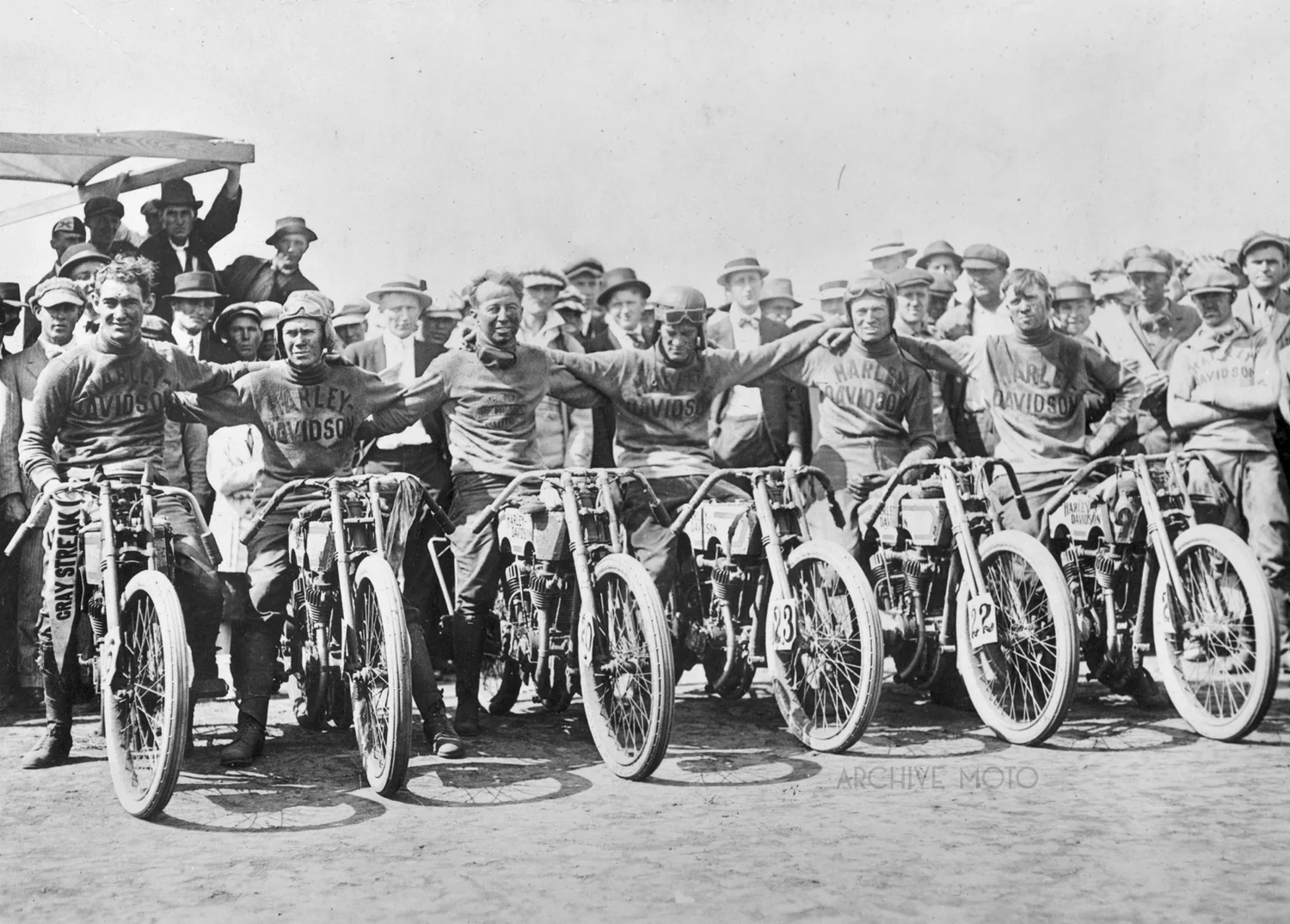
This photo is from Johnson's home track, the Wandamere Motordrome in Salt Lake City, Utah taken on May 31st 1912. It was the first day of the 1912 season, only days before the death of H.F. Johnson. I believe Odin Johnson is second from left in the button down sweater.
Comment

Jake DeRosier, LA Motordrome November 1910

Comment

Jake DeRosier, LA Motordrome November 1910

Assembling the stories of early American motorcycle culture typically requires a good bit of unraveling, connecting scattered dots, and examining the smallest details of photographs. Luckily, in a time before TV and radio, the printed word conveyed the stories of the day in an endlessly entertaining fashion. Today’s post is in tribute to those verbose scribes from dawn of our culture, without whom we would know little of our beginnings and historians would be tremendously uninspired.

It is taken from a small article in the November 1910 issue of Bicycling World & Motorcycle Review that offered an account of Jake DeRosier's record breaking runs at the Playa del Rey Motordrome.

“Undaunted by the refusal of the competition committee, for technical reasons, to place the seal of approval on the recent crop of records which he harvested, Jake DeRosier and his band of warriors went after Father Time’s scalp again at the Playa del Rey Motordrome, Los Angeles, Cal., on Saturday, 29th ult.,and got several strips of it. 

DeRosier, who of course rode an Indian, a "7,” went after the 100 miles record and captured it in the greatest exhibition of space annihilating which that peerless speed artist ever has given. He pounded out the century in the phenomenal time of 1:15:24 2/5, which is nearly 11 minutes better than his old mark made on the same track last May. 

Still more wonderful was the new hour record which DeRosier set up, when he traveled the astonishing distance of nearly 80 miles, to be exact, 79 7/8 miles, in 60 minutes, almost 1 1/3 miles a minute. This record also totally eclipses Jake’s old hour figure of 74 miles 667 yards, which he hung up last May. 

Nor were the lusty speed merchants content to let Father Time get away with this punishment, for they took some more tuft at the mile distance. DeRosier also took the honors in this class, with a dash around the wooden bowl in 0:41 1/5. Ray Seymour was a close second with 0:41 2/5, and Charles Balke, was clocked in 0:41 3/5. The old record was 0:43 1/5, made by DeRosier. 

The trails were duly sanctioned, and it said unofficially that the machines on being measured were found to be under the .61 cubic inches limit. Upon receipt of the official credentials from the officials, the chairman of the competition committee will determine whether or not the records will stand.”

And I thought that I used a lot of commas.

The photograph was found randomly placed in a later issue of the magazine, but shows racers and officials breaking down DeRosier’s machine for inspection after that record run at Playa. To the far right in the checkered cap is fellow racer Morty Graves, and seated in the center, black long sleeve and cap is Charlie Balke.

Comment

Ray Turskey

1 Comment

Ray Turskey

The supremely spruce Ray Tursky, Harley-Davidson dealer from Fond du Lac, Wisconsin and accomplished Class-A racer in the 1930’s. At the 1934 Jack Pine Endurance Race, a gruelling 3 day, 500-mile hard-fought battle in the wilderness of Michigan’s Upper Peninsula, Tursky bested a field of 87 entrants and came in first out of only 9 finishers. Tursky claimed victory in ‘34 on a top of the line 74ci VLD Flathead, Harley’s latest side-valve big twin. In 1935, equipped with yet another VLD Tursky returned to defend his title, but finished 3rd behind Jack Pine legend Oscar Lenz. 

Ray Tursky, Sept. 1935.

1 Comment

Archive Icon: Harry Otto Walker

5 Comments

Archive Icon: Harry Otto Walker

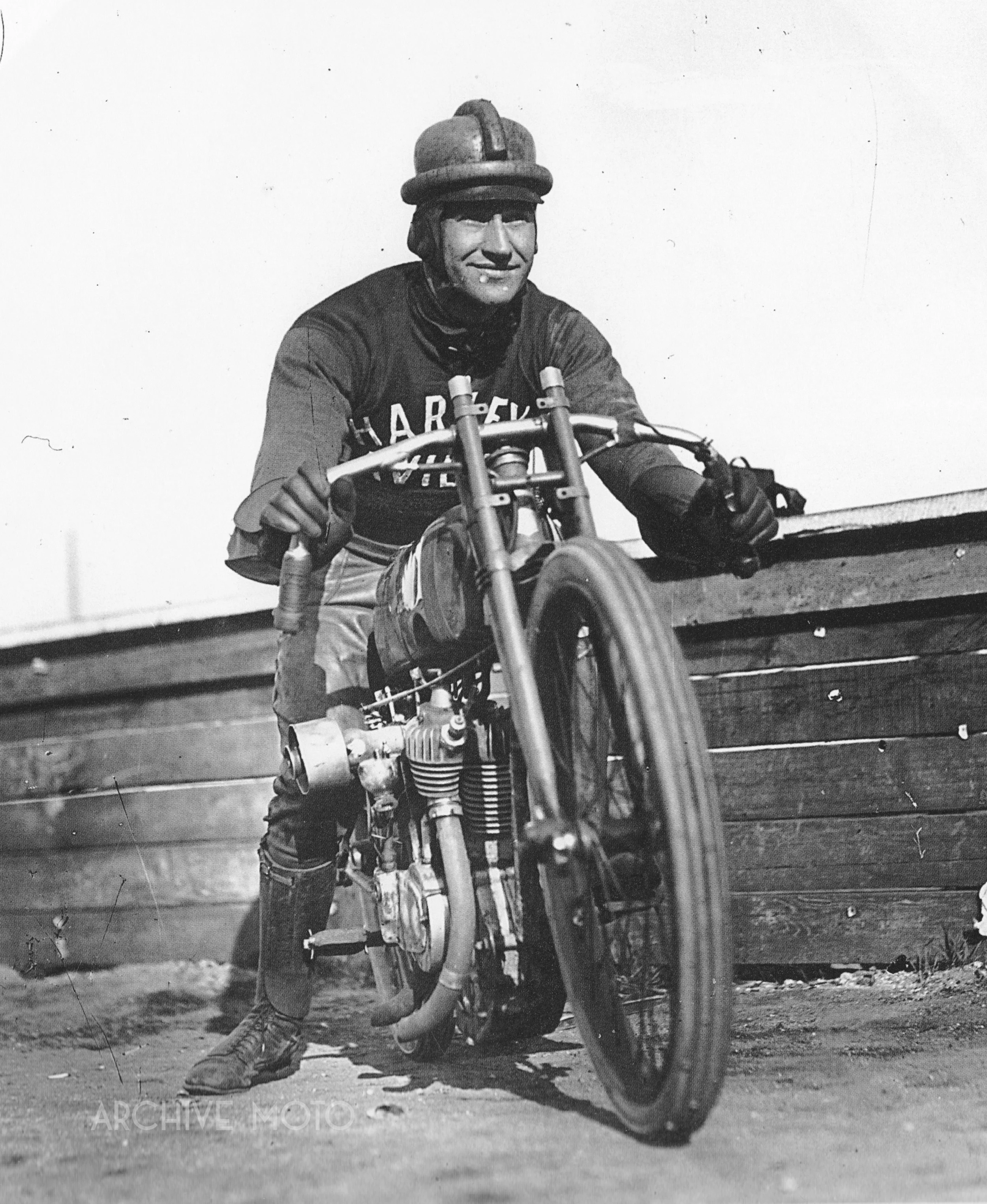
With the suspension of professional racing in the months leading up to the United States involvement in WWI, many of America’s most notable motorcycle racers put away their goggles and jerseys in order to suit up in the olive drab wool and canvas uniform of the US Army. Dispatch and Signal Corp were some of the more common assignments for America’s motorcycling heroes, but a handful, no doubt with a hankering for the more exhilarating roles in the war enlisted for service in the aviation sector. 

Most notably Cleo Pineau, one of the darlings of the Flying Merkel squad became a pilot, earning the distinction of “Ace,” and even survived being shot down and becoming a P.O.W. under the command of Kaiser Wilhelm’s son the Crown Prince. One of the brightest stars and fastest racers just before the war, Harley-Davidson’s pride, Otto Walker signed up for duty in the US Army’s aviation section. After missing the majority of the 1916 season due to a leg injury, Otto had moved from California and was living in Manhattan, working as the foreman of the Harley-Davidson Sales Co. at 226 W. 108th St. On July 20th of 1917 Otto entered his last event before service and set a new 24 hr record at the Sheepshead Bay Speedway in an HD sidecar setup, covering a distance of 1,159.75 miles.

After enlisting, Otto was trained as an electrical engineer in the US Army’s aviation division, and by May of 1918 he had arrived in France. Little information is available regarding the specific of Walker’s tour of duty, though the United States role in air combat during WWI was limited and quite outmatched until late 1918. By all accounts the former Harley-Davidson superstar was deployed in Europe for the next year, returning in the summer of 1919, but the story left untold is that Walker’s wartime souvenir, a cork and leather German pilot’s crash helmet that he acquired during his service and proudly began wearing upon his return to America.

Walker was quickly welcomed back by Bill Ottaway with a spot on Harley-Davidson's star-studded new team, the legendary lineup soon be known as the “Wrecking Crew.” In the August 28th issue of Motorcycle Illustrated America welcomed back one of its most beloved racers from the war to end all wars; “Take your hats and chuck them in the air. Here comes Otto Walker back from Over There.” Walker debuted his new war trophy helmet on September 1st at at the International Championship Road Race in Marion, Indiana, and again a few days later at the new Lakewood Speedway in Atlanta. In this photograph, Walker poses in his new signature helmet and full Harley-Davidson regalia during the week long national races at Ascot Park in January, 1920. Though at the time some would refer to it as bad luck to wear a German’s helmet after the war, its distinct, padded-leather crest separated Walker from the pack and became somewhat of a trademark, the calling card of an American icon.

5 Comments