Archive Icon: Harry Otto Walker

5 Comments

Archive Icon: Harry Otto Walker

With the suspension of professional racing in the months leading up to the United States involvement in WWI, many of America’s most notable motorcycle racers put away their goggles and jerseys in order to suit up in the olive drab wool and canvas uniform of the US Army. Dispatch and Signal Corp were some of the more common assignments for America’s motorcycling heroes, but a handful, no doubt with a hankering for the more exhilarating roles in the war enlisted for service in the aviation sector. 

Most notably Cleo Pineau, one of the darlings of the Flying Merkel squad became a pilot, earning the distinction of “Ace,” and even survived being shot down and becoming a P.O.W. under the command of Kaiser Wilhelm’s son the Crown Prince. One of the brightest stars and fastest racers just before the war, Harley-Davidson’s pride, Otto Walker signed up for duty in the US Army’s aviation section. After missing the majority of the 1916 season due to a leg injury, Otto had moved from California and was living in Manhattan, working as the foreman of the Harley-Davidson Sales Co. at 226 W. 108th St. On July 20th of 1917 Otto entered his last event before service and set a new 24 hr record at the Sheepshead Bay Speedway in an HD sidecar setup, covering a distance of 1,159.75 miles.

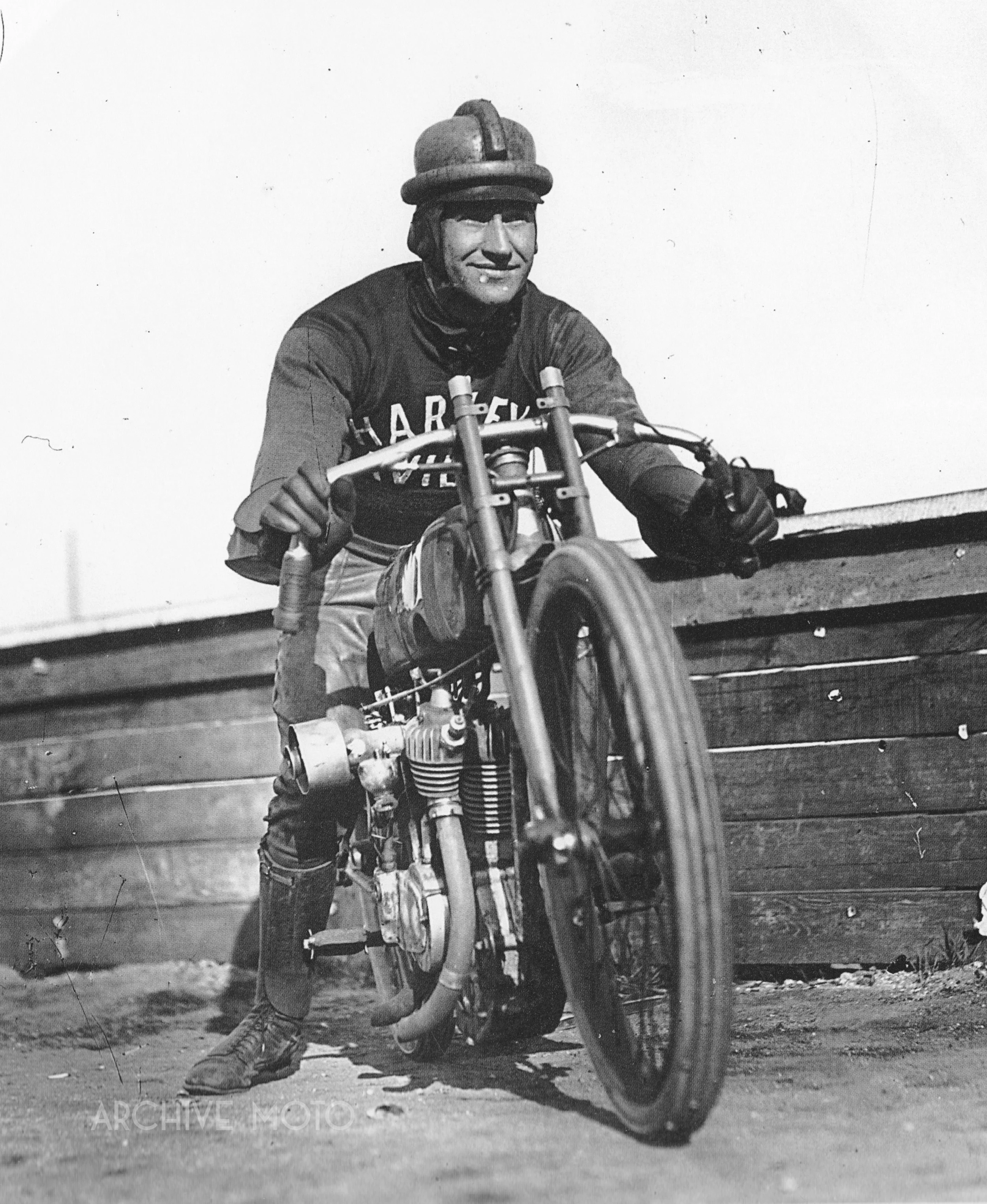
After enlisting, Otto was trained as an electrical engineer in the US Army’s aviation division, and by May of 1918 he had arrived in France. Little information is available regarding the specific of Walker’s tour of duty, though the United States role in air combat during WWI was limited and quite outmatched until late 1918. By all accounts the former Harley-Davidson superstar was deployed in Europe for the next year, returning in the summer of 1919, but the story left untold is that Walker’s wartime souvenir, a cork and leather German pilot’s crash helmet that he acquired during his service and proudly began wearing upon his return to America.

Walker was quickly welcomed back by Bill Ottaway with a spot on Harley-Davidson's star-studded new team, the legendary lineup soon be known as the “Wrecking Crew.” In the August 28th issue of Motorcycle Illustrated America welcomed back one of its most beloved racers from the war to end all wars; “Take your hats and chuck them in the air. Here comes Otto Walker back from Over There.” Walker debuted his new war trophy helmet on September 1st at at the International Championship Road Race in Marion, Indiana, and again a few days later at the new Lakewood Speedway in Atlanta. In this photograph, Walker poses in his new signature helmet and full Harley-Davidson regalia during the week long national races at Ascot Park in January, 1920. Though at the time some would refer to it as bad luck to wear a German’s helmet after the war, its distinct, padded-leather crest separated Walker from the pack and became somewhat of a trademark, the calling card of an American icon.
5 Comments

Archive Icon: Morton J. Graves

Comment

Archive Icon: Morton J. Graves

It is a remarkable event when a photograph captures the very spirit of an individual, forever making that person a friendly acquaintance to anyone fortunate enough to come across his likeness. Meet Morty Graves, one of America’s fastest sons; a legendary pioneer in the sport of motorcycle racing.

Morton James Graves, sometimes referred to as “Millionaire Morty,” was born in Chicago on December 10th, 1890. Morty spent his early years in Chicago, but by 1900 his family had relocated to the Pasadena area just outside of Los Angeles, the womb American motorcycle racing. Like many teenagers of the time, Morty became fascinated with the rapidly developing motorcycle culture in the United States. Living in LA that interest was greatly amplified and it was only a matter of time before a young man’s enthusiasm led him to test his skills on the track. It is said that Morty acquired his first machine, an Indian in 1906 at the age of 16, and within a year he was already on the track and honing his skills in the saddle. 

Throughout 1908 Graves raced his Indian on the horse tracks, velodromes, and dirt ovals of California, he also began making appearances outside of the state reaching as far out as Boston. Young Morty lined up against the fathers of American motorcycle racing, competing against Paul Derkum, Charlie Balke, Ray Seymour, Arthur Mitchell, and America's first star Jake DeRosier. His reputation caught the attention of the manufacturers, who were quickly becoming aware of how valuable track presence was becoming and Morty began testing new machines for various companies. In March of 1909 he began a relationship with the German manufacturer NSU, debuting his new ride at the newly constructed Los Angeles Coliseum, America’s first motorcycle board track.

It was at that time that a wonderstruck America witnessed the birth of the Motordrome. Famed bicycle track builder Jack Prince had recently observed the success of his latest experiment, the Clifton Velodrome in Paterson, NJ, a slightly larger version of his typical wooden velodrome design. Onboard a prototype loop-framed Indian, Jake DeRosier smashed nearly every available record of the day on the boards at Clifton and Prince quickly took note. Jack Prince then traveled to LA to build a larger version of the board track, this time the design was tailored specifically for motorcycle racing. It was there that Graves debuted the powerful, belt-driven NSU in March, but by May Morty was back onboard an Indian. In an ironic twist of fate, Morty rocketed into the national spotlight on the boards in LA when, in a brief protest to compete by DeRosier, Graves took the prototype “Bent Tank” Indian that DeRosier had established his own legendary reputation on at Clifton the year before and smashed DeRosier’s 100 mile record by an astonishing 10 minutes. 

The dapper teenager, seemingly always with a devilish smile on his face continued to be one of the favored racers, and as the motordrome craze swept through American cities, Graves was a contracted competitor at nearly every opening. In July of 1910 at the Wandamere Motordrome in Salt Lake City, Graves thrilled the crowd when he hoped onboard F.E. Whittler’s Flying Merkel to set a 2-mile record. The brass at Merkel must have liked what they saw, the next month Graves won his first FAM National in Philadelphia onboard a Flying Merkel.

As new motordromes opened their gates throughout the teens, Graves was sure to be there giving veteran racers, local heroes, and eager amateurs a true run for their money. NSU, Flying Merkel, Excelsior, and Indian; no matter the mount Morty was the fastest on the boards in Atlanta, LA, Chicago, Oakland, and Salt Lake City amongst others. In what was reported by Motorcycle Illustrated as “one of the most thrilling track duels that ever happened,” Graves beat out Indian teammate Ray Creviston and rival Dave Kinnie on the mighty yellow Cyclone to win the 100-mile national in Detroit of 1915.

Not to be outpaced on any surface, Graves was just as good in the dirt as he was on the boards, it is where he cut his teeth after all. In fact, at the 1915 Dodge City 300, what many consider to be the debut of Harley-Davidson’s domination on the track, it was Morty Graves who was leading the race until running out of fuel on the last lap due to a crack in his Indian’s tank. Morty continued to compete throughout 1915 and into 1916, though he was burdened with a slew of mechanical difficulties. In a followup performance at the 1916 Dodge City 300 he placed 6th, after being one of the fastest men in the world for nearly a decade he was now being outpaced by a new, hungry, and damn fast generation. Reports from the 1916 Dodge City race are the last to include the legendary “Millionaire" Morty Graves, though in June of 1917 he listed “Motorcycle Racer” as his occupation on his draft card.

Like so many motorcycle racers in the teens, Morty enlisted for service after the interruption of professional racing due to WWI. In July of 1918 he became Private in the US Army through the S.A.T.C. program and was honorably discharged in December. Also in 1918 the 27 year old Graves and his wife Madge welcomed a daughter, Betty Erma that August. When professional motorcycle racing resumed in 1919, Graves, one of the founders of American motorcycle racing had officially retired. After putting away his jersey and helmet Morty went on to open an Indian dealership on Sunset Blvd. in Hollywood where he worked until his death on December 31st, 1944. Eighty-two years after Morty’s last blast around a track he was honored as one of the first inductees into the AMA Motorcycle Hall of Fame in 1998.

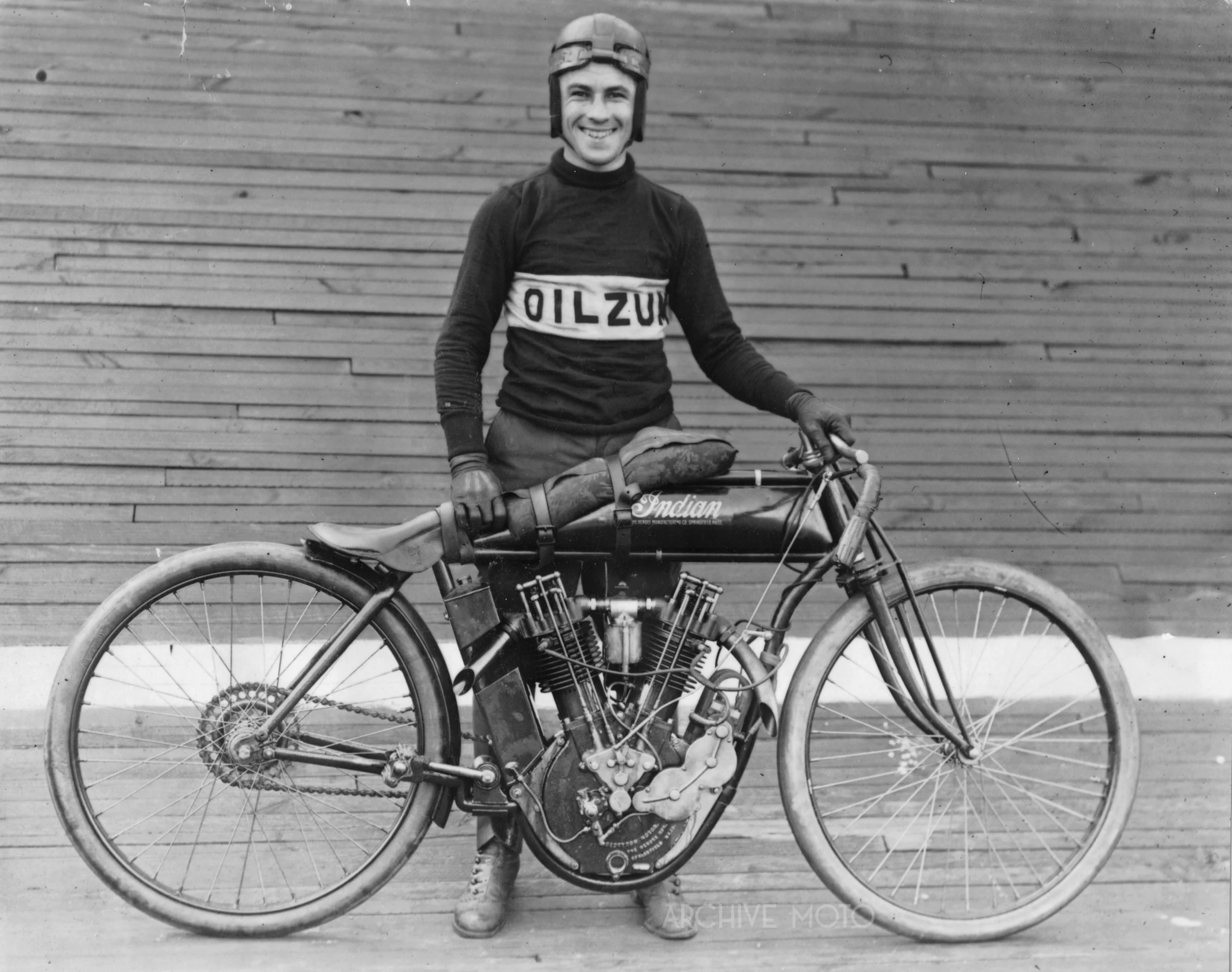
Seen here with his signature smile, Morty stands with a brawney Big-Base, 8-Valve Indian in front of the 56 degree board track of the Atlanta Motordrome in 1914.

Comment

1919 Cornfield Classic, Marion, IN.

4 Comments

1919 Cornfield Classic, Marion, IN.

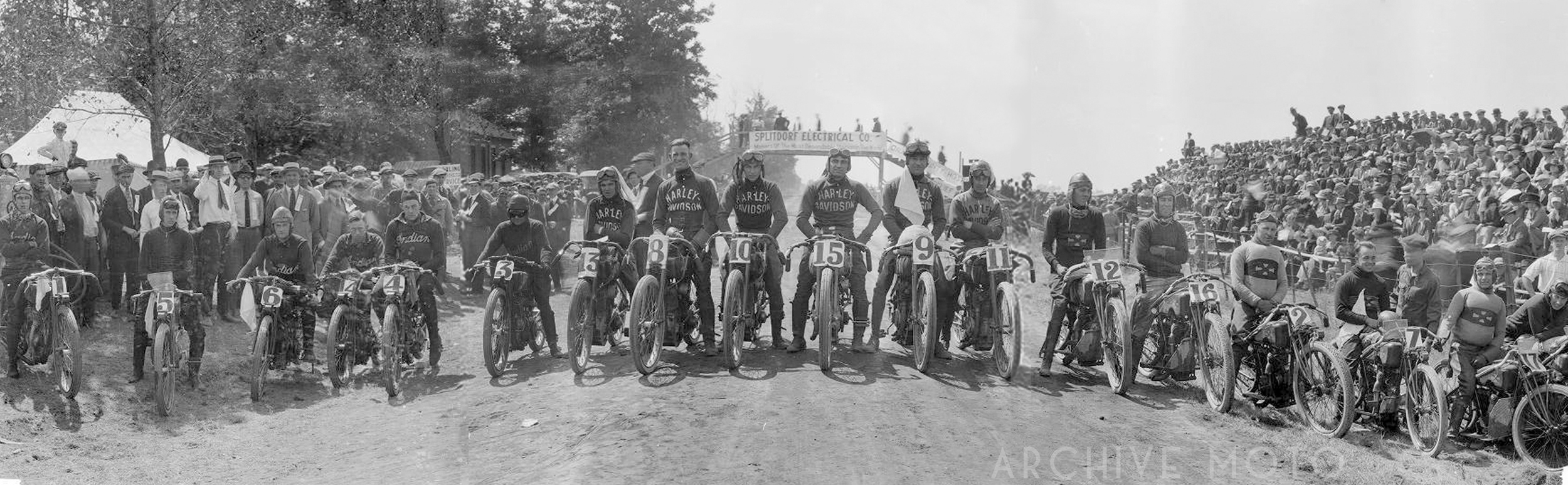
I recently posted the video from the 200-Mile International Road Championship held in Marion, Indiana September 1st, 1919, but lately I have seen portions of the lineup photo making the rounds. After some digital fiddling I stitched together the full panorama and figured I would share it. Thanks to the bottomless knowledge and generosity of Mr. Don Emde I can post the names here as well for thoseinterested. 

Left to Right:

Indian
1 Percy Coleman
5 Gene Walker
6 Baxter Potter
14 Teddy Caroll
4 Roy Artley
3 Don Marks

Harley-Davidson
13 Albert "Shrimp" Burns
8 Leslie "Red" Parkhurst
10 Ralph Hepburn
15 Ray Weishaar
9 Otto Walker
11 Maldwyn Jones

Excelsior
12 Floyd Clymer
16 Joe Wolters
2 Warren Cropp
7 Bob Perry
17 Wells Bennett
18 Ray Creviston

By 1919 the world was attempting to pick up what remained of itself after the first World War and in America, motorcycle racing experienced an energized rebirth. Though the once countless manufacturers of American motorcycles had atrophied to a small handful, those who had faired well on the track before the war were now the dominant brands. Indian and Excelsior were early powerhouses in the arena of racing, but they were now joined by a sturdy and hungry Harley-Davidson. The machines became engineered for speed, Big Valve Excelsiors, Keystone framed Harleys and Indians, and new power plants like Indian's Powerplus and Harley's 8-valves made the spectacle of racing even more intoxicating. The exhilarating circular motordrome board tracks had almost all been abandoned before the war and races now took place on dirt road courses, or the handful of large board track speedways. The FAM (Federation of American Motorcyclists) who had helped give birth to organized motorcycle racing in this country had diminished and was replaced by a new sanctioning body, the M&ATA (Motorcycle & Allied Trade Association) who would eventually turn into the modern AMA (American Motorcycle Association). A lot of early board track stars who had transitioned from cycle racing had sadly either died or retired, but a new breed of professional had been mentored and took to the sport just as vigorously. Factory teams busted at the seams with talent and they all came out for the September race in Marion. Otto Walker, Joe Wolters, Shrimp Burns, Bob Perry, Leslie Parkhurst, Teddy Carroll, Ray Weishaar, and Maldwyn Jones were just a few of the now legendary men who took to the 5.17 mile Indiana road course that day. Leslie "Red" Parkhurst, a longtime key player on the Harley team took the checkered flag in Marion, followed by his teammates Ralph Hepburn and Otto Walker to close out the podium for the Milwaukee factory.

4 Comments

Origins

Comment

Origins

Let's go back to the very beginning, back to our origin. High-Wheeler, Penny Farthing, and Ordinary, all names for an iconic machine, the first to bear the name bicycle and one which sparked a revolution in recreation, transportation, and sport. Originally developed in France and England as the new United States was just picking up the pieces from the Civil War, the high-wheel bicycle didn't make its American debut until 1876 at an exhibition in Philadelphia. 

By that time the more affluent of imperial Europe had nurtured an expansive bicycle culture, at the center of which was racing. Though the new machines debuted to a frenzy of interest in United States the high-wheel bicycle was already on its way out. Innovations like pneumatic tires, chain-drives, and symmetrical wheel sizes would rapidly evolve the bicycle industry as it took hold in America, eventually making a perfect platform to pair with the developing gasoline engine. 

However, it is from this early era of high-wheel racing that emerged perhaps two of American motorcycle history's most important people. One, a British champion by the name of John Shilignton Prince who came to America and pioneered the development, construction, and promotion of the notorious wooden tracks known as Motordromes. The other, an American champion turned manufacturer named George M. Hendee who, with his partner Carl Oscar Hedstrom introduced the first Indian motorcycle on May 10, 1901. 

This photo comes from September of 1910 during a nostalgic exhibition of the old "Ordinaries," a veteran rider H.W. Bartleet clearly at home on the cumbersome contraption in the lead.

Comment