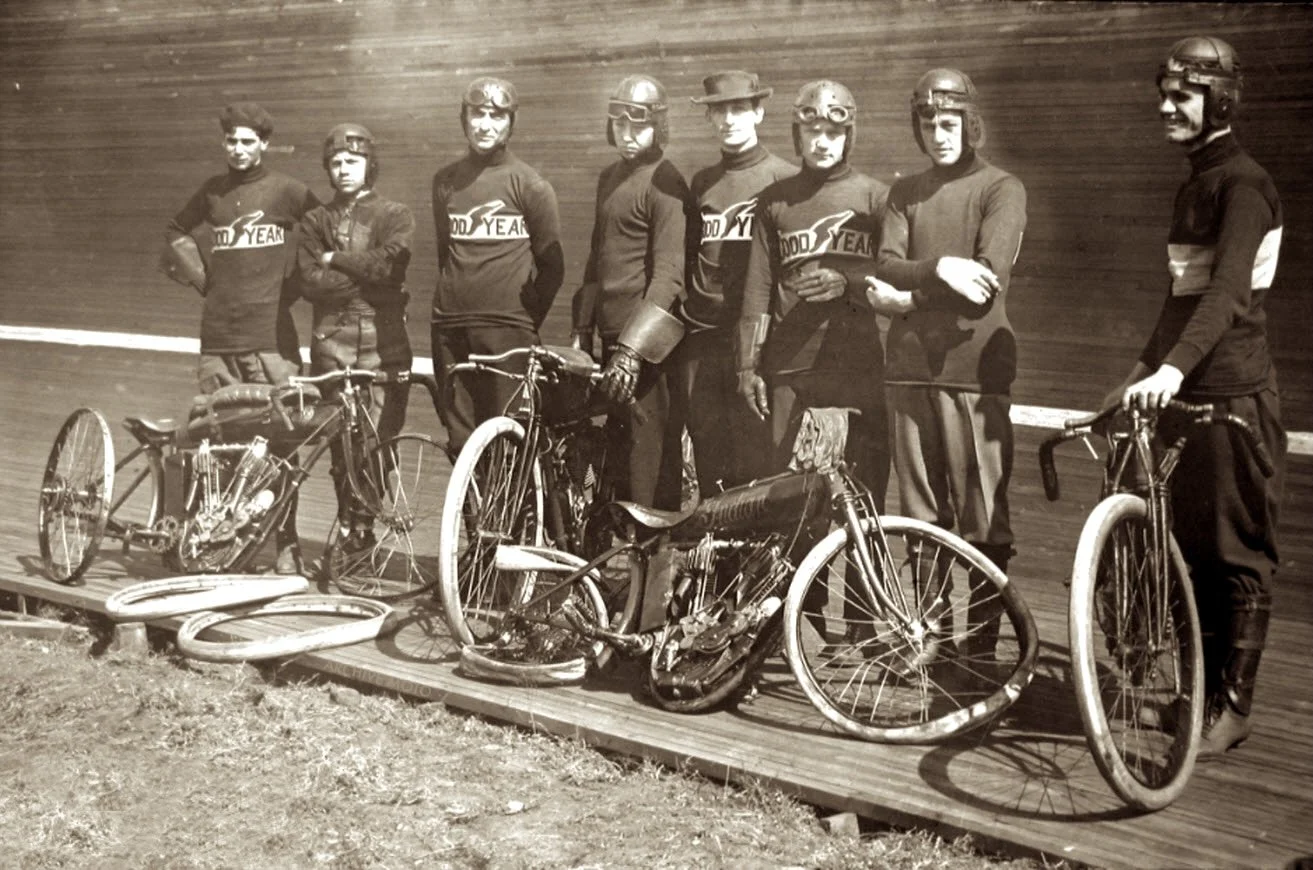
Seen here following the wreck at the Lake Cliff Motordrome on October 21, 1912, are Ed Bowen, Mike Cafarello, Bert Bruggerman, Jim Trafsky, Ed Harmer, Jim Cox, Harry Swartz, Wilmur “Tex” Richards, and their mangled Indian factory racing machines..
Eddie Hasha on his 1912 Indian Big Base 8-Valve factory racer.
On the warm autumn evening of October 21, 1912, beneath the arc lights of the Lake Cliff Motordrome in Dallas, Texas, a stadium full of racing enthusiasts witnessed a miracle on the boards. The country was still in shock as the tragedy at the Valisburg Motordrome occurred only weeks before, on September 8. The horrific and now infamous crash, the precursor of the “murderdrome” moniker, claimed the lives of Indian racing stars Johnny Albright and local Texan hero Eddie Hasha, along with 6 spectators, 5 of whom were teenage boys. In the weeks that followed the Valisburg track shutdown, papers nationwide ran stories about the carnage, and an outcry for improved safety standards prompted organizers and promoters to implement new rules and infrastructure. For the riders, however, racing was their livelihood, and though their friends had just perished, death was just another aspect of their daily lives and most were eager to get back onto the boards.
The majority of motordromes in operation at that time were located in northern U.S. cities, their colder climates dictating that Labor Day weekend would typically be the end of the season. Brooklyn’s Brighton Beach Motordrome, Point Breeze in Philly, Tuileries in Denver, and Cleveland’s Luna Park were already winding down before the crash at Valisburg. For the riders, that meant making plans to move west and south for work as the temperatures began to drop. 1912 marked the beginning of the motordrome boom in the U.S., with a total of eight new tracks springing up throughout the year. Valisburg was the sixth of these new tracks, built in 1912 and opened in July, followed by a new 1/4-mile track in St. Louis, which opened at the end of August.
A glimpse inside the Lake Cliff saucer, built in the emerging formula for a successful board track with added safety structures based on the frequent incidents.
The last to be built that year would also be the southernmost in the United States to date, located inside Dallas’s Lake Cliff Amusement Park. An undertaking of promoter George Kreamer, the haste to erect the new track was his attempt to secure the license out from under motordrome pioneer Jack Prince, who was also bidding for the city’s F.A.M. sanctioning franchise. He was also hoping to coordinate the opening of the new motordrome with the annual county fair dirt-track races to draw more fans, the same fairground flat-track races where Eddie Hasha himself had started competing a few years before. Kraemer’s haste led to a few questionable business tactics that would later result in the Dallas track’s unstable, abbreviated lifespan. Nevertheless, he completed construction in a record two weeks after breaking ground and organized the first races. The Lake Cliff Motordrome would be a duplicate of the saucer recently completed in St. Louis. It was a 1/4-mile banked circle at an intense 62 degrees, one of the steepest angles ever built, and featured 4 levels of grandstand seating, dotted with lights along the top for night races. A new guardrail and fencing were also constructed along the top of the track in front of the stands, as a result of Hasha and Albright’s crash a few weeks prior. Upon its completion, the Lake Cliff Motordrome was billed as the fastest track on Earth.
A look at the Lake Cliff Motordrome taken October 13, 1912.
Harry Swartz and his Excelsior 7 factory racer in the Atlanta Motordrome, 1913.
After another successful night of thrilling races, it was while the riders were on the approach lap of the final Free-For-All that the fracas unfurled. The pack of riders jockeyed for position as the race reached its climax, making their way around to the far side of the saucer opposite the judging booth and thankfully a less densely populated section of the grandstands. Bert Bruggerman from Los Angeles had taken the lead on the approach lap, followed by Cleveland’s Mike Cafarello and Harry Swartz from Denver. As the riders dashed beneath the lights, Swartz shot to the top of the track in a violent spurt, attempting to pass Cafarello at 80 mph. A friend and Indian teammate of the late Eddie Hasha, Swartz misjudged the top line and shot off the track, striking a guard rail support post, knocking him from his Indian just like in Hasha’s accident. The machine then ricocheted down the track into Cafarello, throwing him off and bringing the action to an immediate halt. Chaos, in an instant, cascaded down the boards, eerily similar to the crash in Vailsburg.
Wilmer Tex Richards, Atlanta Motordrome, 1913
Jim Trafsky was just behind the spill but was able to maneuver around the riders and machines. Both Cafarello and Swartz, then at the bottom of the track, simply stood up and walked away to the great relief of all in attendance. Swartz had a small cut to his head and a few injured fingers; Cafarello suffered only a few bruises. Both men’s machines were mangled and, according to one article, were “practically bent double.” With the pain of Valisburg still fresh in everyone's mind, coupled with the fact that Eddie Hasha was from nearby Waco, it was considered nothing short of a miracle that Swartz and Cafarello walked away that evening. This photo comes from the aftermath of the incident at Lake Cliff on October 21, though it wouldn’t be the last at the track. Just one month later, on November 28, Wilmer “Tex” Richards, while running at speed, rolled both wheels over the neck of Mike Cafarello, who had just taken a spill. To the shock of everyone in attendance, neither man sustained any major injuries. Cafarello was reported to have asked for only a cigarette and a soda when he arrived a few minutes later.