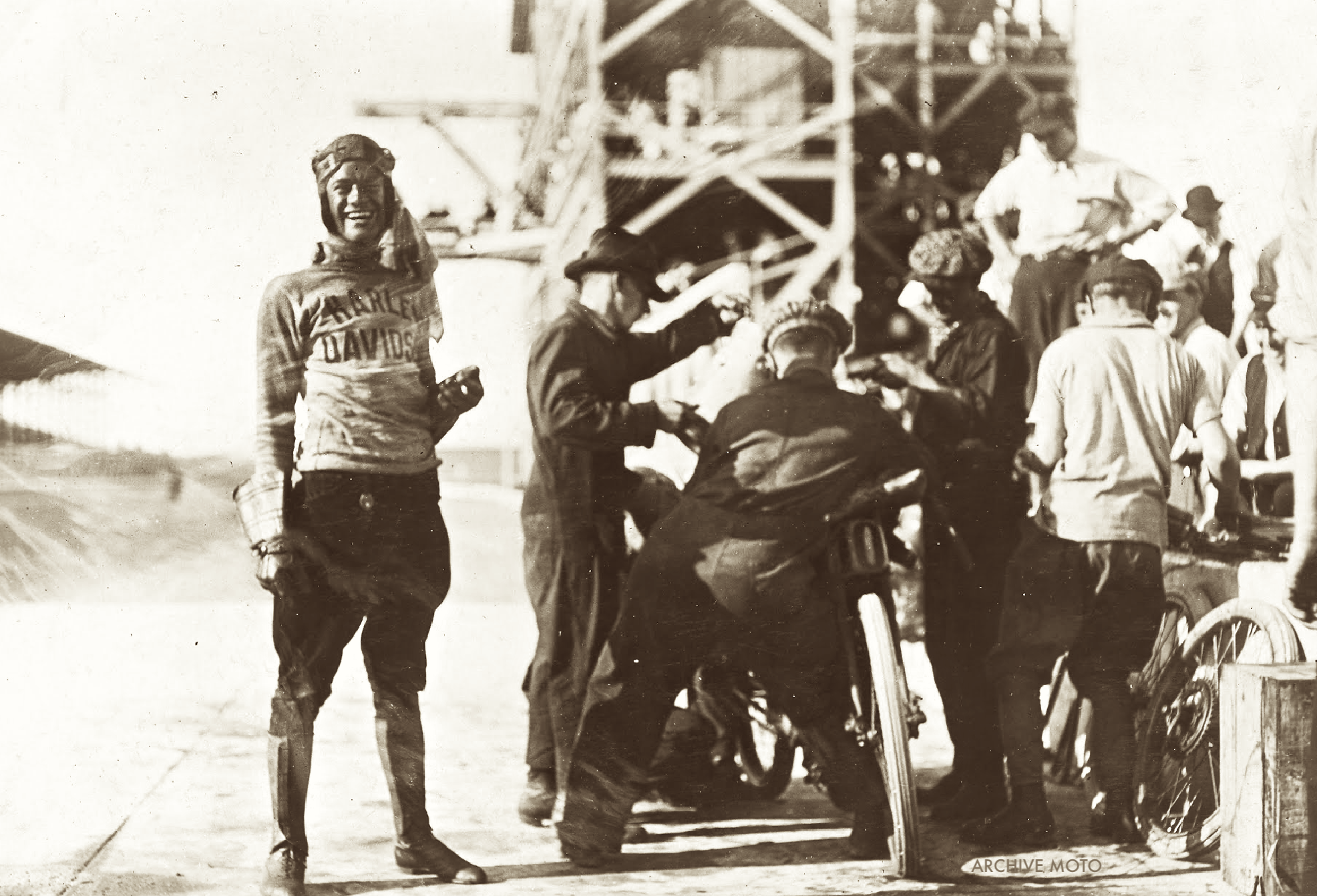
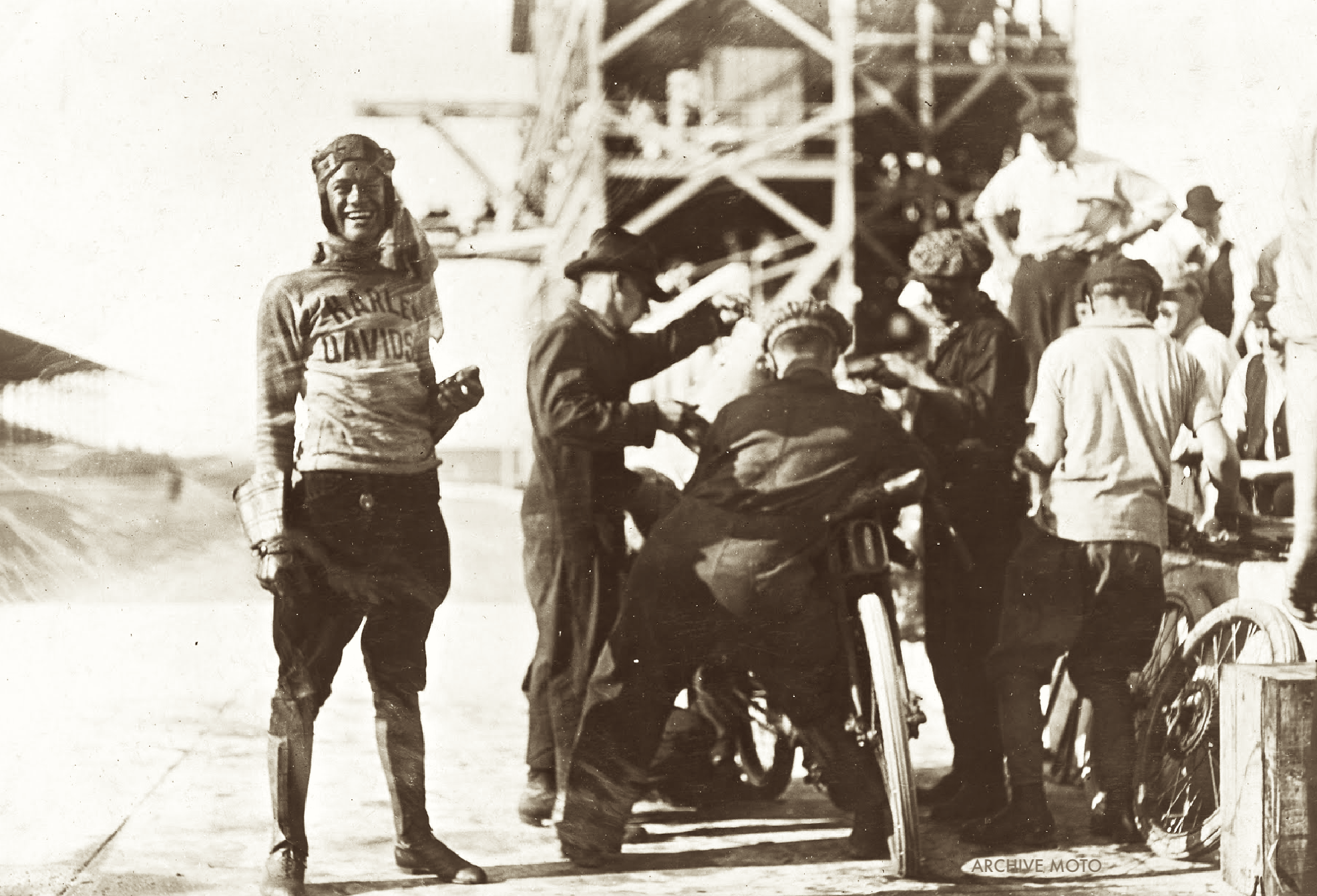
Motorcycle racing’s Captain America, Leslie Eaton “Red” Parlhurst down and out, but really never down or out at Chicago’s Speedway Park, September, 1915.
A titan among America’s pioneer motorcycle racers, Leslie “Red” Parkhurst had spent most of 1915 making The Harley-Davidson Motor Company the most talked-about name in the sport. Still, captured in this photo with his considerably less-than-silent gray 11K factory racer parked in the pits at Chicago’s Speedway Park, the captain of Milwaukee’s new racing team could do little but wait, catch a heater, and smile for the camera. Just shy of the 100-mile mark on the 48th lap of the 300-Mile championship at Chicago’s massive new wooden racetrack, Speedway Park, Red’s brake had stuck, and his inlet valve had developed trouble of its own. As Bill Ottaway’s crew worked to replenish supplies and address the issues, nearly half an hour slipped away before Parkhurst could get back into the mix. Every passing lap put the leaders another two miles farther beyond his reach.
Teenaged Leslie Eaton Parkhurst onboard his Indian twin inside the Milwaukee Motordrome, spring 1914.
It was an aggravating afternoon for a rider who had helped get the whole Harley racing enterprise moving over the previous year and some odd months, though you’d never know it from this photo. A lanky redhead with a smile that seemed to stretch from one track to the next, Parkhurst had learned his trade on the boards in Denver and Milwaukee. Born in Denver and having come from little means, Red left school early and picked up work as a truck driver for a local painting crew. After his boss discovered his penchant for speed, he was relieved of his driving duties and handed a brush, which didn’t suit the young man now craving a bit of a thrill, so he took up wrenching on bikes and begged for a go at the local motordrome at Tuileries. He quickly cleaned up at Denver’s two saucers, his skill and success summed up by fellow riders quoted in the press at the time: “that guy sure ain’t got no brains.” From Denver, he traveled to the drome in Milwaukee, and while racing there in early 1914, William Ottaway approached him to try one of his freshly tuned Harley-Davidson racing engines. Ottaway himself had just come over from Thor’s racing department in December 1913. His prototype for Harley was a specially built 10-series that would become the cornerstone of the Motor Company’s first official entry into professional track racing. Red was to be the man to help put it through its paces.
Young and dapper Leslie Parkhurst in Ottaway’s Juneau Avenue workshop with the new short-coupled 11K prototype in 1914.
Parkhurst became Harley’s earliest professional rider, initially joined by Alva Stratton and Bill Brier to help turn Ottaway’s fast motors into motorcycles capable of taking on Indian and Excelsior. Following a less-than-stellar soft launch at the 1914 Dodge City classic, Ottaway, Parkhurst, and the rest of the small Milwaukee effort continued to develop and refine the racing platform through the autumn of 1914, culminating in the first officially supported team appearance at the 300-mile road race in Savannah, Georgia, in November 1914. Oddly enough, Parkhurst was not part of that debut team, having been sent to Phoenix to run for a few weeks, rack up a half-dozen some-odd trophies, and fill his pockets with coin before returning to Milwaukee. Still, the young Milwaukeean Irving Janke made history by winning 3rd place in that race, Harley-Davidson’s first official competition podium. From that point, the Harley racing program exploded: Ottaway’s design was perfected, a stable of new, talented riders was hired, and Parkhurst remained the Bar & Shield’s stalwart rider.
Parkhurst and Stratton onboard short-coupled 10K racers with auxiliary fuel tanks in Minneapolis, 1914.
The job came with a very fast motorcycle and some equally fast company, as new riders were quickly recruited to kick off the 1915 season. Though Stratton, Brier, and Janke continued to ride for the Motor Co., a new core group of professionals was forming what would become known as the Wrecking Crew. Icons like Joe Wolter, Ray Weishaar, Maldwyn Jones, and Jim Davis would soon don the gray sweater as a legacy first formed out of Milwaukee. Bill Ottaway’s stripped-stock 61 CI pocket-valve twins, known as the 11K series for 1915, were beginning to deliver, and on April 4th, Otto Walker gave Harley-Davidson its first major national victory in the 300-mile road race at Venice, California. Parkhurst was right there with him, crossing the line in second place just fifteen seconds behind. After more than four hours of racing, the two gray machines had finished close enough together to leave very little doubt about Milwaukee’s intentions.
The ill-fated debut squad from Milwaukee at Dodge City, July 4, 1914.
Red had a win of his own sixteen days later. At Oklahoma City on April 20th, Parkhurst took the 150-mile race with teammate Joe Wolter following him home in second. He also collected the fastest-lap trophy, turning his 28th lap in two minutes and two seconds. Still, the watershed moment came at Dodge City on July 3rd. It had been a year since the development team of Parkhurst, Garst, Gott, Cunningham, and Stratton had tested Ottaway’s earliest racer, only to drop off one after another in front of the race-reluctant bosses at Harley’s Dodge City debut. Still, the 1915 race around that dusty Kansas course would mark the marque’s arrival in the sport with emphasis. Otto Walker won the 300-mile grind, his teammate Harry Crandall took second, Joe Wolter forth, Stratton sixth, and Ralph Cooper seventh. In all, the Harley-Davidson crew claimed six of the first seven places, with later reports claiming the winners circle was so full of gray that no one could tell who was who. Parkhurst finished fifth, with only Carl Goudy’s and his Excelsior’s third-place interrupting the run of Milwaukee machines.
Harley-Davidson’s factory team just before the triumphant return to Dodge City in 1915. Left to right is Parkhurst, Stratton, Cooper, Walker, Wolter, Crandall, Brier, and Weishaar.
A week later, Red won the hundred-mile event at Saratoga Springs, passing Indian rider Jim Davis on the 73rd lap and keeping the lead to finish in 97 minutes and 31 seconds. Another week later it was Sheepshead Bay and then another hundred-mile win for Parkhurst on August 1st at the Milwaukee Mile. Before being recruited by Harley-Davidson, Parkhurst was an emerging board track motordrome star, but in the two years since, those tracks had all but vanished. Professional racing in America had shifted away from the deadly motordromes in favor of dirt tracks and the grind of endurance GP-style events like Dodge City and Savannah. However, by September 1915, with the momentum of a benchmark year behind him, Parkhurst and the Harley-Davidson team would assemble once again in Chicago to usher in a new era in the sport.
Jack Prince overlooking construction plans of the Chicago’s Speedway Park at Maywood, America’s first board track super speedway.
Jack Prince had been the man responsible for the sensational rise of the motordrome in America, and his latest venture expanded its timber blueprint to an entirely new scale. Inspired by the great automobile speedways and the rising factory interest in long-distance events, Prince transformed 230 acres at Chicago’s Maywood suburb into a two-mile wooden oval, laying 14 million board feet of poplar across broad straights and sweeping, banked corners. The grandstands that had once sat atop the saucer tracks now stood safely removed from the action, while the factory thoroughbreds finally had room to stretch beyond the old quarter-mile bowl.
Opened that June, Speedway Park established the pattern for the immense wooden speedways that would carry American motorcycle racing through the 1920s. The machines had outgrown the motordrome, and the sport had grown with them. Racing was big business now, with factory programs, lucrative sponsorships, and professional jockeys earning their living at extraordinary speeds. Chicago offered a fitting stage for the escalating rivalry between Indian, Excelsior, and Harley-Davidson. For Parkhurst, September meant a return to the boards, but on a scale the old motordrome stars had never known. “The guy that wins that Chicago race is going to ride the fastest 300 miles that he ever rode in his life,” Parkhurst told a reporter in August 1915.
He had already sampled the new two-mile wooden oval with Maurice “Curly” Fredericks, testing tires and getting acquainted with a track that seemed capable of swallowing whatever speed the factories could produce. Parkhurst figured the riders would scarcely need to change position all afternoon. Ninety miles per hour would be the low average, he predicted, and the drafting effect was so strong that a fellow might hang onto the man ahead from seventy-five feet back. His biggest concern was falling asleep. Three hundred miles on a fresh, predictable surface without the usual pounding and bumps, Red explained, could leave a rider fighting numb hands, numb feet, and a back that had long since lost interest in the proceedings. He was conditioning accordingly, pointing to 520 miles covered in two days and suggesting another hundred-mile ride to Lake Geneva with Curly that afternoon.
“If I win at Chicago, I want to be wide awake when I do it.”
Red Parkhurst promotional photo onboard his Dodge City rivet-tank 11K at Speedway Park for the 300-Mile race in September, 1915.
Rain pushed the race from Labor Day to September 12th, when the weather supplied more than enough heat to make up for the delay. William S. Harley and a contingent of factory men joined Ottaway’s crew, along with approximately a hundred enthusiasts who had made the run down from Milwaukee. A military band worked the scattered crowd in the immense stands while the pit crews, dressed in Firestone-supplied uniforms, prepared for a long afternoon beside the hot concrete. Six Harley-Davidsons joined eight Excelsiors, ten Indians, and a lone four-cylinder Henderson piloted by William Kemp, making twenty-five starters. At 1:22 P.M., they were away, the opening laps carrying the tightly bunched field around the boards at roughly ninety miles an hour.
Bill Ottaway overlooking repairs during the grueling 300-miler at Chicago.
The gray jerseys began disappearing early. Fredericks had been running close behind Indian’s Gene Walker when his rear tire blew at more than ninety, catching the small rear mudguard and folding it into the wheel. Curly slid approximately two hundred feet with the rear wheel locked before being thrown onto his shoulder. He got up and pulled the damaged Harley out of the way, but his afternoon was over. Wolter, who had arrived with an injured foot and two canes, lasted until the 17th lap. A blown tire, broken chain, and sprung frame put the determined veteran out as well. Little more than thirty miles into the race, Milwaukee had lost a third of its team.
Parkhurst’s long stop followed on the 48th lap. While Red waited on repairs, Walker kept the factory in contention, fighting Bert Bruggerman’s Excelsior for the hundred-mile prize. The timing was close enough to require a review, but the award ultimately went to Walker. He stopped for supplies on the 50th lap, came back for a spark plug on the 85th, and broke a valve on the 95th. The winner of Venice and Dodge City was finished before reaching two hundred miles. Red got going again, returning for fluids on his 96th lap, and stayed in the race as mechanical trouble kept working through the rival camps. Bob Perry’s Excelsior lost a piston, Morty Graves’ Indian broke its crankcase, and Don Johns fought a leaking oil tank with paste and tape before finally retiring. Parkhurst’s repair bill had been paid in laps, but at least his Harley was still out on the boards.
A never-before-seen number of racers running the boards in Chicago side by side, 1915.
That left Ray Weishaar and Bill Brier with Milwaukee’s best chances of collecting prize money. Brier brought his machine home fourth after two pit stops and a late spark-plug change. Weishaar’s race included a less-than-ordinary interruption when his helmet came unfastened, and for four laps he held it with his teeth before throwing it into the pits. The referee made him stop for another. Ray had kept his engine running, only to lose time keeping his helmet on. He believed the delay had cost him second place, perhaps even the race. Carl Goudy took the thousand-dollar first prize on his Excelsior, Teddy Carroll finished second for Indian, and Weishaar earned three hundred dollars for third, just twenty-seven seconds behind Carroll. With Brier fourth, Bruggerman fifth, and Erle Armstrong sixth, the paid positions were settled. Parkhurst was still circulating, alongside Seymour, Lockner, Whittler, Taylor, and Kemp, when officials called the event without assigning Red a numbered finish.
Chicago came up a loss for Parkhurst and the majority of his Milwaukee brethren, though it did little to interrupt their season. A week later, on September 19th, Parkhurst was back in Milwaukee for a hundred-mile feature, winning in 90 minutes and 54 seconds and setting a new track record. Wolter and Fredericks completed a Harley-Davidson sweep, all three covering the hundred miles without a stop. One week after watching Chicago’s leaders thunder past the pits, the sorrel-topped comet was back out front. All in all, 1915 had been a breakout year for both Harley-Davidson and its fearless champion, Red himself later reflecting that it had been one of his busiest years. Still, 1916 would bring even more victories, both on and off the track, as he also married and welcomed his first child that spring.
Red Parkhurst promotional photoshoot for the 1915 season.
In an excerpt from an interview in the 1920s, Parkhurst said following his 1915 season, “to go on through the next ten years in chronological order would be to consume considerable space. On the other hand, it cannot be passed over too lightly, because during that period a lot of motorcycle history was made… A lot of the boys turned in some hard riding, and where “yours truly” managed to grab off some of the honors.” Those honors would include the hundred-mile championship at Sheepshead Bay in 1916, victory in Marion’s 200-mile road race in 1919, and a string of speed records on the sands at Daytona in 1920.
Red stepped away from full-time competition after the 1922 season, making occasional starts through 1924 before settling into sales work for companies including Firestone and Valvoline. His association with Harley-Davidson continued through sales and promotional work, and during the Second World War he served as a civilian government inspector at the Motor Company. The trophies and records Leslie Parkhurst accumulated could fill a lengthy story of their own. Still, the man survives most clearly here at Chicago’s Speedway Park in September 1915, catching a smoke beside his troubled gray 11K, wearing the familiar grin that will forever remain inseparable from one of the greatest legends of American motorcycle racing.